
Saturday, June 06, 2015
Grandma Gatewood's Walk: The Inspiring Story of the Woman Who Saved the Appalachian Trail
Grandma Gatewood's Walk: The Inspiring Story of the Woman Who Saved the Appalachian Trail by Ben Montgomery
 Emma Gatewood was an abused housewife who, in 1955 when she turned 67, decided to walk the Appalachian Trail. She was the first woman to walk the entire trail and she did it with about 22 pounds of gear in a hand-sewn duffle bag and Converse sneakers. I decided to read this as inspirational reading for my turning 67 and retiring from full-time employment. It has worked. While I am not planning any interstate walking, I do plan to walk myself back to fitness in the local area.
Emma's journey is well documented by Ben Montgomery who intersperses events from Emma's history with the long trek of the trail. He has access to her journals and goes looking for the people she met along the trail and to see how the trail has changed since the early days when she travelled from Georgia to Maine. It is truly an inspiring story and not an overstatement that she saved the trail.
She appeared on Groucho Marx's You Bet Your Life television show, which is now available on YouTube, but I have not been able to find the episode in which she was a guest. I would love to see her talk on screen to see how she compares with the woman Ben Montgomery has written about.
Emma Gatewood was an abused housewife who, in 1955 when she turned 67, decided to walk the Appalachian Trail. She was the first woman to walk the entire trail and she did it with about 22 pounds of gear in a hand-sewn duffle bag and Converse sneakers. I decided to read this as inspirational reading for my turning 67 and retiring from full-time employment. It has worked. While I am not planning any interstate walking, I do plan to walk myself back to fitness in the local area.
Emma's journey is well documented by Ben Montgomery who intersperses events from Emma's history with the long trek of the trail. He has access to her journals and goes looking for the people she met along the trail and to see how the trail has changed since the early days when she travelled from Georgia to Maine. It is truly an inspiring story and not an overstatement that she saved the trail.
She appeared on Groucho Marx's You Bet Your Life television show, which is now available on YouTube, but I have not been able to find the episode in which she was a guest. I would love to see her talk on screen to see how she compares with the woman Ben Montgomery has written about.


The Kingdom of God is Within You : Christianity Not as a Mystic Religion But as a New Theory of Life
The Kingdom of God is Within You : Christianity Not as a Mystic Religion But as a New Theory of Life by Leo Tolstoy
 This is Tolstoy's major work on Christian nonviolence. He puts forth the principle on non-violent resistance to evil and bases it on Christian principles. It took me a long time to read this book because, being written in 1894, the significance of many of the references that Tolstoy makes to 19th century European politics and society are not easily grasped by the modern 21st century reader. Yet if you want to understand the history and theory of nonviolent resistance, I feel this is an important book to read and understand. Not only because of Tolstoy's thinking, but because he outlines the work of previous writers and activists that contributed to his thinking. Tolstoy raises the stakes on what it means to be Christian. I am sure that most of the people who profess Christianity today would turn away from Tolstoy's teachings and go on supporting their country's wars and their own personal wealth that comes from these wars. He starts small with just asking his readers to recognize the truth of what he says, and to speak the truth instead of living the lies. I believe I will read this book again someday as the long time it took to read has diluted its impact on me. Having sampled the wine and found it good, I hope someday to be able to drink it to the dregs.

Wednesday, March 11, 2015
Sister India
Sister India by Peggy Payne
 In Sister India Peggy Payne masterfully mixed her travel writing background into a novel about three guests and their fateful week staying at The Saraswati Guest House alongside the Ganges River in Varanasi, India. Each is new to India. Marie Jasper is 75 and, after the death of her husband, is seeking peace in her soul. Jill Thornton is a young businesswoman doing some sightseeing after a business meeting, and T. J. Clayton is a married man from Florida on a grant to study river pollution. The Saraswati Guest House is considered to be a worthwhile experience for adventuresome travelers, largely due to the unique perspective of the massive proprietor Madame Natraja, a 300-400 pound blonde practicing Hindu from North Carolina, who has spent the last 20 years of her life in Varanasi.
The story of the week is told from the viewpoint of Madame Natraja who has spent the past 20 years turning herself from thin to obese suppressing her feelings by stuffing herself with Indian sweets. My favorite sentence in the book is on page 271 when Madame Natraja muses to herself: "Surely there is in each life a natural process of unfoldment, like the gradual bloom and ripening of the papaya, which even the most skeptical will agree is foreordained." Maybe Payne puts these words in the book to explain why it has taken 20 years for Natraja to face her inner demons. She, her Indian cook Ramesh, and these three guests will all take a new look at their lives after the killing of a Muslim man by two Hindus just outside the guest house leads to a week of retaliations and curfews.
Sister India is a short book that provides great detail without overdoing it. While experiences are related carefully and accurately, the background details of the culture and conflicts in Varanasi are given sparingly so as to not bog the reader down in history or theology. I found myself often looking up things online that Payne mentions but does not explain. While this is not necessary to understand the story line, I found it useful to see how much research Payne did in writing this work. I recommend Sister India to those who like stories about the natural healing power of the human spirit and who enjoy a novel set in a distant place.

The story of the week is told from the viewpoint of Madame Natraja who has spent the past 20 years turning herself from thin to obese suppressing her feelings by stuffing herself with Indian sweets. My favorite sentence in the book is on page 271 when Madame Natraja muses to herself: "Surely there is in each life a natural process of unfoldment, like the gradual bloom and ripening of the papaya, which even the most skeptical will agree is foreordained." Maybe Payne puts these words in the book to explain why it has taken 20 years for Natraja to face her inner demons. She, her Indian cook Ramesh, and these three guests will all take a new look at their lives after the killing of a Muslim man by two Hindus just outside the guest house leads to a week of retaliations and curfews.
Sister India is a short book that provides great detail without overdoing it. While experiences are related carefully and accurately, the background details of the culture and conflicts in Varanasi are given sparingly so as to not bog the reader down in history or theology. I found myself often looking up things online that Payne mentions but does not explain. While this is not necessary to understand the story line, I found it useful to see how much research Payne did in writing this work. I recommend Sister India to those who like stories about the natural healing power of the human spirit and who enjoy a novel set in a distant place.
Sunday, March 01, 2015
Spider House
Spider House by Van Wyck Mason
 I heard of Spider House because the Oxford English Dictionary says the first usage of the phrase "cold as a witch's tit" appears on page 210 of this book:
Quote: 1932 Van Wyck Mason, Spider House p. 210 It's cold as a witch's tit outside.
I had been trying to find out where this phrase came from, and Cecil Adams' The Straight Dope listed the OED reference and goes on to say: "Van Wyck Mason was a writer of mysteries, at a time when colorful metaphors were common. There is a strong possibility that he invented the phrase himself." So I started looking into the book and Van Wyck Mason, its author.
Fortunately my local college library has the original 1932 edition of Spider House. As a special treat this copy was originally owned by Merle Norman whose famous line of cosmetics is known around the country.

The story is about a man named Ezra Boonton who made a fortune on Wall Street taking money from poor good-hearted people. He became known as The Spider of the Street and is now retired and living in fear for his life in a specially built house in New Brunswick, NJ, where he has blockaded himself on the 2nd floor with a guard and security systems to protect him from being murdered. On a particular cold November night he has asked State Trooper Captain Janos Catlin to visit him because he is in "a momentary danger" of his life. At the house are his butler/guard Kelly, his nurses Dora DelRay and Hans Gruber, his brother Juan Boonton, and Dr. Lewes his physician. Two more troopers join Captain Catlin to provide extra security. Then, in this secure house, first the butler appears to shoot himself while cleaning his gun and then it seems a gun with a silencer is used to kill Ezra Boonton, but the murder weapon cannot be found. All that can be determined is that several people heard a low hum and there is a smell of burnt hair.
By the time it is solved this is quite an elaborate mystery with lots of excitement and intrigue. Van Wyck Mason's writing suffers from racial and ethnic caricatures that, while acceptable in the 1930s, make this book hard to read now. As for the famous phrase in the book, "It's cold as a witch's tit outside," that would outlive the author's fame, it was one of seven similes for how cold it was that Mason used in this book. The others being:
Cold as an Arctic gale (p.74), Cold as all hell (p.107), Cold as human greed (p.107), Cold as a grave stone (p.210) Cold as a witch's tit (p. 210), Colder'n a loan shark's smile (p.214), and Cold as a Pharoah's heart (p.272).
This gives credence to Cecil Adam's theory that Mason was just trying to use colorful similes to get across the frigidness of the weather.

Quote: 1932 Van Wyck Mason, Spider House p. 210 It's cold as a witch's tit outside.
I had been trying to find out where this phrase came from, and Cecil Adams' The Straight Dope listed the OED reference and goes on to say: "Van Wyck Mason was a writer of mysteries, at a time when colorful metaphors were common. There is a strong possibility that he invented the phrase himself." So I started looking into the book and Van Wyck Mason, its author.
Fortunately my local college library has the original 1932 edition of Spider House. As a special treat this copy was originally owned by Merle Norman whose famous line of cosmetics is known around the country.

The story is about a man named Ezra Boonton who made a fortune on Wall Street taking money from poor good-hearted people. He became known as The Spider of the Street and is now retired and living in fear for his life in a specially built house in New Brunswick, NJ, where he has blockaded himself on the 2nd floor with a guard and security systems to protect him from being murdered. On a particular cold November night he has asked State Trooper Captain Janos Catlin to visit him because he is in "a momentary danger" of his life. At the house are his butler/guard Kelly, his nurses Dora DelRay and Hans Gruber, his brother Juan Boonton, and Dr. Lewes his physician. Two more troopers join Captain Catlin to provide extra security. Then, in this secure house, first the butler appears to shoot himself while cleaning his gun and then it seems a gun with a silencer is used to kill Ezra Boonton, but the murder weapon cannot be found. All that can be determined is that several people heard a low hum and there is a smell of burnt hair.
By the time it is solved this is quite an elaborate mystery with lots of excitement and intrigue. Van Wyck Mason's writing suffers from racial and ethnic caricatures that, while acceptable in the 1930s, make this book hard to read now. As for the famous phrase in the book, "It's cold as a witch's tit outside," that would outlive the author's fame, it was one of seven similes for how cold it was that Mason used in this book. The others being:
Cold as an Arctic gale (p.74), Cold as all hell (p.107), Cold as human greed (p.107), Cold as a grave stone (p.210) Cold as a witch's tit (p. 210), Colder'n a loan shark's smile (p.214), and Cold as a Pharoah's heart (p.272).
This gives credence to Cecil Adam's theory that Mason was just trying to use colorful similes to get across the frigidness of the weather.
Monday, February 02, 2015
Wim Delvoye: Art Farming
Wim Delvoye: Art Farming by Wim Delvoye
 Wim Delvoye is a Belgian artist. One of his projects has been tattooing pigs and exhibiting them in various places around the world. Originating in Belgium, he now has a farm in China called the Art Farm where he raises these pigs. This book, published in 2008, is a photographic album of this project. Each chapter contains color photos from different places arranged in chronological order from 1997 to 2007. Some are collections of photos from exhibits which, since his art is displayed on the skins of live pigs, have the strange mix of an art exhibit and an agricultural show. Some chapters are of his production facilities, first in Belgium and later in China, where he has tattooed and raised the pigs. The cover and fly leafs are pictures of tattoos on the skins of two of his pigs. There are no captions to the photos, just an introductory chapter title giving the location and date of the photos in the set. At the end of the book is a page giving a full Exhibition List showing all the places the pigs have been.
If you want to know more about this project you will have to look elsewhere. This book could have used some additional text to describe the photos, the project, the lives of the pigs, or reactions to the work. It stands as a visual display. The pictures show pigs at the farm, at exhibits, being tattooed, and being seen by audiences and staff. The tattoos are beautiful as are the pigs. While the pigs seem to have a better life than the typical factory farmed pigs raised for food, the book raises questions in my mind on the relationship between humans and animals. This is certainly an unusual aspect of the relationship, but totally in keeping with the power dynamics of humans and farm animals.

If you want to know more about this project you will have to look elsewhere. This book could have used some additional text to describe the photos, the project, the lives of the pigs, or reactions to the work. It stands as a visual display. The pictures show pigs at the farm, at exhibits, being tattooed, and being seen by audiences and staff. The tattoos are beautiful as are the pigs. While the pigs seem to have a better life than the typical factory farmed pigs raised for food, the book raises questions in my mind on the relationship between humans and animals. This is certainly an unusual aspect of the relationship, but totally in keeping with the power dynamics of humans and farm animals.
Sunday, January 25, 2015
Femen
Femen by Galia Ackerman
 Femen tells the story of the Femen radical feminist group that originated in Ukraine and has become an international movement based in Paris. Told by French historian Galia Ackerman this brief history also includes many sections written by the four major founders of the movement Anna Hutso, Oksana Shachko, Alexandra Shevchenko, and Inna Shevchenko. The result is both an objective look and a personal statement.
Femen is a nonviolent radical group opposed to women's oppression that uses the tactic of appearing at public meetings of major sexist patriarchal political figures with flower crowns on their heads and bare chests covered in brief feminist slogans like "Ukraine is Not a Brothel." They are radical in that their purpose is to disrupts events, so as to be arrested and removed forcibly by police, creating publicity for their cause.
The book tells the story of how these women met, became radical feminists, and built a movement in five years that drew world-wide attention. It explains how they developed their ideology and their methodology. There is an Afterword entitled One Year Later that tells of events in 2013 after the completion of the book. The book is one-sided telling Femen's history from the perspective of its leaders. While conflicts and criticisms are mentioned, the leaders are portrayed as they see themselves.

Femen is a nonviolent radical group opposed to women's oppression that uses the tactic of appearing at public meetings of major sexist patriarchal political figures with flower crowns on their heads and bare chests covered in brief feminist slogans like "Ukraine is Not a Brothel." They are radical in that their purpose is to disrupts events, so as to be arrested and removed forcibly by police, creating publicity for their cause.
The book tells the story of how these women met, became radical feminists, and built a movement in five years that drew world-wide attention. It explains how they developed their ideology and their methodology. There is an Afterword entitled One Year Later that tells of events in 2013 after the completion of the book. The book is one-sided telling Femen's history from the perspective of its leaders. While conflicts and criticisms are mentioned, the leaders are portrayed as they see themselves.
Thursday, January 08, 2015
Out of Oz
Out of Oz, by Gregory Maguire
 I wanted to like this book more because there are a lot of really good plot elements. However, for a final book of a series, it feels like Maguire was just trying to tie up loose ends rather than making some grand closing statement.
His first book Wicked inverted the L. Frank Baum's Oz story making it about Glinda the Good Witch and Elphaba the Wicked Witch of the West, and telling the story from Elphaba's point of view. He presents an Oz troubled by civil war and social injustice that is much different than the benevolent fairyland of L. Frank Baum. Dorothy is now only a minor character who succeeds in killing both wicked witches but does little else. The second book of The Wicked Years series, Son of a Witch, tells the story of Liir, a boy Elphaba raised who may be her son. The third book, A Lion Among Men, tells the story of Brrr, the Cowardly Lion.
Out of Oz claims to be the final volume in the Wicked Years, but its ending leads me to believe that a new era may follow the Wicked era of these four books. It tells the story of Liir's daughter Rain who is born green like her grandmother Elphaba as she and Liir struggle to stay alive being hunted by both sides in the ongoing war. Some of Baum's most famous characters like the Scarecrow and Tin Woodman are only mentioned in passing, and others like Jack Pumpkinhead, Tiktok and General Jinjur make the briefest of cameo appearances. Dorothy, Tip and Mombi have roles to play but they seem to be inserted into Maguire's world as an afterthought rather than integral parts of the story. Only Brrr the Lion has made the transition naturally from Baum's Oz to Maguire's.
While some elements of the plot seem contrived, the basic story of Rain and her parents negotiating their own familial relationships while trying to find peace in a troubled country at war is a strong and fitting end to the series.
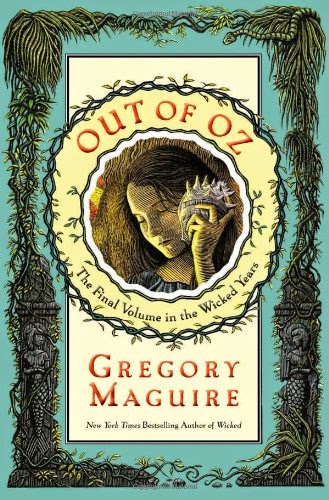
His first book Wicked inverted the L. Frank Baum's Oz story making it about Glinda the Good Witch and Elphaba the Wicked Witch of the West, and telling the story from Elphaba's point of view. He presents an Oz troubled by civil war and social injustice that is much different than the benevolent fairyland of L. Frank Baum. Dorothy is now only a minor character who succeeds in killing both wicked witches but does little else. The second book of The Wicked Years series, Son of a Witch, tells the story of Liir, a boy Elphaba raised who may be her son. The third book, A Lion Among Men, tells the story of Brrr, the Cowardly Lion.
Out of Oz claims to be the final volume in the Wicked Years, but its ending leads me to believe that a new era may follow the Wicked era of these four books. It tells the story of Liir's daughter Rain who is born green like her grandmother Elphaba as she and Liir struggle to stay alive being hunted by both sides in the ongoing war. Some of Baum's most famous characters like the Scarecrow and Tin Woodman are only mentioned in passing, and others like Jack Pumpkinhead, Tiktok and General Jinjur make the briefest of cameo appearances. Dorothy, Tip and Mombi have roles to play but they seem to be inserted into Maguire's world as an afterthought rather than integral parts of the story. Only Brrr the Lion has made the transition naturally from Baum's Oz to Maguire's.
While some elements of the plot seem contrived, the basic story of Rain and her parents negotiating their own familial relationships while trying to find peace in a troubled country at war is a strong and fitting end to the series.
Monday, December 29, 2014
It Rhymes with Lust
It Rhymes with Lust by Arnold Drake & Leslie Waller with Illustrations by Matt Baker
 It Rhymes with Lust, written in 1949, lays claim to being the first graphic novel, combining a novel-length story with comic book art and speech balloon dialog. At the time the authors called it a picture novel as the term graphic novel didn't come into use until the 1970s. Reprinted in 2006 by Black Horse Books, this early graphic novel while primarily of interest for its historic significance, remains a beautifully drawn work that is filled with panels that create lasting impressions.
The book is about a power struggle in Copper City, a mining town run by mine owner Buck Masson until his death. In his absence, Buck's scheming second wife Rust Masson and political boss Marcus Jeffers are fighting for control. Rust asks her old lover Hal Weber, a disillusioned newspaperman who still has a powerful longing for her, to be editor of the local paper and help her fight Jeffers. While Hal still longs for Rust, he finds himself smitten with Audrey Masson, Buck's virtuous and beautiful daughter from his first wife. Can she convince him of Rust's treachery, win his heart, and save the town?
While the story is well-written, it suffers from age, and plot elements that were fresh 65 years ago can seem corny or formulaic. What makes this book a joy to read is the artwork of Matt Baker that has held up well over the years. Baker was one of the few African-American artists in the field at the time, and his female characters are not only well-drawn, but their stylish clothing is amazing.
The 2006 edition contains a 5-page Afterword by Arnold Drake that provides the historic setting for this groundbreaking novel. Also included are brief biographies of Matt Baker and the two authors.

The book is about a power struggle in Copper City, a mining town run by mine owner Buck Masson until his death. In his absence, Buck's scheming second wife Rust Masson and political boss Marcus Jeffers are fighting for control. Rust asks her old lover Hal Weber, a disillusioned newspaperman who still has a powerful longing for her, to be editor of the local paper and help her fight Jeffers. While Hal still longs for Rust, he finds himself smitten with Audrey Masson, Buck's virtuous and beautiful daughter from his first wife. Can she convince him of Rust's treachery, win his heart, and save the town?
While the story is well-written, it suffers from age, and plot elements that were fresh 65 years ago can seem corny or formulaic. What makes this book a joy to read is the artwork of Matt Baker that has held up well over the years. Baker was one of the few African-American artists in the field at the time, and his female characters are not only well-drawn, but their stylish clothing is amazing.
The 2006 edition contains a 5-page Afterword by Arnold Drake that provides the historic setting for this groundbreaking novel. Also included are brief biographies of Matt Baker and the two authors.
Tuesday, December 16, 2014
Safe Area Gorazde: The War in Eastern Bosnia 1992-1995
Safe Area Gorazde: The War in Eastern Bosnia 1992-1995, by Joe Sacco
 A friend of mine loaned Safe Area Goražde to me. When I started reading it, I discovered that it has to do with the same region of Bosnia as Ivo Andric's Nobel Prize winning 1945 novel Bridge on the Drina. In fact, on page 110 of Safe Area Goražde, Sacco tells how on June 17, 1992 Serbian Chetniks killed 300 Bosnian Muslims on this bridge and threw the corpses into the Drina River. Andric used the historic Mehmed Paša Sokolović Bridge in Višegrad (the next town down the river from Goražde) as the principle "character" in his novel that covers 400 years of life in this small area of Bosnia, telling the history of the Serb and Muslim people in a series of episodes over time.
In his graphic novel Joe Sacco tells of his visits to Goražde in 1995 and 1996, his interviews with the people of the city, and their memories of the war in eastern Bosnia that started in 1992. His work reminds me of Martha Gellhorn's reporting of the turmoil in Europe in the 1930s in the personal touch he brings by telling the story through the people he met. Gelhorn was no artist and relied on her prose, while Sacco brings his story to life with his great black and white drawings.
Sacco's story is of the Muslim residents of Goražde and the assault on their UN designated "safe zone" by Serbian forces. It is one-sided as is most war reporting, but his attention to detail and his closeness to the people he writes about makes this a compelling and powerful story. His being "embedded" with the people of the city allows him to get details and personalities that escape most war reporting. What he doesn't do well is explain why the Serbs suddenly turn on their neighbors in such a violent and deadly fashion.
I recommend reading Andric's Bridge on the Drina for people who wonder why the Serbs suddenly turned to armed conflict and ethnic cleansing after living together in peace with the other nationalities in Yugoslavia.

In his graphic novel Joe Sacco tells of his visits to Goražde in 1995 and 1996, his interviews with the people of the city, and their memories of the war in eastern Bosnia that started in 1992. His work reminds me of Martha Gellhorn's reporting of the turmoil in Europe in the 1930s in the personal touch he brings by telling the story through the people he met. Gelhorn was no artist and relied on her prose, while Sacco brings his story to life with his great black and white drawings.
Sacco's story is of the Muslim residents of Goražde and the assault on their UN designated "safe zone" by Serbian forces. It is one-sided as is most war reporting, but his attention to detail and his closeness to the people he writes about makes this a compelling and powerful story. His being "embedded" with the people of the city allows him to get details and personalities that escape most war reporting. What he doesn't do well is explain why the Serbs suddenly turn on their neighbors in such a violent and deadly fashion.
I recommend reading Andric's Bridge on the Drina for people who wonder why the Serbs suddenly turned to armed conflict and ethnic cleansing after living together in peace with the other nationalities in Yugoslavia.
Wednesday, November 26, 2014
John Dough and the Cherub
John Dough and the Cherub by L. Frank Baum

Published in 2008 by Hungry Tiger, a press that publishes quality editions of the works of L. Frank Baum, this book brings together L. Frank Baum's original 1906 text and all of John R. Neill's original illustrations with a new 13 page foreword by J. L. Bell, editor of the International Wizard of Oz Club's magazine Oziana. Also included is a one page note on the making of this new edition by David Maxine of Hungry Tiger Press. This is a loving recreation of a book that, while in the Public Domain, has been out of print for a long time.
J. L. Bell tells us in the foreword that the book was originally commissioned for serialization by Ladies' Home Journal, the largest subscription magazine in the world at the time. However, when Baum submitted his first four chapters based on a children's story "The Gingerbread Boy" about a pastry that comes to life and runs away rather than be eaten by everyone he meets, the editor decided to reject the story. The story published in St. Nicholas Magazine in 1875 comes to an abrupt end when the pastry is eaten by a fox.
While the original story does not explain how the gingerbread comes to life, Baum has an Arab named Ali Dubh who is being pursued by three other Arabs, visit an American bake shop in his neighborhood and ask the baker's wife to hide a golden flask that contains The Great Elixir, the Water of Life, that his pursuers seek. In return he offers her a silver flask that will cure her rheumatism. The woman mixes up the two flasks and pours the Water of Life into a large bowl of water which her husband, unaware of its significance, uses to fashion a life-sized gingerbread man. Infused with The Great Elixir, the baker's creation that he named John Dough comes to life and begins to stroll through the town.
While all who meet him think of him as food, John Dough sees himself as a living being with a life of his own. This creates even more existential conflict when it becomes obvious to him and others that anyone who does eat him will not only fill their stomach but gain the benefits of the Water of Life and become stronger and more vibrant. Ali Dubh pays the baker for the gingerbread man and starts off in pursuit of his property. To escape capture John Dough catches a ride on a 4th of July rocket and lands days later on the Isle of Phreex in what Baum will in a a later book call the Nonestic Ocean. It is the body of water that surrounds the land that contains his fairyland of Oz.
When John Dough lands on the Isle of Phreex, a place inhabited by unusual people, it appears he has found a home where he can be accepted and makes friends with Chick the Cherub, an Incubator Baby who has grown up on the isle without parents. No one seems to know Chick's gender making the Cherub gender queer in today's terminology, a character that does not conform to either male or female gender identification. J. L. Bell in the foreword tells of a contest where the publisher would reward the reader who submitted the best reason Chick was a boy or a girl.
However, John and Chick are not safe and Ali Dubh is in hot pursuit. Does John Dough get eaten or allow himself to be eaten? Can you guess Chick's gender? All the while Baum has his characters on an island hopping adventure as they seek safety and a home. This book has many features of his American fairytale series of stories, where he tries to bring the magic of fairytales to everyday American settings, and it has the features of a minor Oz story in that it also takes place in the magical lands surrounding Oz, but without any of the main Ozian characters. I like it because it raises ethical questions about owning and eating living creatures and takes a refreshing look at gender identity. The book will appeal to Baum's fans and deserves reading because of the issues it addresses.

Published in 2008 by Hungry Tiger, a press that publishes quality editions of the works of L. Frank Baum, this book brings together L. Frank Baum's original 1906 text and all of John R. Neill's original illustrations with a new 13 page foreword by J. L. Bell, editor of the International Wizard of Oz Club's magazine Oziana. Also included is a one page note on the making of this new edition by David Maxine of Hungry Tiger Press. This is a loving recreation of a book that, while in the Public Domain, has been out of print for a long time.
J. L. Bell tells us in the foreword that the book was originally commissioned for serialization by Ladies' Home Journal, the largest subscription magazine in the world at the time. However, when Baum submitted his first four chapters based on a children's story "The Gingerbread Boy" about a pastry that comes to life and runs away rather than be eaten by everyone he meets, the editor decided to reject the story. The story published in St. Nicholas Magazine in 1875 comes to an abrupt end when the pastry is eaten by a fox.
While the original story does not explain how the gingerbread comes to life, Baum has an Arab named Ali Dubh who is being pursued by three other Arabs, visit an American bake shop in his neighborhood and ask the baker's wife to hide a golden flask that contains The Great Elixir, the Water of Life, that his pursuers seek. In return he offers her a silver flask that will cure her rheumatism. The woman mixes up the two flasks and pours the Water of Life into a large bowl of water which her husband, unaware of its significance, uses to fashion a life-sized gingerbread man. Infused with The Great Elixir, the baker's creation that he named John Dough comes to life and begins to stroll through the town.
While all who meet him think of him as food, John Dough sees himself as a living being with a life of his own. This creates even more existential conflict when it becomes obvious to him and others that anyone who does eat him will not only fill their stomach but gain the benefits of the Water of Life and become stronger and more vibrant. Ali Dubh pays the baker for the gingerbread man and starts off in pursuit of his property. To escape capture John Dough catches a ride on a 4th of July rocket and lands days later on the Isle of Phreex in what Baum will in a a later book call the Nonestic Ocean. It is the body of water that surrounds the land that contains his fairyland of Oz.
When John Dough lands on the Isle of Phreex, a place inhabited by unusual people, it appears he has found a home where he can be accepted and makes friends with Chick the Cherub, an Incubator Baby who has grown up on the isle without parents. No one seems to know Chick's gender making the Cherub gender queer in today's terminology, a character that does not conform to either male or female gender identification. J. L. Bell in the foreword tells of a contest where the publisher would reward the reader who submitted the best reason Chick was a boy or a girl.
However, John and Chick are not safe and Ali Dubh is in hot pursuit. Does John Dough get eaten or allow himself to be eaten? Can you guess Chick's gender? All the while Baum has his characters on an island hopping adventure as they seek safety and a home. This book has many features of his American fairytale series of stories, where he tries to bring the magic of fairytales to everyday American settings, and it has the features of a minor Oz story in that it also takes place in the magical lands surrounding Oz, but without any of the main Ozian characters. I like it because it raises ethical questions about owning and eating living creatures and takes a refreshing look at gender identity. The book will appeal to Baum's fans and deserves reading because of the issues it addresses.
Sunday, November 23, 2014
Auschwitz
Auschwitz by Pascal Croci

Auschwitz is a graphic novel depicting a typical Jewish family's experience of the Nazi death camp written by Italian artist Pascal Croci. The author portrays Kazik and Cessia looking back 50 years to their time at Auschwitz from their current life in Yugoslavia. He portrays the transport by train, the initial selection process where they are separated from each other and their daughter Ann, Kazik's day to day life, his work in the gas chambers and crematoria, the whole horror of the death camp is portrayed through the lives of these two composite personalities.
The book concludes with 13 pages of information about the project of creating the book. There are four pages of questions and answers, information on the sources he used for the characters and imagery, a glossary, and a bibliography of sources.
Not for the squeamish, this is a good introduction to what the realities of Auschwitz were.

Auschwitz is a graphic novel depicting a typical Jewish family's experience of the Nazi death camp written by Italian artist Pascal Croci. The author portrays Kazik and Cessia looking back 50 years to their time at Auschwitz from their current life in Yugoslavia. He portrays the transport by train, the initial selection process where they are separated from each other and their daughter Ann, Kazik's day to day life, his work in the gas chambers and crematoria, the whole horror of the death camp is portrayed through the lives of these two composite personalities.
The book concludes with 13 pages of information about the project of creating the book. There are four pages of questions and answers, information on the sources he used for the characters and imagery, a glossary, and a bibliography of sources.
Not for the squeamish, this is a good introduction to what the realities of Auschwitz were.
Can't We Talk about Something More Pleasant?
Can't We Talk about Something More Pleasant? by Roz Chast

George and Elizabeth Chast were born of immigrant Jewish parents 10 days apart in 1912 in the same neighborhood of New York City. when they married they lived together in the same Brooklyn apartment their whole lives and had one child, a daughter named Roz. George was a teacher and Elizabeth an assistant principle in the city schools. When Roz grew up she became a book illustrator and cartoonist for the New Yorker and other magazines. She had two children and moved to Connecticut.
Roz Chast uses drawings and text to explore her complex and conflicted relationship with her elderly parents from 2001 until their deaths in 2007 and 2009 as she is called on to care for them through their declining years. It is a memoir in graphic novel format with occasional photographs.
She is best at depicting her own insecurities and feelings as she is drawn deeper and deeper into the care of her parents. From occasional visits to Brooklyn to moving them to a facility nearby in Connecticut we see how she resists and accepts her evolving role as caretaker. Through memories and photos we learn of their early lives together.
I recommend this book for anyone who wants to get an in depth and personal look at the process of caring for elderly parents. My mother is 95, and she and I are on Chapter 11 of this book as she marks her first anniversary in an assisted living facility. I read this book twice and plan to read it again. Even if you don't have aging parents, but are getting old yourself, this is an eye-opener for what is in store.

Roz Chast uses drawings and text to explore her complex and conflicted relationship with her elderly parents from 2001 until their deaths in 2007 and 2009 as she is called on to care for them through their declining years. It is a memoir in graphic novel format with occasional photographs.
She is best at depicting her own insecurities and feelings as she is drawn deeper and deeper into the care of her parents. From occasional visits to Brooklyn to moving them to a facility nearby in Connecticut we see how she resists and accepts her evolving role as caretaker. Through memories and photos we learn of their early lives together.
I recommend this book for anyone who wants to get an in depth and personal look at the process of caring for elderly parents. My mother is 95, and she and I are on Chapter 11 of this book as she marks her first anniversary in an assisted living facility. I read this book twice and plan to read it again. Even if you don't have aging parents, but are getting old yourself, this is an eye-opener for what is in store.
Friday, September 26, 2014
The Sands of Time: A History of Hilton Head Island
The Sands of Time: A History of Hilton Head Island by Margaret Greer
 Margaret Greer, who lived on Hilton Head Island, wrote this 11 chapter illustrated popular history of the island from its geological formations to the mid-1980s. In 70 pages she covers the island's history and still finds room for both color and black and white pictures on at least every other page.
Chapter I, The Land Made Ready, is a one page geological history of the formation of the island. Chapter II, The Indians, covers in three pages the native American Yemasee tribe's presence on the island and the legacy of names left by them. In Chapter III, The First Europeans, the 16th century Spanish landings and attempts at settlements are discussed in three pages. The French landing in 1562 gets four pages in Chapter IV. This is followed by the three pages of Chapter V on the Spanish return to the area in the late 16th century. Chapter VI, The English Come to Stay, devotes seven pages to the 1663 explorations of Captain William Hilton, who gave the island its present name, and the English settlements that followed.
Chapter VII, The Planters, in four pages talks about the first plantations established on the island. Chapter VIII, The Golden Age, spends nine pages talking about the period from the Revolutionary War to the Civil War and the ante-bellum plantation system that developed then. Chapter IX, The Civil War, is the actual heart of the book with 18 pages devoted to the battle for Hilton Head and the Union presence on the island after their victory.
The 100 years between the Civil War and the post World War II developments into a resort, when the islands were home to "native islanders," descendants of freed slaves known as the Gullah (or Geechee), are covered in the eight pages of Chapter X, Sleeping Beauty, half of which are devoted to photos. The concluding Chapter XI, The Modern Age, covers in eight pages the development of the resort community from 1950 to 1988.
Painted in broad strokes, The Sands of Time is a brief and general historic introduction to Hilton Head Island. well-illustrated and short, it serves this purpose well. A Sources page listing eight items is a good place to start looking for more information.

Chapter I, The Land Made Ready, is a one page geological history of the formation of the island. Chapter II, The Indians, covers in three pages the native American Yemasee tribe's presence on the island and the legacy of names left by them. In Chapter III, The First Europeans, the 16th century Spanish landings and attempts at settlements are discussed in three pages. The French landing in 1562 gets four pages in Chapter IV. This is followed by the three pages of Chapter V on the Spanish return to the area in the late 16th century. Chapter VI, The English Come to Stay, devotes seven pages to the 1663 explorations of Captain William Hilton, who gave the island its present name, and the English settlements that followed.
Chapter VII, The Planters, in four pages talks about the first plantations established on the island. Chapter VIII, The Golden Age, spends nine pages talking about the period from the Revolutionary War to the Civil War and the ante-bellum plantation system that developed then. Chapter IX, The Civil War, is the actual heart of the book with 18 pages devoted to the battle for Hilton Head and the Union presence on the island after their victory.
The 100 years between the Civil War and the post World War II developments into a resort, when the islands were home to "native islanders," descendants of freed slaves known as the Gullah (or Geechee), are covered in the eight pages of Chapter X, Sleeping Beauty, half of which are devoted to photos. The concluding Chapter XI, The Modern Age, covers in eight pages the development of the resort community from 1950 to 1988.
Painted in broad strokes, The Sands of Time is a brief and general historic introduction to Hilton Head Island. well-illustrated and short, it serves this purpose well. A Sources page listing eight items is a good place to start looking for more information.
Tuesday, September 23, 2014
Nymphs of the Valley
Nymphs of the Valley by Kahlil Gibran
 Kahlil Gibran is an early 20th Century Lebanese writer who is best known for his 1923 book The Prophet. The dust jacket flap says this small volume of three Arabic stories were found amongst his papers by his translator and made available in English in 1948. The original 1906 Arabic version was published in New York by Al-Mohajer with the title Ara'is al-Muruj. Wikipedia lists it as his 2nd published book. PoemHunter.com - The World's Poetry Archive's Classic Poetry Series 2008 article on Kahlil Gibran describes these stories as expressive of Gibran's "anti-feudal and anti-clerical convictions."
The dust jacket to the British edition describes them as follows.
Kahlil Gibran is an early 20th Century Lebanese writer who is best known for his 1923 book The Prophet. The dust jacket flap says this small volume of three Arabic stories were found amongst his papers by his translator and made available in English in 1948. The original 1906 Arabic version was published in New York by Al-Mohajer with the title Ara'is al-Muruj. Wikipedia lists it as his 2nd published book. PoemHunter.com - The World's Poetry Archive's Classic Poetry Series 2008 article on Kahlil Gibran describes these stories as expressive of Gibran's "anti-feudal and anti-clerical convictions."
The dust jacket to the British edition describes them as follows.
"The setting of all three is the Lebanon. The first [Martha] tells the story of a poor and innocent village girl who is seduced and stranded in the city. On her deathbed she is consoled by a youth from her native village. The second [Dust of the Ages and The Eternal Fire] is a story of reincarnation; two lovers parted by death in ancient Baal are joined together in life two thousand years afterwards. The third [Yuhanna the Mad] is the portrait of a true Christian in rebellion against the vested interests of the monasteries. And he who has real wisdom is said by the world to be mad."
All three describe a Lebanon that is part of the crumbling Turkish Empire where the powerful and the poor are widely separated. Gibran, like Tolstoy, sees the corrupt church in league with the government and the rich, robbing the poor of what little they have, to maintain their status and wealth. His heart is with the poor villagers and these stories tell a timeless message of love and humanity struggling against wealth and privilege.

"The setting of all three is the Lebanon. The first [Martha] tells the story of a poor and innocent village girl who is seduced and stranded in the city. On her deathbed she is consoled by a youth from her native village. The second [Dust of the Ages and The Eternal Fire] is a story of reincarnation; two lovers parted by death in ancient Baal are joined together in life two thousand years afterwards. The third [Yuhanna the Mad] is the portrait of a true Christian in rebellion against the vested interests of the monasteries. And he who has real wisdom is said by the world to be mad."
All three describe a Lebanon that is part of the crumbling Turkish Empire where the powerful and the poor are widely separated. Gibran, like Tolstoy, sees the corrupt church in league with the government and the rich, robbing the poor of what little they have, to maintain their status and wealth. His heart is with the poor villagers and these stories tell a timeless message of love and humanity struggling against wealth and privilege.
Sunday, September 14, 2014
Modesty Blaise
Modesty Blaise by Peter O'Donnell
 Modesty Blaise started out as a comic strip character created by Peter O'Donnell in 1963. The comics were produced until 2001, and O'Donnell wrote a 13 book series of novels and collections of short stories that started with this book in 1965 and ended in 1996. There have even been two or three movies made featuring her character. I became intrigued with the series when I saw the 2004 movie My Name Is Modesty starring Alexandra Staden.
In this first novel, we meet Modesty after she has retired with a fortune from a life in the underworld. Her loyal sidekick Willie Garvin has gotten himself into trouble, and a couple of British agents let her know his situation hoping that in return she will help them with a situation that can use her particular talents. After saving Willie, she agrees to help the agents with a payoff to a Middle Eastern sheik of 10 million British Pounds worth of diamonds being transferred from South Africa. When two of their agents are killed, they fear that the jewels are being targeted for a heist along the way.
The story was written 50 years ago, and it may not appeal to a younger audience. O'Donnell pays great attention to detail, creates a strong female lead character, and has a skill at developing interesting secondary characters throughout the story. Similar in appeal to the early James Bond novels.

In this first novel, we meet Modesty after she has retired with a fortune from a life in the underworld. Her loyal sidekick Willie Garvin has gotten himself into trouble, and a couple of British agents let her know his situation hoping that in return she will help them with a situation that can use her particular talents. After saving Willie, she agrees to help the agents with a payoff to a Middle Eastern sheik of 10 million British Pounds worth of diamonds being transferred from South Africa. When two of their agents are killed, they fear that the jewels are being targeted for a heist along the way.
The story was written 50 years ago, and it may not appeal to a younger audience. O'Donnell pays great attention to detail, creates a strong female lead character, and has a skill at developing interesting secondary characters throughout the story. Similar in appeal to the early James Bond novels.
Wednesday, September 03, 2014
Folk Medicine
Folk Medicine: A Vermont Doctor's Guide to Good Health by D. C. Jarvis
 Dr. Jarvis spent his medical career serving the rural state of Vermont and studying the folk medicine practices he found there. The results of his lifetime work in this area are published in this 1958 book aptly titled Folk Medicine. To read it today is to go back in a time machine to visit a rural doctor of the first half of the 20th century who is studying the folk medicines of his time. He speaks of people growing up close to the land, small farmers eating their locally grown crops and the products of their animals. He never mentions a veterinarian, and he cares for the farmer's animals as much as he cares for the farmers and their families.
The Vermont soil is low in potassium. He personally added granite dust from the stone cutters in Barre to his garden soil because granite has potassium in it. People were shorter in Vermont because they ate foods grown in this potassium-deficient soil.
One of the things he discovered in his research into the folk medicine practices of rural Vermont was the many ways that the people compensated for the low potassium in their diet. The major one was a reliance on a drink made of apple cider vinegar, often mixed with an equal quantity of honey and diluted with water. Much of the book is devoted to this simple drink and the many beneficial effects he ascribes to it. He claims the benefits come from vinegar's acidifying effects on the body, the healthful sugars present in the natural honey, and the many minerals, particularly potassium, contained in both ingredients.
Vermont farmers of Dr. Jarvis' time didn't go down to a local grocery and buy a bottle of apple cider vinegar and a jar of honey. They got a barrel of fresh-pressed apple cider, most likely from their own trees or a neighbors, and let it ferment in the barn, past the hard cider stage, until it turned to vinegar. They got their honey from local bees. Today you would have to look far and wide to find anyone with a vinegar barrel somewhere around their property; today vinegar is made in a factory in 2-3 days rather than the back yard in 6-12 months.
Dr. Jarvis was writing for a time and place that do not exist anymore, but our need for potassium still remains essential, and food is its primary source. The kind of vinegar the farmers brewed in their barns is made by a few health food companies, and fortunately almost everywhere in America you can find local sources of honey. The modern diet is built around supermarkets instead of gardens and livestock. Much of our food is manufactured, where efficiency and shelf life are industrial concerns. We take multivitamins and supplements, often added to our manufactured foods, to meet our nutritional needs. A vital connection is lost in all of this with the life of the soil and the plants grown in it. Could a drink made from raw, organic, unfiltered apple cider vinegar and honey make a difference to our lives? I would like to think so. Is this magical thinking? At this time you could it is, since I haven't found research to back it up, but as a librarian I know how to look for information.

The Vermont soil is low in potassium. He personally added granite dust from the stone cutters in Barre to his garden soil because granite has potassium in it. People were shorter in Vermont because they ate foods grown in this potassium-deficient soil.
One of the things he discovered in his research into the folk medicine practices of rural Vermont was the many ways that the people compensated for the low potassium in their diet. The major one was a reliance on a drink made of apple cider vinegar, often mixed with an equal quantity of honey and diluted with water. Much of the book is devoted to this simple drink and the many beneficial effects he ascribes to it. He claims the benefits come from vinegar's acidifying effects on the body, the healthful sugars present in the natural honey, and the many minerals, particularly potassium, contained in both ingredients.
Vermont farmers of Dr. Jarvis' time didn't go down to a local grocery and buy a bottle of apple cider vinegar and a jar of honey. They got a barrel of fresh-pressed apple cider, most likely from their own trees or a neighbors, and let it ferment in the barn, past the hard cider stage, until it turned to vinegar. They got their honey from local bees. Today you would have to look far and wide to find anyone with a vinegar barrel somewhere around their property; today vinegar is made in a factory in 2-3 days rather than the back yard in 6-12 months.
Dr. Jarvis was writing for a time and place that do not exist anymore, but our need for potassium still remains essential, and food is its primary source. The kind of vinegar the farmers brewed in their barns is made by a few health food companies, and fortunately almost everywhere in America you can find local sources of honey. The modern diet is built around supermarkets instead of gardens and livestock. Much of our food is manufactured, where efficiency and shelf life are industrial concerns. We take multivitamins and supplements, often added to our manufactured foods, to meet our nutritional needs. A vital connection is lost in all of this with the life of the soil and the plants grown in it. Could a drink made from raw, organic, unfiltered apple cider vinegar and honey make a difference to our lives? I would like to think so. Is this magical thinking? At this time you could it is, since I haven't found research to back it up, but as a librarian I know how to look for information.
Monday, September 01, 2014
Tomatoland
Tomatoland: How Modern Industrial Agriculture Destroyed Our Most Alluring Fruit by Barry Estabrook
 Tomatoland is an investigative report on the Florida agricultural businesses that supply winter tomatoes to the supermarkets. Most of the book focuses on a city most people don't know which is a drained swamp just 42 miles inland from Naples Florida called Immokalee.
The book looks at labor conditions and efforts that have been taken to improve them. It investigates the major growing firms and the agriculture techniques required to grow tomatoes in Florida, including the heavy use of fungicides, pesticides and herbicides, many of which are dangerous to humans.
The book also looks at an organic farmer in Florida who is proving that these methods can work there. A Pennsylvania farmer who grows Heirloom Tomatoes for New York City restaurants is also highlighted. The book begins and ends with a search for the tomato's earliest relatives in the dry mountainous soils of Mexico and South America.
If tomatoes are more than something red you add to your diet, if you love tomatoes for their taste and dread the winter products in the marketplace, if you care for social justice for farmworkers and their families, then this is a book to savor with a fresh garden tomato sandwich before the frosts of winter ends the season of local joy.

The book looks at labor conditions and efforts that have been taken to improve them. It investigates the major growing firms and the agriculture techniques required to grow tomatoes in Florida, including the heavy use of fungicides, pesticides and herbicides, many of which are dangerous to humans.
The book also looks at an organic farmer in Florida who is proving that these methods can work there. A Pennsylvania farmer who grows Heirloom Tomatoes for New York City restaurants is also highlighted. The book begins and ends with a search for the tomato's earliest relatives in the dry mountainous soils of Mexico and South America.
If tomatoes are more than something red you add to your diet, if you love tomatoes for their taste and dread the winter products in the marketplace, if you care for social justice for farmworkers and their families, then this is a book to savor with a fresh garden tomato sandwich before the frosts of winter ends the season of local joy.
Saturday, August 30, 2014
Martin Luther King and the Montgomery Story
Martin Luther King and the Montgomery Story by Alfred Hassler and Benton Resnik
 Created by Alfred Hassler and Benton Resnik this short 16 pager comic book was first published in December 1957 by the Fellowship of Reconciliation. Illustrating the Nonviolent Method using the case of the Montgomery Bus Boycott, the comic very simple and elegantly tells how nonviolent action works.
I read Stanford University's digitized copy.

I read Stanford University's digitized copy.
Sunday, August 24, 2014
Naked
Naked by David Sedaris

Naked is a series of 17 essays written by David Sedaris and published in 1997. Sedaris includes a note to say that the events depicted are real but names and identifying characteristics have been changed except for those of his family. The author grew up in Raleigh, and I met him in 1979 when I moved to Raleigh and he worked as a waiter at the Breakfast House restaurant on Hillsborough Street.
The essays in Naked focus on David's life growing up in Raleigh, his college years, early work experiences, and his relationship with his family members. The 40 page title essay Naked relates his week-long first visit to a nudist club and his adjustment to a clothes-free environment and the nudists he met.
As a 1990s retrospective look back on the 19760s and 70s, this book may not be for everyone. I enjoyed it as a tribute to a Raleigh that was much smaller and in many ways than the city we know today, as the gifted writings of a gay man growing up in a intolerant world, and as a long-lost letter from a person I met many years ago who made me feel welcome in a strange city.

Naked is a series of 17 essays written by David Sedaris and published in 1997. Sedaris includes a note to say that the events depicted are real but names and identifying characteristics have been changed except for those of his family. The author grew up in Raleigh, and I met him in 1979 when I moved to Raleigh and he worked as a waiter at the Breakfast House restaurant on Hillsborough Street.
The essays in Naked focus on David's life growing up in Raleigh, his college years, early work experiences, and his relationship with his family members. The 40 page title essay Naked relates his week-long first visit to a nudist club and his adjustment to a clothes-free environment and the nudists he met.
As a 1990s retrospective look back on the 19760s and 70s, this book may not be for everyone. I enjoyed it as a tribute to a Raleigh that was much smaller and in many ways than the city we know today, as the gifted writings of a gay man growing up in a intolerant world, and as a long-lost letter from a person I met many years ago who made me feel welcome in a strange city.
Saturday, August 16, 2014
Manon Lescaut
Manon Lescaut by Antoine François Prévost
 Manon Lescaut is a story of a young man, the Chevalier des Grieux, and his lover, Manon Lescaut. Set in the year 1721 and first published in 1731, this story of uninhibited love and its dire consequences was both quickly banned and widely read. The novel begins when a narrator, spending the night in a small town, who sees the townspeople gathered around two large wagons loaded with women criminals who are being banished to the colony of New Orleans. Amongst this "frail sisterhood" sits Manon "whose whole air and figure seemed so ill-suited to her present condition, that under other circumstances I should not have hesitated to pronounce her a person of high birth. Her excessive grief, and even the wretchedness of her attire, detracted so little from her surpassing beauty... " Asking one of the guards about this rare beauty, the guard points to a man who has followed them from Paris, crying all the way and says that he knows her. Asked about Manon, the despondent stranger replies that he is completely in love with her and having failed at all attempts to free her, he plans to follow her to the ends of the Earth. Seeing that the stranger has no money and is in desperate need, the narrator gives him 4 gold louis-d'ors and 2 more to the lead guard, and goes on his way.
Two years later he again sees the young man, poorly dressed and walking the street of Calais, having just returned from America. Greeting him and learning he is still destitute, the narrator offers him a room for the night at the inn where he is staying. That night the stranger, who is the Chevalier des Grieux, tells the story of his tragic three year love affair with the beautiful and charming Manon Lescaut.
Manon is poor but beautiful and the 17 year old Chevalier's love for her is instantaneous and intense. He must have her, and runs off with her to Paris in spite of the disapproval of his father and brother. Losing his savings through various circumstances, he relies on the generosity of friends and his skill at gambling to support their existence. Manon, while she professes love for the Chevalier, uses her beauty and charm to attract the generosity of other men. Instead of her loose virtue turning him away, their mutual love keeps him faithful to her. Eventually they run into trouble with the law and he follows her into exile.
Told completely from his point of view, Manon's life and motives are at best poorly understood. We see her through the filter of 300 years, a translation into another language, and the eyes of a deeply infatuated young man. It is believed that the story is in part based upon an early love affair of the author Prevost.
Manon's story and the Chevalier's love for her has inspired several operas, and, 100 years later, the novel and play Camille by Alexandre Dumas. Both Manon and Camille have been made into movies again and again. I am glad that I have read the original version of this classic love story.

Two years later he again sees the young man, poorly dressed and walking the street of Calais, having just returned from America. Greeting him and learning he is still destitute, the narrator offers him a room for the night at the inn where he is staying. That night the stranger, who is the Chevalier des Grieux, tells the story of his tragic three year love affair with the beautiful and charming Manon Lescaut.
Manon is poor but beautiful and the 17 year old Chevalier's love for her is instantaneous and intense. He must have her, and runs off with her to Paris in spite of the disapproval of his father and brother. Losing his savings through various circumstances, he relies on the generosity of friends and his skill at gambling to support their existence. Manon, while she professes love for the Chevalier, uses her beauty and charm to attract the generosity of other men. Instead of her loose virtue turning him away, their mutual love keeps him faithful to her. Eventually they run into trouble with the law and he follows her into exile.
Told completely from his point of view, Manon's life and motives are at best poorly understood. We see her through the filter of 300 years, a translation into another language, and the eyes of a deeply infatuated young man. It is believed that the story is in part based upon an early love affair of the author Prevost.
Manon's story and the Chevalier's love for her has inspired several operas, and, 100 years later, the novel and play Camille by Alexandre Dumas. Both Manon and Camille have been made into movies again and again. I am glad that I have read the original version of this classic love story.
Subscribe to:
Posts (Atom)