Saturday, May 20, 2017

A Samba for Sherlock

A Samba for Sherlock by Jô Soares
Originally published in Brazil in 1995 as O Xangô De Baker Street and translated into English in 1997, this novel features Sherlock Holmes and his partner Dr. John Watson being summoned to Rio by the real life actress Sarah Bernhardt who, on the first stop of her 1886 world tour, suggests to the Emperor of Brazil that the famous detective may help him find a stolen Stradivarius violin. While they are on board ship to Rio matters take a macabre turn as a prostitute is found in an alley stabbed to death with a violin string curled into her pubic hair and a flap of skin cut from her body. So when they arrive, it is not only a theft, but a murder they are asked to solve.

The author José Eugênio "Jô" Soares is a Brazilian television talk show host known for his observational comedy, surreal humor, and deadpan style, and this is his first novel. He takes liberties with his portrayal of Sherlock making the book both humorous as well as a mystery. I fear that a lot of his Brazilian humor gets lost in translation to an American audience. His willingness to make the detective the butt of much of his humor may not endear this work to diehard Holmesians. Readers willing to go along with the joke may find his portrayal a lot of fun.

Soares fills the book with a large cast of characters, as well as locational and historic details, that make it a rich and rewarding experience. I have not come across many novels like this one where the author provides a five page Bibliography of references, although I am sure other authors have done even more research than he in creating their historical fiction. I found it hard to keep track of all the names of the players and, even though the book came with a detailed endpaper map of Rio, impossible to follow the geographic references. So while I enjoyed the book, I was left feeling I had missed half the jokes, found the cast of characters confusing, and was in the dark on most of the local references.

The book was made into an award winning Portuguese/Brazilian movie O Xangô de Baker Street in 2000.

Thursday, March 30, 2017

Are You My Mother?: A Comic Drama

Are You My Mother?: A Comic Drama by Alison Bechdel
Following up on Alison Bechdel's first exploration into her family history called Fun Home is Are You My Mother? A Comic Drama. The first book looked at her relationship with her father, a closeted bisexual who commits suicide, as she is coming out as a lesbian. This second excursion, as the title suggests, examines her relationship with her mother, but also the love relationships in her life, her connection with her psychoanalysts, and her reading of the works of Sigmund Freud and D. W. Winnicott.

Monday, February 27, 2017

Nat Turner

Nat Turner by Kyle Baker
Nat Turner was a African American slave in Southampton County Virginia who was born in 1800. He led a slave rebellion in August 1831 and was executed that November. When he was in jail awaiting execution, a white lawyer named Thomas R. Gray visited him and wrote down Turner's own story which was published in 1831 as The Confessions of Nat Turner. This is not to be confused with the 1967 novel of the same title by the white Virginia author William Styron. However both Styron's novel and the graphic novel Nat Turner by Kyle Baker are derived from Gray's original Confessions.

The illustrations for Baker's Nat Turner wordlessly illustrate the original 1831 Confessions which appears as text set in the graphic novel. The words of the original Confessions and Baker's graphic narrative enhance each other, creating a most powerful document for understanding Turner's life and motivation. Originally self published as a four part series, Nat Turner sold out two printings and won several prizes in 2006, including an Eisner Award for best reality-based work. Since 2008 it has been published as a single volume through a commercial press.

Part One is called "Home" and tells the story prior to that covered in Gray's Confessions of Nat Turner of Nat's mother being captured in Africa by slavers, transported to the coast, and put onto a slave ship to America where she is sold as a slave. Part Two is called "Education" and tells the remarkable story of Nat, a gifted child with mysterious powers, who can read, who is deeply spiritual, and starts to receive visions and messages. At the same time, he is witness to the brutality of human slavery all around him and as it effects him and his parents, wife and children. After his wife and children are sold away from him, his visions take a dark turn where he sees white spirits and black spirits engaged in battle and blood flowing in streams. He is told to be prepared to receive a sign to begin his fight against the Serpent. The first sign of a solar eclipse marks the beginning of Part Three - Freedom in which Nat starts to tell a select group of close associates of his visions and they make plans for the rebellion. The Great Barbados hurricane of August 1831, which turned the Sun blue as far north as Virginia was to Nat Turner, the sign he had been waiting for to begin the slaughter. He and his four allies went into houses in the dark of night, killing all the whites, taking their weapons and horses, and recruiting followers from their slaves. Before they were eventually stopped, there were about 60 armed freed slaves following him and over 55 dead whites in their trail. Part Four - Triumph details Turner's last days.

I had read Gray's book The Confessions of Nat Turner prior to reading Baker's graphic novel, and I find the combination of the hauntingly expressive images with the simple straightforward text an exceedingly effective manner to present Nat Turner's life and activities to a modern audience. The story is compelling to me because I live just two hours from the site of the rebellion, and slave conditions would have been the same here as they were for Nat Turner in Virginia. Baker has made the story one that I will never forget. At the end of the book is a Bibliography of further readings and a Teacher's Guide that would make this a powerful classroom instructional tool.

Saturday, February 25, 2017

Fräulein Else by Arthur Schnitzler

Fräulein Else by Arthur Schnitzler
This novelette written in 1924 and translated into English in 1925 by Francis Hamilton Lyon, a prolific translator of Scandinavian and German books, tells in stream of consciousness style one day in the life of 19 year old Else while she is on holiday at the Hotel Fratazza near Monte Cimone, the highest mountain in the northern Apennines, of Italy. She is traveling with her aunt Emma, cousin Paul, and his girl friend Cissy when an express letter comes to her from her mother in Vienna. The letter states that Else's father, a lawyer, is in a dire financial situation and needs 30,000 Guldens, or he will be arrested for embezzling a trust fund. All other avenues of borrowing the money are exhausted, and her mother asks Else to make a personal request of a loan from Herr von Dorsday, who has loaned her father money in the past, and have him wire the money as soon as possible.
The Austro-Hungarian Gulden was replaced by the Krone in 1892, with 1 Gulden = 2 Kronen. In 1913 one US Dollar was worth approximately 5 Kronen. So the 30,000 Gulden of this story might have had a value of around $12,000.
Dorsday is a rake who was been casting lingering glances at Else, and she is reluctant to put herself in a compromising situation with him. The book follows her thought process as she struggles with the dilemma that her mother's letter has created for her. She cannot ignore her father's plight and yet is in dread of her own situation of being indebted to von Dorsday. How she resolves her inner struggle makes compelling reading.
Some of Schnitzler's works were controversial due to their frank description of sexuality. While Else is not unaware of the sexual implications of her plight, this is not one of his pornographically labeled works. It is one of his notable works, and this edition provides a good readable English translation.

Tuesday, January 10, 2017

Myra Breckinridge & Myron

Myra Breckinridge & Myron by Gore Vidal

Today author Gore Vidal is mostly known for his Narratives of Empire series of seven novels on American history published between 1967 and 2000. These books (Burr, Lincoln, 1876, Empire, Hollywood, Washington, D.C., and The Golden Age) tell the history of the American Empire through the lives of two fictional families and their interactions with real figures in American history. Few recall the critical uproar caused by his 1948 novel The City and the Pillar that dealt frankly with male homosexuality. And while many recall Myra Breckinridge, it is usually the 1970 film (often listed as one of the worst films ever made), not Vidal's 1968 best-selling novel, that people remember. The 1974 sequel Myron is largely forgotten.

Myra Breckinridge and its sequel Myron are two novels that were very much a product of their times, the Sexual Revolution of the late 1960s. In his 1993 Introduction to this volume combining the two, Vidal quotes poet Thom Gunn as saying "These two books [are] the twentieth-century equivalents of Alice in Wonderland and Through the Looking Glass." They form part of a series of completely fictional novels that Vidal calls his satirical inventions, that also include Messiah, Kalki, and Duluth. In the 2014 biographical documentary Gore Vidal: The United States of Amnesia Vidal says of the novel: "When I start an entirely invented book like Myra, I seldom start with anything more than a sentence that has taken possession of me. In this case, 'I am Myra Breckenridge whom no man will ever possess.' Who was she? I could only find out if I kept on writing. It was not until I was half way through the story that I realized that she had been a male who changed his sex."

Told as a series of entries in a therapy journal kept by Myra for her analyst and doctor, the novel tells the story of her arriving in Hollywood to meet retired film star "Buck" Loner who now runs the Academy of Drama and Modeling on the fifty acres of land that once held his father's orange groves. Myra claims to be his nephew Myron's widow. She tells Buck that his sister, her mother-in-law Gertrude, always told her and Myron that her father's property was left jointly to her and Buck, and that she passed on the rights to her half to Myron and Myra. Myron was a film critic who studied the films of the 1930s and 40s. Myra tells Buck that Myron fell off the Staten Island Ferry and drowned. When Buck offers Myra a job teaching at the Academy as their lawyers work out the details of the inheritance, the plot is set for the novel.

I was surprised at how much of this novel is about film theory and criticism. Myra's stated goal in the novel is to finish writing Myron's book Parker Tyler and the Films of the Forties; or, the Transcendental Pantheon. I had to look up Parker Tyler who it turns out was a New York film critic who wrote on gay and underground films from the mid-40s to the mid-70s when he died. Throughout the book Myra exhibits an encyclopedic knowledge of the films of the first half of the 20th century. So while this book is one of the earliest novels about a transgender character, it is not really written to provide insight into the concerns and problems of a transgender person, which often disappoints its audience. Both these books are social satires on sexuality that explore Vidal's belief that people are basically bisexual and that gender roles and sexual orientation are social constructs established by societal norms.

If Myra Breckinridge is a satire on social norms with Myra as a modern Alice visiting a Hollywood wonderland, the second book Myron is a Through the Looking Glass time travel sci-fi satire where Myron, now happily married and living in the suburbs, falls through the screen of his television one night while watching the 1948 MGM movie Siren of Babylon starring Maria Montez. He lands on the set of the film in production just at the scene he was watching, and is trapped in the Hollywood past with a group of other viewers who seem to stumble through the screen each time the film is aired on TV. The actors on the set cannot see these visitors from the future, but once Myron leaves the set, the local people outside the studio and across the street at the neighborhood hotel can see the people they call out of towners who have taken up residence there. Here Myron starts to struggle with his alter personality Myra for control of their body with comic effect. The locals and the other out of towners are left wondering at this strange person with dual gendered personalities. While Myron seeks to get back to his wife and life in the suburbs, Myra wants to save MGM at this crucial point in their history and recreate a golden age of film. She also has a plan to save the world from overpopulation that is unique. I find the time travel paradoxes handled quite well by the author. The two books together like this in a single volume make for great reading. They have inspired me to take a look at other of Vidal's satirical invention novels.

Sunday, January 01, 2017

The Curious Cruise of Captain Santa

The Curious Cruise of Captain Santa by Ruth Plumly Thompson
Ruth Plumly Thompson was hired by the publisher Reilly & Lee when L. Frank Baum died to continue writing books in his Oz series. She ended up writing almost twice as many Oz books as Baum did. So it is quite natural for Thompson to also try her hand at writing a children's book about Santa Claus, seeing as how Baum had written several. Originally published in 1926, and using the same illustrator she and Baum used for the Oz series, John R. Neill, The Curious Cruise of Captain Santa is a delightful fantasy adventure.
Just after Christmas one year, Santa decides to build a ship and go sailing in search of new and interesting toys for him to give to children. He has heard of The Lost Islands and the rumors that they have living dolls, and he wants to find the islands and bring back some of these fabulous dolls for the children next Christmas. Accompanying him on the adventure is an orphan named Jim who has come to live at Santa's North Pole Palace, a talking polar bear named Huggerumbo, and Penny the Penguin, who looks after Santa. They set sail for the Lost Islands with a cargo of toys and treats to trade for new toys that they might discover along the way. After many amusing adventures, they return with a hold full of new toys and the hope to sail again another year.
While the book can be read on its own and enjoyed as a post-Christmas adventure yarn for children who wonder what Santa does the rest of the year, this is most likely to appeal to folks like me who are devoted readers of the Oz series.

Friday, November 18, 2016

Paying for It

Paying for It by Chester Brown
Paying for It by Chester Brown is an autobiographical graphic novel that relates Mr. Brown's sex life from 1996 to 2010, which consists of his using professional female escorts for his heterosexual encounters. He mentions using masturbation to cool his ardor prior to these encounters, but provides no further details. To protect the women he changes their names and doesn't provide locations or identifying features. For those of us not familiar with sex workers or their customers, this is a chance to get a glimpse into the workings of this trade.
Brown is dispassionate but clearly happy with his decision to outsource his sexual needs, feeling that sex and girlfriends do not go together well for him. The text alternates visits to various escorts with discussions with his male friends and ex-girlfriends about the advantages of his chosen sexual lifestyle. He is well-read on the politics of sex workers and takes a Libertarian position condemning the present laws restricting or outlawing sex work.
The body of the book is preceded by an Introduction by Robert Crumb who calls it Mr. Brown's best work. At the end of the book there are 50 pages of Appendices and Notes that go into much deeper detail than the narrative of the book permitted. I would say that he makes as good an argument for unregulated prostitution as you will find in the popular literature.

Thursday, November 03, 2016

The Unknown Witches Of Oz: Locasta And The Three Adepts

The Unknown Witches Of Oz: Locasta And The Three Adepts by Dave Hardenbrook
The Unknown Witches of Oz is a uneven addition to the Oz tradition that was started in 1900 by L. Frank Baum. Baum wrote over a dozen Oz books before he died, and the publisher then hired Ruth Plumly Thompson to write over a dozen more, starting a genre that continues down to today. I would rate Dave Hardenbrook's contribution to the field as an amusing self-published fan fiction that makes a poor attempt to bring the magical land of Oz into the 21st century. Modern technology is thrown in with classic Ozian magic in mostly jarring ways.
These flaws aside, his main characters are charmingly Ozian in their approach to life and may appeal to loyal Oz fans. A young computer geek named Dan is transported to Oz and struggles along with the titular witches to save Oz from a concerted attack by all the evil characters of Oz.
This was to be the first of a trilogy of novels. The second in the series, Jellia Jamb, Maid of Oz was also self published in 2008 at Lulu.com. Not highly recommended.

Wednesday, October 26, 2016

Castro: A Graphic Novel

Castro: A Graphic Novel by Reinhard Kleist
While this book is sold as the life of Fidel Castro, it is also the life of a fictional German journalist named Karl Mertens. Reinhard Kleist tells the story of Castro's Cuba as seen through Mertens' eyes as he covers the rise to power and life of Fidel Castro, and its effect on the life of the Cubans around him.

As the book opens we see an aged Mertens reminiscing about his life in Cuba. He thinks back to the day he landed in Cuba as a young journalist on his first assignment in October 1958 to cover events involving the Castro-led rebels in the Sierra Maestra mountains of eastern Cuba. He arranges passage to the east and spends several days with the rebel forces, interviews Castro to find out the principles of the fight, and talks to several of his followers to learn Castro's early life. The days pass and Karl becomes involved with the rebels on a deeper level and, losing his journalistic objectivity, he become an active participant in the fight, not with a gun, but with his pen and his camera.

He relates the story of Castro's rise to power and the transformation of the revolution into communism, the disruption of relations with the USA and the alliance with the USSR, and the major events in Cuba since Castro came to power. He also tells of Karl's relationships with his friends Juan and Lara, people he met during the early days of the rebellion. Through the lives of these three people we see the day-to-day life in Cuba and its effects on the people. The shortages caused by the embargo, the restrictions on dissent and social freedom take their toll on these friendships as Karl remains committed to the ideals of the revolution. Finally we see Karl and Castro reflecting on their lives and the choices they have made: two old men looking at their lives and wondering.

Originally publish in Germany, this is an English translation. Castro is one of the leading Wester Hemisphere figures of the second half of the Twentieth Century. This book provides an accessible and engaging look into the man and the country that he shaped and is well-worth reading.

Monday, October 10, 2016

The Cartoon Introduction to Philosophy

The Cartoon Introduction to Philosophy by Michael F. Patton and Kevin Cannon
The Cartoon Introduction to Philosophy uses the graphic novel format effectively in providing a well-rounded introduction to the field of Philosophy. The progression of knowledge in Philosophy is symbolized in the book by a journey down The River of Philosophy, narrated by the Pre-Socratic philosopher Heraclitus, most famous for his belief in change being the fundamental nature of the universe, and for saying, "No man ever steps in the same river twice."
Rather than provide a linear historic outline, the book is divided into seven chapters: an Introduction to the field and then chapters devoted to six of the major subfields of Philosophy: Logic, Perception, Minds, Free Will, God, and Ethics. In these chapters Heraclitus meets the Western philosophers who developed the major theories in each field as he travels down the river, mostly by canoe. They engage in discussions that often bring together competing thinkers to argue their beliefs. Each of the major philosophers is introduced in a half page panel that gives their dates, a brief summary of their importance, the name of their most famous work, a map that shows their home country, a quote from their works, and a Fun Fact. Along the way he is pursued by a pair of wise-cracking talking fish.
The language of Philosophy is bogged down with many abstract "-isms" coined by philosophers to give names to their theories. Each are defined as they are introduced, and there is a three page Glossary at the end of the book where they are summarized alphabetically. This is followed by a one page Bibliography that lists some of the major books written by the philosophers Heraclitus has met along the way.
I found this a rewarding book for getting a grasp of these major concepts and how they have played out in Western thought. As the authors state, it only "scratched the surface" and, as such leaves, out much more than it contains. Hopefully, it will leave the reader wanting to pursue further study.

Wednesday, August 24, 2016

Gone to Amerikay

Gone to Amerikay by Derek McCulloch
This is a beautifully drawn graphic novel that recounts the tale of an Irish mother and her young daughter who leave for New York in 1870 to stay with an aunt while waiting for her husband to follow. However the book also tells the story of a young man from Ireland who sails for New York in 1960 and becomes involved in the Greenwich Village arts scene of off-Broadway plays, coffee houses, and folk music. And, yes, there is a third story of a wealthy Irishman who hires a private investigator to track down a mystery involving the 1870's mother and the 1960's lad.

Disconcertingly at first, the novel as it progresses switches between these three stories about Irish people in New York. You the reader can see them eventually merging, but it left me a bit confused at first. The stories are richly rewarding and worth any trouble the sudden changes in settings may cause.

The artist excels at portraits of his characters both visually and in character development. I fell in love with the good heroes and even the villains of this richly rewarding portrait of the immigrant experience.

Wednesday, August 10, 2016

Beauty's Kingdom

Beauty's Kingdom by Anne Rice writing as A. N. Roquelaure
Anne Rice has written a fourth volume to the Sleeping Beauty Trilogy she wrote in 1983 under the pseudonym A. N. Roquelaure. The Claiming of Sleeping Beauty, Beauty's Punishment, and Beauty's Release now have a companion volume called Beauty's Kingdom. The original trilogy was an erotic retelling of the Sleeping Beauty legend in which the prince who awakens Beauty after her 100 years of sleep takes her away from her familial home to live in sexual servitude in his mother's kingdom, a land where the children of the neighboring kingdoms are taken to serve and please the nobles of the court.

It has been thirty years between the publication of the final volume of the trilogy and the release of this fourth installment, but in Beauty's world a little over 20 years have gone by. She and her husband Laurent have retired and passed on their kingdom to their son. The old queen and her son have died while on an ocean voyage, and messengers visit Laurent and Beauty to ask if they would be willing to rule her mysterious land of erotic servitude. They agree to become the rulers of what is to become known as Beauty's Kingdom with the stipulation that from now on all erotic servitude be voluntary and no longer restricted to the nobility.

The book is in eighteen chapters, each told from a different person's perspective. Beauty is the narrator of five chapters, her husband King Laurent of two. Lady Eva, who was in charge in the queen's absence has four chapters. The story progresses slowly and without the brutality of the forced servitude of the original trilogy. Yet Anne Rice shows she still can write convincingly and beautifully. Some of the fans of the original volumes are disappointed, which can be expected. This is not volume four of the trilogy. It is a look back at the story by a more mature author and brings her readers for a new look at the setting with a different perspective. No longer is Beauty the passive yet erotically aroused submissive. She is now the queen and it is her vision that will bring the kingdom back to life and give it new meaning. Yet she is not a dominatrix like the old queen, and it is this difference that gives this new volume a life of its own.

Sunday, June 19, 2016

The Camino: A Journey of the Spirit

The Camino: A Journey of the Spirit by Shirley MacLaine
The Camino, officially known as the Santiago de Compostela Camino, is a 500-mile path across northern Spain that for centuries people have walked for spiritual growth or other reasons. This book is the actress Shirley MacLaine's personal statement of her own travels on the Camino when she was 60 years old which is described as "an intense spiritual and physical challenge." She set a goal of doing it in 30 days which meant she had to average 20 miles a day over mountainous terrain. As the book progresses the focus shifts from the original physical challenge of walking so far, to a spiritual challenge that occurs for Shirley in her dreams where she is confronted with memories of past lives and spirit guides. If you are just looking for a book about the physical features of the Camino then this is not the best book for you. If you want to catch a glimpse into the rich inner spiritual struggles of Shirley MacLaine, and to perhaps grow a bit from the experience yourself, then you can be sure that this book will give you one heck of an adventure.

Thursday, May 19, 2016

Me Talk Pretty One Day

Me Talk Pretty One Day by David Sedaris

When I moved to Raleigh in May of 1979, I started having my morning coffee at The Breakfast House Restaurant across from NC State University's Bell Tower. This is where I met David Sedaris who was the morning waiter. This was during the time David was a Raleigh performance artist as described in the chapter "Twelve Moments in the Life of an Artist."
Reading David's books is like getting a letter from a long lost friend. Only funnier.

Monday, April 18, 2016

Barefoot Gen, Volume Ten: Never Give Up

Barefoot Gen, Volume Ten: Never Give Up by Keiji Nakazawa
The Barefoot Gen series documents the life of young Gen Nakaoka of Hiroshima starting when he is six years old in the summer of 1945 when the USA dropped an atomic bomb on the city. Never Give Up is the tenth and final volume of the series, and is set in Hiroshima in 1953, eight years after the events of the first book. As in previous books, the characters suffer from memories of both the terrors of the war and the horrendous day the atomic bomb destroyed their city and caused their lives to change forever.
Gen and three other orphans of the bomb live together in a small shack and dream of opening their own business making and selling the dresses they now sell as street corner vendors. Gen has also been learning to be an artist while working at a sign shop, and falls in love with his boss's daughter. Yet the long lasting effects of the atomic bomb on the people of Hiroshima's bodies and their souls will not let them live in peace. Memories of the horrendous day and its aftereffects continue to fill their minds, as the silent poison of radiation sickness eats away at their bodies.
The anti-war theme that has pervaded this series, starting in the first book with Gen's father and his opposition to the war that the military and the emperor have forced on the nation, is especially visible in this, the last book of the series. In this book the author outlines Japanese war crimes and makes a call for a world without war, especially calling for an end to atomic weapons. The book opens with a short two page introduction called "Gen's Message: A Plea For Nuclear Abolition" written by the translators and editors of Project Gen. It states clearly that "nuclear weapons and nuclear power cannot coexist with life on Earth." This strong pacifist message against war and nuclear power gives the ten volume story of the bomb and its aftermath a structure and a meaning far beyond simple history.

Thursday, April 07, 2016

Barefoot Gen, Volume 9: Breaking Down Borders

Barefoot Gen, Volume 9: Breaking Down Borders by Keiji Nakazawa

The Barefoot Gen series documents the life of young Gen Nakaoka of Hiroshima starting when he is six years old in the summer of 1945 when the USA dropped an atomic bomb on the city. Volume 9 takes place at the end of 1950 and through 1951. Gen is now 12 years old, and as the book opens the city has condemned the small hut that his family had called home. The rest of his family has either died from the blast or radiation sickness, or moved out. Now homeless, Gen decides to move in with the group of orphans he has befriended who have their own hut. While he is happy to be near the girl Natsue that he is fond of, her radiation sickness is now in its final stages and she is dying. After Natsue dies he is heartbroken but the spirit to live on through any adversity that his father instilled in him keeps him from despair.

The same spirit that has helped him and all who come in contact with him as they struggle out of the hellish remains of the atomic destruction of their city and their lives, now helps an artist in despair. The artist returns the favor by teaching Gen how to draw. The artist tells Gen "Art Has No Borders" which inspires him to learn the universal language of art so that he can break down the national barriers that led to the war and the destruction of his beloved city. As the book ends he dreams of a peaceful world free of war where all the countries are connected by rainbow bridges that people can cross freely and be friends.

Wednesday, April 06, 2016

Dreaming Spies

Dreaming Spies by Laurie R. King

Dreaming Spies finds Mary Russell and her husband Sherlock Holmes in three separate settings during the years 1924-25; on a ship from India to Japan, in a small inn along the ancient Japanese Kisokaido Road, and in Oxford, London and the countryside of England. On board the ship from India Holmes sees the Earl of Darley, his young new wife, and his adult son. He remembers the Earl from before the war when he was involved in blackmailing. Mary Russell meets a Japanese woman who is returning home from her studies in England and asks her to teach Russell and Holmes some Japanese language and culture.

Laurie King takes the readers slowly into a finely-crafted mystery filled with great attention to detail. She brings to life first the confined life on a steamship, then the turbulent changes sweeping over Japan as it transitions from a traditional to a modern culture, and also the academic community of Oxford and the Bodleian Library. Each chapter is introduced by a haiku written by King. This story of international blackmail at the highest levels of political life increases in intensity as it builds to a surprising and satisfying conclusion.

Tuesday, March 22, 2016

A Father's Story

A Father's Story by Lionel Dahmer
Jeffrey Dahmer was a serial killer and sex offender, who raped, murdered, and dismembered 17 men and boys between 1978 and 1991. This book is written by Jeff's father as he goes back over the life of his son and tries to understand what drove him to commit such ghastly actions.
Lionel Dahmer is a PhD chemist whose 1966 dissertation at Iowa State University, written in Jeffrey's childhood years, was titled: Chromatographic separations of niobium, tantalum, molybdenum, and tungsten. In this book both father and son seem emotionally detached, and Lionel even equates his son's bizarre desires to his own unrealized childhood fascination with explosives and murder.
While I found this book interesting to read, the parents' and grandmother's total unawareness of Jeffrey's crimes and pathological thinking limit the value of the book to helping the readers understand what happened to this young man.

Monday, March 21, 2016

Fifteenth century books and the twentieth century: an address ... and a catalogue of an exhibition of fifteenth century books held at the Grolier Club, April 15 - June 1, 1952

Fifteenth century books and the twentieth century: an address ... and a catalogue of an exhibition of fifteenth century books held at the Grolier Club, April 15 - June 1, 1952 by Curt F. Buhler
Curt Ferdinand Bühler (11 July 1905–2 August 1985) was the rare book curator at the Pierpont Morgan Library and an expert on the art and history of books printed during the fifteenth century. In this book he gives a talk on the first half century of printed books which is followed by a catalog of 77 15th century books from the 1952 exhibition at the Grolier Club, and four full page pictures from these books. It is an amazingly good introduction to incunabula, the printed books of the 15th century.

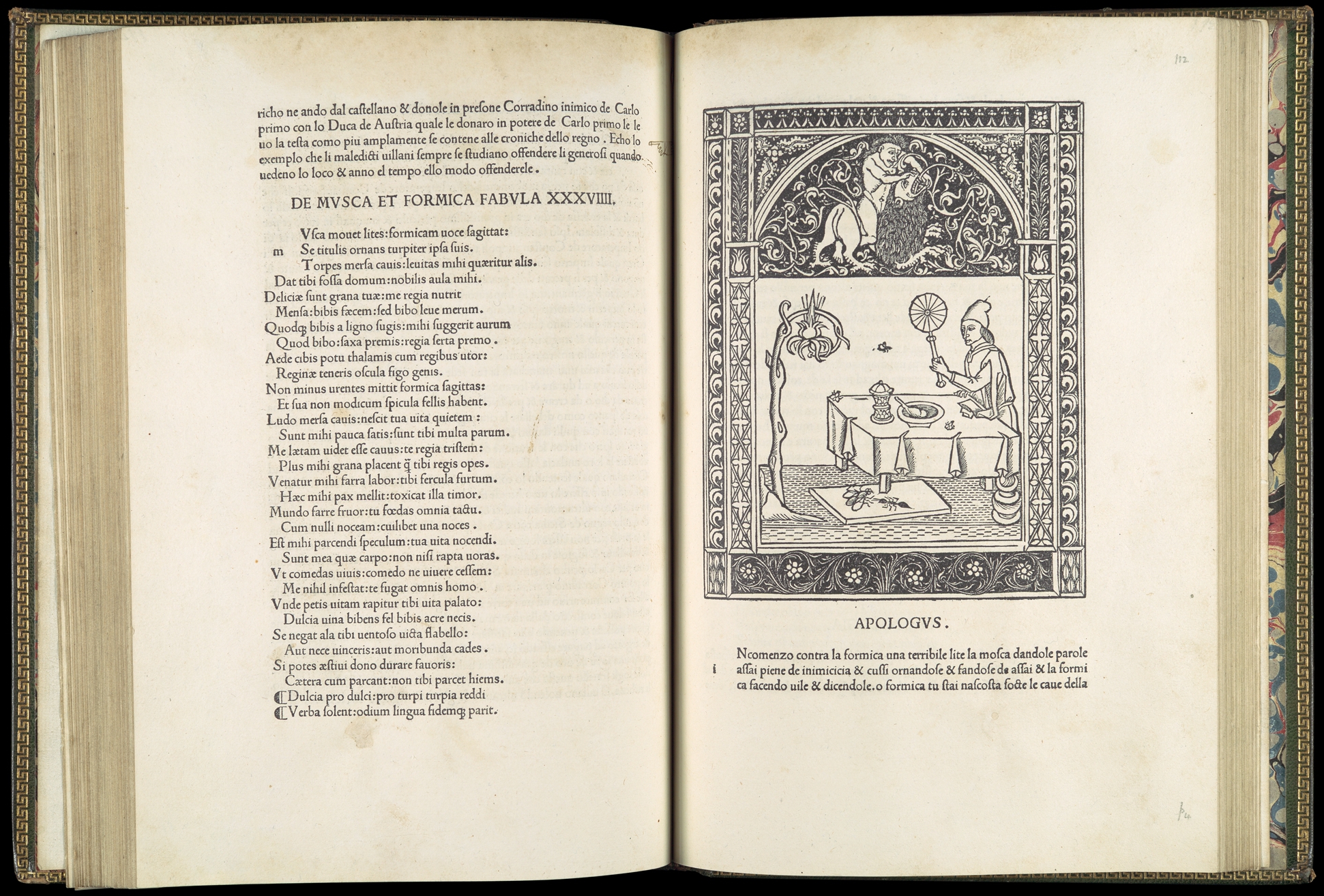
One of the four illustrations is an illustration from an Italian 15th century book Vita et Aesopus Moralisatus edited by Francesco del Tuppo and published in Naples, February 13, 1485 that appears on page 55 of the book.

I found a link to the illustration at the Metropolitan Museum of Art:

http://images.metmuseum.org/CRDImages/dp/original/DP108935.jpg

which explains the story behind the picture as follows:

"The fable of the ant and the fly is not unlike that of the country mouse and the city mouse. The fly boasted that he partook of the finest wines and the choicest delicacies and drank and ate from vessels of precious metal. But the wise ant, who ate simply and lived by his honest labor, pointed out that the fly was always unwanted and scorned and could never take a bite without being in fear for his life."

Here is a version of the story online: http://www.aesops-fables.com/the-ant-and-the-fly

Sunday, March 20, 2016

Lost Horizon

Lost Horizon by James Hilton
I have wanted to read this book since I was a child watching the movie version starring Ronald Colman and Jane Wyatt on TV.
It is the story of a chance for healing given to a World War I veteran who has been psychologically damaged by the war and living out his life as consular staff in remote outposts of the British Empire. Escaping from an Afghan city in turmoil in an air rescue mission, Hugh Conway and three others discover that their pilot has hijacked the plane. Instead of taking them to safety in India, they are flown to the most remote region of Tibet and saved from freezing to death by the lamas of a remote Buddhist monastery called Shangri-La.
Written during the Great Depression, the book is a Utopian novel that describes Shangri-La as a haven in a world set on self-destruction that promotes a philosophy mixing Buddhist and Christian values and holding a secret to extremely long life. Conway and his three companions each react differently to the environment, but the story is about the healing nature of the place on Conway's damaged soul.
The book suffers from undeveloped and stereotyped female characters, but James Hilton's prose is still a delight to read. It has instilled a desire in me to see the 1937 Frank Capra film again that was restored in 1986 and released on DVD in 1999.