Wednesday, August 24, 2016

Gone to Amerikay

Gone to Amerikay by Derek McCulloch
This is a beautifully drawn graphic novel that recounts the tale of an Irish mother and her young daughter who leave for New York in 1870 to stay with an aunt while waiting for her husband to follow. However the book also tells the story of a young man from Ireland who sails for New York in 1960 and becomes involved in the Greenwich Village arts scene of off-Broadway plays, coffee houses, and folk music. And, yes, there is a third story of a wealthy Irishman who hires a private investigator to track down a mystery involving the 1870's mother and the 1960's lad.

Disconcertingly at first, the novel as it progresses switches between these three stories about Irish people in New York. You the reader can see them eventually merging, but it left me a bit confused at first. The stories are richly rewarding and worth any trouble the sudden changes in settings may cause.

The artist excels at portraits of his characters both visually and in character development. I fell in love with the good heroes and even the villains of this richly rewarding portrait of the immigrant experience.

Wednesday, August 10, 2016

Beauty's Kingdom

Beauty's Kingdom by Anne Rice writing as A. N. Roquelaure
Anne Rice has written a fourth volume to the Sleeping Beauty Trilogy she wrote in 1983 under the pseudonym A. N. Roquelaure. The Claiming of Sleeping Beauty, Beauty's Punishment, and Beauty's Release now have a companion volume called Beauty's Kingdom. The original trilogy was an erotic retelling of the Sleeping Beauty legend in which the prince who awakens Beauty after her 100 years of sleep takes her away from her familial home to live in sexual servitude in his mother's kingdom, a land where the children of the neighboring kingdoms are taken to serve and please the nobles of the court.

It has been thirty years between the publication of the final volume of the trilogy and the release of this fourth installment, but in Beauty's world a little over 20 years have gone by. She and her husband Laurent have retired and passed on their kingdom to their son. The old queen and her son have died while on an ocean voyage, and messengers visit Laurent and Beauty to ask if they would be willing to rule her mysterious land of erotic servitude. They agree to become the rulers of what is to become known as Beauty's Kingdom with the stipulation that from now on all erotic servitude be voluntary and no longer restricted to the nobility.

The book is in eighteen chapters, each told from a different person's perspective. Beauty is the narrator of five chapters, her husband King Laurent of two. Lady Eva, who was in charge in the queen's absence has four chapters. The story progresses slowly and without the brutality of the forced servitude of the original trilogy. Yet Anne Rice shows she still can write convincingly and beautifully. Some of the fans of the original volumes are disappointed, which can be expected. This is not volume four of the trilogy. It is a look back at the story by a more mature author and brings her readers for a new look at the setting with a different perspective. No longer is Beauty the passive yet erotically aroused submissive. She is now the queen and it is her vision that will bring the kingdom back to life and give it new meaning. Yet she is not a dominatrix like the old queen, and it is this difference that gives this new volume a life of its own.

Sunday, June 19, 2016

The Camino: A Journey of the Spirit

The Camino: A Journey of the Spirit by Shirley MacLaine
The Camino, officially known as the Santiago de Compostela Camino, is a 500-mile path across northern Spain that for centuries people have walked for spiritual growth or other reasons. This book is the actress Shirley MacLaine's personal statement of her own travels on the Camino when she was 60 years old which is described as "an intense spiritual and physical challenge." She set a goal of doing it in 30 days which meant she had to average 20 miles a day over mountainous terrain. As the book progresses the focus shifts from the original physical challenge of walking so far, to a spiritual challenge that occurs for Shirley in her dreams where she is confronted with memories of past lives and spirit guides. If you are just looking for a book about the physical features of the Camino then this is not the best book for you. If you want to catch a glimpse into the rich inner spiritual struggles of Shirley MacLaine, and to perhaps grow a bit from the experience yourself, then you can be sure that this book will give you one heck of an adventure.

Thursday, May 19, 2016

Me Talk Pretty One Day

Me Talk Pretty One Day by David Sedaris

When I moved to Raleigh in May of 1979, I started having my morning coffee at The Breakfast House Restaurant across from NC State University's Bell Tower. This is where I met David Sedaris who was the morning waiter. This was during the time David was a Raleigh performance artist as described in the chapter "Twelve Moments in the Life of an Artist."
Reading David's books is like getting a letter from a long lost friend. Only funnier.

Monday, April 18, 2016

Barefoot Gen, Volume Ten: Never Give Up

Barefoot Gen, Volume Ten: Never Give Up by Keiji Nakazawa
The Barefoot Gen series documents the life of young Gen Nakaoka of Hiroshima starting when he is six years old in the summer of 1945 when the USA dropped an atomic bomb on the city. Never Give Up is the tenth and final volume of the series, and is set in Hiroshima in 1953, eight years after the events of the first book. As in previous books, the characters suffer from memories of both the terrors of the war and the horrendous day the atomic bomb destroyed their city and caused their lives to change forever.
Gen and three other orphans of the bomb live together in a small shack and dream of opening their own business making and selling the dresses they now sell as street corner vendors. Gen has also been learning to be an artist while working at a sign shop, and falls in love with his boss's daughter. Yet the long lasting effects of the atomic bomb on the people of Hiroshima's bodies and their souls will not let them live in peace. Memories of the horrendous day and its aftereffects continue to fill their minds, as the silent poison of radiation sickness eats away at their bodies.
The anti-war theme that has pervaded this series, starting in the first book with Gen's father and his opposition to the war that the military and the emperor have forced on the nation, is especially visible in this, the last book of the series. In this book the author outlines Japanese war crimes and makes a call for a world without war, especially calling for an end to atomic weapons. The book opens with a short two page introduction called "Gen's Message: A Plea For Nuclear Abolition" written by the translators and editors of Project Gen. It states clearly that "nuclear weapons and nuclear power cannot coexist with life on Earth." This strong pacifist message against war and nuclear power gives the ten volume story of the bomb and its aftermath a structure and a meaning far beyond simple history.

Thursday, April 07, 2016

Barefoot Gen, Volume 9: Breaking Down Borders

Barefoot Gen, Volume 9: Breaking Down Borders by Keiji Nakazawa

The Barefoot Gen series documents the life of young Gen Nakaoka of Hiroshima starting when he is six years old in the summer of 1945 when the USA dropped an atomic bomb on the city. Volume 9 takes place at the end of 1950 and through 1951. Gen is now 12 years old, and as the book opens the city has condemned the small hut that his family had called home. The rest of his family has either died from the blast or radiation sickness, or moved out. Now homeless, Gen decides to move in with the group of orphans he has befriended who have their own hut. While he is happy to be near the girl Natsue that he is fond of, her radiation sickness is now in its final stages and she is dying. After Natsue dies he is heartbroken but the spirit to live on through any adversity that his father instilled in him keeps him from despair.

The same spirit that has helped him and all who come in contact with him as they struggle out of the hellish remains of the atomic destruction of their city and their lives, now helps an artist in despair. The artist returns the favor by teaching Gen how to draw. The artist tells Gen "Art Has No Borders" which inspires him to learn the universal language of art so that he can break down the national barriers that led to the war and the destruction of his beloved city. As the book ends he dreams of a peaceful world free of war where all the countries are connected by rainbow bridges that people can cross freely and be friends.

Wednesday, April 06, 2016

Dreaming Spies

Dreaming Spies by Laurie R. King

Dreaming Spies finds Mary Russell and her husband Sherlock Holmes in three separate settings during the years 1924-25; on a ship from India to Japan, in a small inn along the ancient Japanese Kisokaido Road, and in Oxford, London and the countryside of England. On board the ship from India Holmes sees the Earl of Darley, his young new wife, and his adult son. He remembers the Earl from before the war when he was involved in blackmailing. Mary Russell meets a Japanese woman who is returning home from her studies in England and asks her to teach Russell and Holmes some Japanese language and culture.

Laurie King takes the readers slowly into a finely-crafted mystery filled with great attention to detail. She brings to life first the confined life on a steamship, then the turbulent changes sweeping over Japan as it transitions from a traditional to a modern culture, and also the academic community of Oxford and the Bodleian Library. Each chapter is introduced by a haiku written by King. This story of international blackmail at the highest levels of political life increases in intensity as it builds to a surprising and satisfying conclusion.

Tuesday, March 22, 2016

A Father's Story

A Father's Story by Lionel Dahmer
Jeffrey Dahmer was a serial killer and sex offender, who raped, murdered, and dismembered 17 men and boys between 1978 and 1991. This book is written by Jeff's father as he goes back over the life of his son and tries to understand what drove him to commit such ghastly actions.
Lionel Dahmer is a PhD chemist whose 1966 dissertation at Iowa State University, written in Jeffrey's childhood years, was titled: Chromatographic separations of niobium, tantalum, molybdenum, and tungsten. In this book both father and son seem emotionally detached, and Lionel even equates his son's bizarre desires to his own unrealized childhood fascination with explosives and murder.
While I found this book interesting to read, the parents' and grandmother's total unawareness of Jeffrey's crimes and pathological thinking limit the value of the book to helping the readers understand what happened to this young man.

Monday, March 21, 2016

Fifteenth century books and the twentieth century: an address ... and a catalogue of an exhibition of fifteenth century books held at the Grolier Club, April 15 - June 1, 1952

Fifteenth century books and the twentieth century: an address ... and a catalogue of an exhibition of fifteenth century books held at the Grolier Club, April 15 - June 1, 1952 by Curt F. Buhler
Curt Ferdinand Bühler (11 July 1905–2 August 1985) was the rare book curator at the Pierpont Morgan Library and an expert on the art and history of books printed during the fifteenth century. In this book he gives a talk on the first half century of printed books which is followed by a catalog of 77 15th century books from the 1952 exhibition at the Grolier Club, and four full page pictures from these books. It is an amazingly good introduction to incunabula, the printed books of the 15th century.

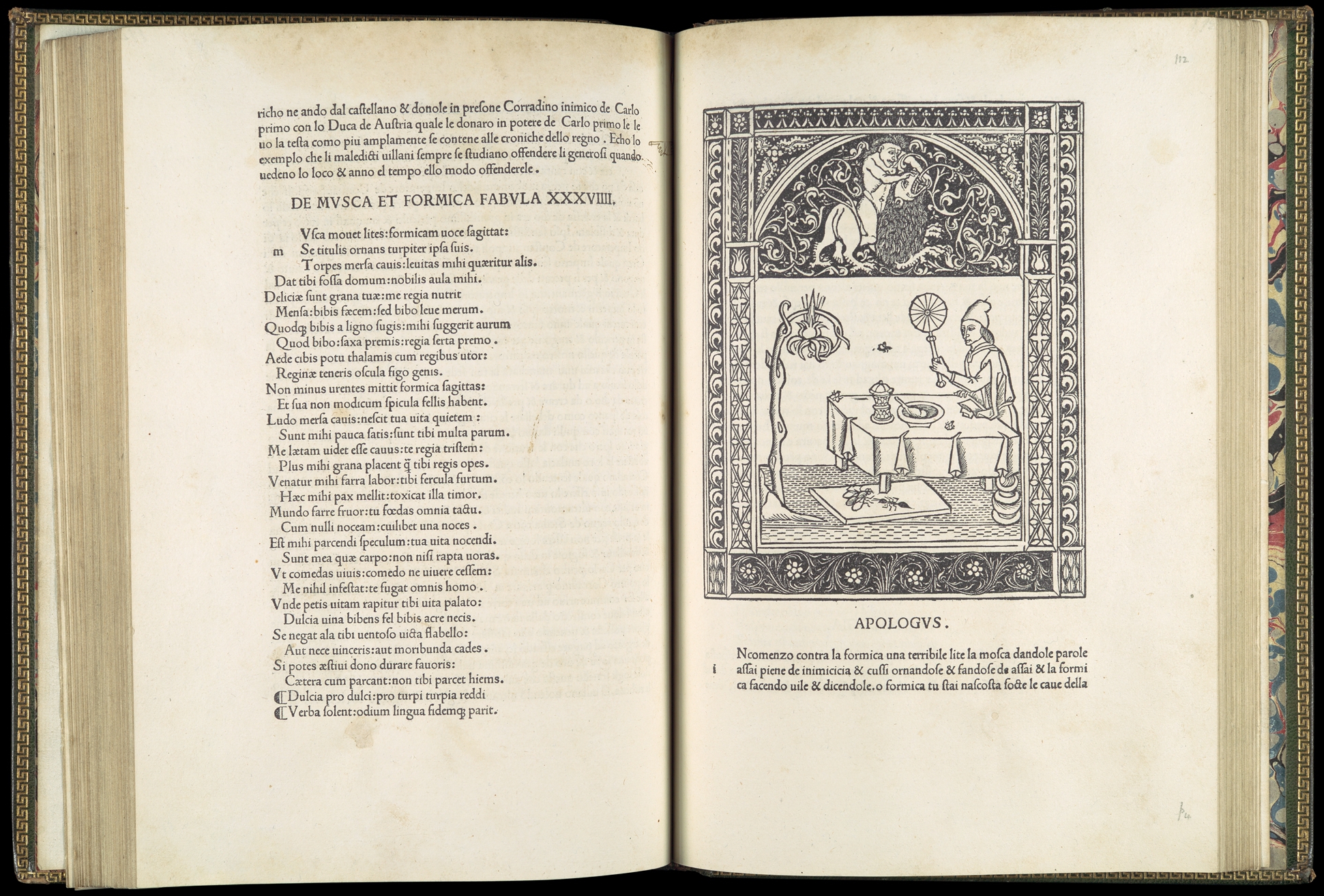
One of the four illustrations is an illustration from an Italian 15th century book Vita et Aesopus Moralisatus edited by Francesco del Tuppo and published in Naples, February 13, 1485 that appears on page 55 of the book.

I found a link to the illustration at the Metropolitan Museum of Art:

http://images.metmuseum.org/CRDImages/dp/original/DP108935.jpg

which explains the story behind the picture as follows:

"The fable of the ant and the fly is not unlike that of the country mouse and the city mouse. The fly boasted that he partook of the finest wines and the choicest delicacies and drank and ate from vessels of precious metal. But the wise ant, who ate simply and lived by his honest labor, pointed out that the fly was always unwanted and scorned and could never take a bite without being in fear for his life."

Here is a version of the story online: http://www.aesops-fables.com/the-ant-and-the-fly

Sunday, March 20, 2016

Lost Horizon

Lost Horizon by James Hilton
I have wanted to read this book since I was a child watching the movie version starring Ronald Colman and Jane Wyatt on TV.
It is the story of a chance for healing given to a World War I veteran who has been psychologically damaged by the war and living out his life as consular staff in remote outposts of the British Empire. Escaping from an Afghan city in turmoil in an air rescue mission, Hugh Conway and three others discover that their pilot has hijacked the plane. Instead of taking them to safety in India, they are flown to the most remote region of Tibet and saved from freezing to death by the lamas of a remote Buddhist monastery called Shangri-La.
Written during the Great Depression, the book is a Utopian novel that describes Shangri-La as a haven in a world set on self-destruction that promotes a philosophy mixing Buddhist and Christian values and holding a secret to extremely long life. Conway and his three companions each react differently to the environment, but the story is about the healing nature of the place on Conway's damaged soul.
The book suffers from undeveloped and stereotyped female characters, but James Hilton's prose is still a delight to read. It has instilled a desire in me to see the 1937 Frank Capra film again that was restored in 1986 and released on DVD in 1999.

Saturday, February 27, 2016

My Friend Dahmer

My Friend Dahmer by Derf Backderf
Having gruesomely murdered 17 young men, Jeffrey Dahmer is probably the most notorious serial killer in the USA. Derf Backderf went to school with Dahmer, and was even the president of the Dahmer Fan Club in their rural Ohio high school. Derf lost track of Dahmer in 1978 after graduation and went on to become a cartoonist. When he found out, along with the rest of the world, of Dahmer's 1991 arrest in Wisconsin he felt compelled to flesh out his memories and to write the story of the lonely, disturbed teenage Dahmer he knew. My Friend Dahmer is the result. In graphic novel form he tells all that he can of Dahmer's teen years. This is not the story of a serial murderer, instead it is the story of a teen age boy who never got any help from his family, his schools, or his community in dealing with the feelings growing inside him. In this book is the boy Derf knew in high school as he struggles with the challenges of growing up that for him were so overwhelming that they eventually lead to a murderous life.
Derf sees the teenage Dahmer as a tragic figure, but he has no sympathy for Dahmer the murderer, who he sees as a selfish coward who should have ended his own life rather than taking the lives of others. He draws from his own memories and others, as well as recorded interviews, FBI reports, newspaper stories, and Lionel Dahmer's book about his son. These are all listed in a 23 page section of "Sources" at the end of the book. While this book is called a graphic novel, it is more a biography than fiction, and is of great value in getting to understand the early years of a serial killer.

Tuesday, February 23, 2016

The Mother of God

The Mother of God by Leopold von Sacher-Masoch
Leopold von Sacher-Masoch was born on January 27, 1836 in the city now known as Lviv in Ukraine. At the time, the city was in the Galicia region of Austria-Hungary and was called Lemberg. His early books were mostly non-fiction historical treatises written while he was a professor at the University of Lviv while his later works were short stories and novels.
Sacher-Masoch's 1870 novel Venus in Furs is his most commonly available book in English. The Mother of God was originally published in Leipzig as Die Gottesmutter in 1883. This is its first translation into English. The translator, William Holmes, is a semi-retired anaesthetist from Northern Ireland. Not liking the abrupt ending, Holmes not only translated the book, but added three additional chapters to the end "to bring it to a more satisfactory ending."
I do not agree with Holmes decision to tack on three additional chapters of what can only be thought of as fan fiction to a 132 year old novel. His writing style is not the same, and he shifts the point of view from Sabadil to Mardona. I feel that Sacher-Masoch ended the story abruptly so that the reader would look back into the text for deeper meanings, not project a satisfying ending. Fortunately, it is very clear in the book that this was done and the reader can view the extra chapters as the translator's work and not the authors. Holmes' translation flows well and where there are references that might not be clear to a modern English-speaking readership, he provides helpful notes to explain them or their significance.
The book tells the story of Sabadil, a 30 year old introverted farmer from the countryside around what is now Kolomyya, Ukraine. He prefers to walk in the woods alone and listen to birds singing rather than to socialize with his neighbors. On one of these solitary excursions he meets and becomes enthralled with Mardona, the charismatic young female leader of a Christian sect of a neighboring village called the Duchobarzen. Known to her followers as the Mother of God, Mardona is treated by them with unquestioning devotion, and has become a spoiled tyrant, yet she feels a strange attraction to Sabadil and his infatuation with her.
The Duchobarzen may have been modeled on the Dukhobors who were a 19th century Russian sect known for pacifism, egalitarianism, and communal living that used the life of Jesus to guide their faith and practice. The Duchobarzen of this novel were a community of a couple hundred farmers who are guided by the wisdom of Mardona and who live a simple life of prosperity, hard work, and communal living.
Mardona's divine love for her community is all-encompassing and egalitarian but isolating. Placed above them, they worship her as a divinity in their midst, kneeling before her and kissing her boots, and treating her every word as sacred. Coming from outside the community, Sabadil's love for her is the human love of a man for a woman. This is a new experience for Mardona, whose other lovers have always been intimidated by her divine nature, and she likes it, but doesn't know how to respond. As she makes Sabadil part of the community, she treats him like a pet that she strokes and keeps by her side.
Through his eyes we see the tension grow between his unrequited love and her annoyance at his failure to fit into the community until it reaches an explosive and shocking ending. This is a novel filled with details of 19th century farming life in central Europe and it is a fascinating look at the experience of divine and human love.
Sacher-Masoch is known to modern readers for his writings on the theme of powerful women and the men who become fascinated and enthralled by them. He was also well known in his own time for his writings about the local ethnic groups of central Europe and their customs. The Mother of God combines these two themes and shows the author at the peak of his literary career.

Wednesday, February 03, 2016

Iola Leroy or, Shadows Uplifted

Iola Leroy or, Shadows Uplifted by Frances Ellen Watkins Harper
Frances Watkins Harper was born free in 1825 in Baltimore and was 67 years old when Iola Leroy was published. Before the Civil War she was a public speaker and political activist in the Abolitionist Movement and helped escaping slaves along the Underground Railroad. After the war she travelled the South speaking out for temperance, and the rights of women and African Americans, and other social causes.
Iola Leroy or, Shadows Uplifted is one of the first novels published by an African-American woman. It tells the story of a wealthy Mississippi planter who frees and marries his mixed-race slave. They have two children, Iola and Harry, that are raised without knowledge of their mixed background and educated in the North. In spite of his sincerest efforts to secure their future, after his death greedy relatives thrust Iola and her mother into slavery.
The book deals with Iola's emancipation and the period after the war when she tries to find her mother and brother and reestablish their lives together. As Iola and her brother are light skinned and highly educated, the book also deals with issues of passing and miscegenation. The concept of a single-drop of African blood making a person non-White and subject to ill-treatment by Society is a major theme. Written less than a decade before the Wilmington Massacre of 1898, this was a time when African-American prospects were still promising but were being threatened by racism and separatist thinking.
This novel is a great window on the era prior to the extreme racial repressions of the 20th Century, when Black people had hoped that education, hard work, and social responsibility could bring them social justice in the nation. As such, it is a great source of information written by a leader in the social justice movement of the time.

Thursday, January 28, 2016

Barefoot Gen, Volume 8: Merchants of Death

Barefoot Gen, Volume 8: Merchants of Death by Keiji Nakazawa
The Barefoot Gen series of 10 graphic novels tells the story of the World War II atomic bombing of Hiroshima Japan through the eyes of a young boy Gen Nakaoka who relates the events lived through by the author Keiji Nakazawa. Gen's father, sister and brother were killed during the blast; his mother died several years later from radiation sickness. Gen is in Middle School and living with his older brother Koji and his younger brother Akira in the shack his family built from the ruins of the blast.
Book 8, Merchants of Death begins in June of 1950 with the beginning of the Korean War. Hiroshima has been rebuilding from the ruins of the blast and the war brings business to local merchants willing to supply materials for the war. With the war comes a crackdown on Communists and their sympathizers. Many in Hiroshima, remembering the horror of the atomic blast, are strongly pacifist. Anti-war feelings are looked on with suspicion by the occupying Americans and the Japanese government. It is from the war profiteering that the book draws its title.
In the first book Gen's father was constantly in trouble for speaking out against Japanese involvement in World War II. Here we see a similar current of suppression of those who speak out against war and militarism as Japan serves as a home base for American soldiers fighting the Korean War. This is an eloquent plea for cooperative action over militarism in a quest for world peace.

Wednesday, January 13, 2016

Revelation

Revelation by Peggy Payne
Revelation portrays one year in the life of a small town Presbyterian pastor as he struggles with his calling. Happily married and successful, Swain Hammond's life is shaken when he hears God talking to him in the backyard of his home in Chapel Hill, NC. Having been sure of his calling to the ministry since he was young, hearing the voice of God at first reaffirms him, but later begins to be an unsettling influence. The members of his church are not ready to accept that their minister is in direct communication with God. Peggy Payne takes us deep into the contemporary meanings of religion and spirituality as we share this year with Swain, his wife Julie, and the members of his small community church.

Friday, January 01, 2016

Being Mortal

Being Mortal: Medicine and What Matters in the End by Atul Gawande
A neighbor gave me this book when my mother died and it took me a long time to read it. The topics it covers are the end of life, the medical response to terminal illness, and the needs of people facing their mortality. It was very hard for me to read about these things after spending 15 years watching my mother's health deteriorate and seeing her die from dementia. However, reading about the realities that we as humans face at the end of our lives, and how others have dealt well with dying, has been remarkably healing for me. I wish I had read this book a year ago so I would have had this information when I was living through my mother's final days. This book is not only useful to the terminally ill and their families, but can be helpful to anyone who wants to get a better understanding of the aging process and how it plays out for humans.

Monday, December 28, 2015

Barefoot Gen Volume Seven: Bones Into Dust

Barefoot Gen Volume Seven: Bones Into Dust by Keiji Nakazawa

The Barefoot Gen series of 10 graphic novels tells the story of the World War II atomic bombing of Hiroshima Japan through the eyes of a young boy Gen Nakaoka who relates the events lived through by the author Keiji Nakazawa. Book 7, Bones Into Dust takes place more than three years after the war has officially ended. Gen's father, sister and brother were killed during the blast, and his mother now suffers from radiation sickness. Gen's older brother Koji has left to work in a coal mine to earn money for the family, leaving Gen and his younger brother Akira to care for their sick mother and find food and medical care. Gen has befriended an older man and a group of street orphans who develop scheme after scheme to find food, raise money, or steal what they need. The old man has written a novel called The End of Summer about the atomic bomb and its effects on Hiroshima that he wants to have published before he dies of radiation sickness.
The book opens with the orphans devising a plan to get the book published. When all the regular publishers have turned them down because they fear reprisal from the Americans, Ryuta, one of the orphans, suggests asking the prison print shop to print the books. All they need to do is find the money to buy the paper for the printing. Finding the money is a challenge that they solve. Once they have the book published and are distributing it, they are picked up by the local police and taken to a U.S. military base for interrogation.
Meanwhile Gen's mother continues to decline from her bomb-induced radiation sickness, and Gen's older brother Koji, now a depressed alcoholic, returns from the mines. The last section of the book reunites the family as the boys try to make Gen's mother happy in her last days. The subtitle Bones Into Dust refers to the cremation remains of Gen's mother as the family deals with yet another loss.

Sunday, December 27, 2015

Taffy of Torpedo Junction

Taffy of Torpedo Junction by Nell Wise Wechter
Taffy of Torpedo Junction is a children's book originally published in 1957 that tells of the time German U-boats preyed on the shipping routes off the North Carolina coast in 1942, sinking tankers, and other vessels bound for England. Taffy was based on the real life Carol White Dillon (1928- ), who is now the owner of the Outer Banks Motel in Buxton, NC, when she was a girl of 13. In 1942 the author Nell Wechter was a school teacher living in a boarding house run by Carol's mother.
At that time Hatteras Island was served by a ferry rather than a bridge and had no tourist industry. Mainlanders on the island were rare. In 1942 the Coast Guard and Nazi submarines brought the war to this tranquil setting with the sinking of more than 60 ships in a six month period. Taffy and her friends experience the war right off their shore as tankers explode in the night, bodies are washed ashore, and talk turns to saboteurs and spies. Although this is a children's book, it can be of interest to adults interested in this unique part of the war. Dennis Rogers of Raleigh's News and Observer called this book "The best piece of children's literature ever produced in this state."
Readers can see a picture of the current day Carol telling of the war here: https://www.flickr.com/photos/blairpub/3447424643/ and hear her talk about about it online: http://monitor.noaa.gov/obxtrail/carol.html.

Saturday, December 26, 2015

The Man in the High Castle

The Man in the High Castle by Philip K. Dick

I started reading The Man in the High Castle after watching the Amazon series of the same name. While all the main characters are present in both, I was drawn to reading the novel when I found the ending of the online series unrewarding. The book is well worth reading even if you have seen the Amazon series. However, the I Ching (or, The Book of Changes), which plays a minor role in the movie, plays a much more significantly part in the book. I counted eight separate times the oracle is consulted and the results described to the reader. In fact the very first sentence of the Acknowledgments tells readers what version of the I Ching is used and quoted in the novel.
The novel is an alternate history set in the early 1960s in which the United States and its Allies lose World War II, and the east coast of the United States is run by Nazi Germany while the West Coast is run by Imperial Japan. Besides the I Ching, the other main plot device is a popular but banned novel written by Hawthorne Abendsen, the titular man in the high castle, which is called The Grasshopper Lies Heavy. The title of this book within a book is taken from Ecclesiastes 12:5. This inner book is also an alternative history, only here the Nazis and Japanese lose World War II and the details are different from the readers' real world history of events.
Readers are left with a view of reality where no one knows what is real, and people use 50 yarrow stalks and an ancient Chinese oracle to make sense of things. While I found the ending of the novel much more satisfying than that of the online series, those unfamiliar with the I Ching or uncomfortable with questioning reality may find the novel unrewarding.

Monday, November 30, 2015

The Blacksmith's Hammer, or The Peasant Code A Tale of the Grand Monarch

The Blacksmith's Hammer, or The Peasant Code A Tale of the Grand Monarch by Eugene Sue
The Blacksmith's Hammer, or The Peasant Code A Tale of the Grand Monarch is the 18th book of Eugene Sue's 20 volume series The Mysteries of the People; or History of a Proletarian Family Across the Age. The series was created to be novelization of European history that depicted the struggle between the ruling and the ruled classes. One family, the descendants of a Gallic chief named Joel, represent the oppressed and the descendants of a Frankish chief Neroweg, typifies the oppressors. Down through the ages the successive struggles between oppressors and oppressed are depicted in a series of stories that culminate in the European Revolutions of 1848.
The Blacksmith's Hammer, which is set in the 1670's, is a sequel to the events of the previous book in the series, The Pocket Bible, which was set in Paris in the 16th century. It is Eugene Sue's Romeo and Juliet, a tale of two lovers from the opposing families of the series, one Gallic and the other Frankish. Having been divided by race and class for so many years, Calvinism has finally created a bridge that can unite Bertha of Plouernel and Nominoë Lebrenn.
Part One takes place in 1672 Holland during William of Orange's persecution and murder of John and Cornelius De Witt. A French ship on its way to England is caught in a storm and seeks safe harbor along the Dutch coast. On board is the young and beautiful Bertha of Plouernel. With it's main mast and rudder lost to the storm, the ship is helpless and sends out distress signals. Just when all hope seems lost, a ship skillfully piloted by a virile and charming young man appears and tows them into the harbor at Delft. The seaman is Nominoë Lebrenn, who goes on to save Bertha's life several times and they fall in love.
Part Two takes place in Brittany during the Revolt of the Bonnets Rouges of 1675. Nominoë is one of the leaders of the peasant revolt and Bertha is the sister of Baron Raoul of Plouernel, the local landlord, whose taxes have caused the unrest. In addition to being a story of a great love, Eugene Sue makes both lovers politically aware of how their love could unite a country and their two races, healing centuries of class struggle.
While this is a sequel to the previous book in the series, it can be read on its own as the characters have their own compelling story to tell. Typical of the series, the author weaves his own fictional families into the real events of the period to create drama while maintaining historic accuracy.
Each volume in this series has a preface by their translator, the Socialist publisher Daniel De Leon, that helps set the story in the history of the labor movement of the early 20th century when these books were first made available to American readers.

TRANSLATOR'S PREFACE.
Edward Bulwer-Lytton observes of fiction that, when aspiring at something higher than mere romance, it does not pervert, but elucidates the facts of the times in which the scene is placed; hence, that fiction serves to illustrate those truths which history is too often compelled to leave to the tale-teller, the dramatist and the poet. In this story, The Blacksmith's Hammer; or, The Peasant Code--the seventeenth of the charming series of Eugene Sue's historic novels, The Mysteries of the People; or, History of a Proletarian Family Across the Ages--the author reaches a height in which are combined all the elements that Bulwer-Lytton distributes among history, tale, drama and poetry. The history is clean cut; the tale fascinates; its dramatic presentation is matchless; last, not least, the poetic note is lyric. As historian, as tale-teller, as dramatist and as a poet the author excels himself in this narrative, that serves at once as a sequel of the age described in the previous story, , and as prelude to the great épopée of the next story that deals with the French Revolution.
DANIEL DE LEON.
New York, March, 1910.