Tuesday, February 28, 2006

A Feast Unknown. Philip Jose Farmer


A Feast Unknown. Philip Jose Farmer

A Feast Unknown by Philip Jose Farmer may not be everybody's cup of tea. There is a lot of graphic descriptions of both violence and male sexual arousal. Yet if the reader is open-minded enough to get past these, this is a well crafted adventure novel by one of the masters of the field.

The novel pits Farmer's versions of Tarzan and Doc Savage against each other in a fight to the death over the secret of eternal life. Farmer calls these foes Lord Grandrith and Doc Caliban, and tells the story from the point of view of Grandrith. Also, it turns out there is another secret these two share that they must discover before they kill each other.

There are enough explosions, deaths, and dismemberments for a summer Hollywood adventure blockbuster, but Farmer has added a strange twist to the story that makes this risky material for the screen. As the novel opens, Grandrith finds that he becomes physically aroused to the point of climax whenever he kills someone. This is very distracting for him, as he must outwit his most deadly enemies while his body is being drawn towards other feelings.

This is difficult material to handle and Farmer does it superbly, and with a touch of humor, while keeping the excitement level high. Leave it to the creator of Riverworld to invent such a fantastic story line and carry it off superbly from beginning to end.

Is this the original slash fiction (fan writings involving fancied romantic liaisons between fictional male companions)? Most articles about slash trace it back to 1970s fan fiction depicting romantic adventures between Star Trek's Kirk and Spock. A Feast Unknown was first published in 1969, a date that precedes the earliest dating for slash so far. However, regardless of whether this novel has anything to do with slash fiction, it is a great work on its own terms that was certainly groundbreaking at the time and can still be controversial to this day.

The Apartment Book: A Day in Five Stories


The Apartment Book: A Day in Five Stories. Leo Hartas

The Apartment Book is an oversize (11"x14") illustrated look into the daily life of an apartment building and its many residents. Each double page illustration shows a cutaway view of an old Victorian building that has five stories and a basement with six apartments. The residents vary, with three families on the first three floors, an actress and her maid on the fourth floor, and an artist and a crazy inventor in two small apartments on the fifth floor. The author has added the maintenance crew, a homeless person seeking temporary shelter, a couple of burglars, and even an alligator that prowls the sewers beneath the basement.

Each of the 14 illustrations shows the events in the house at different times of day, starting at 7 am and ending at one the following morning. The drawings are richly populated with interesting details and the dialog is neatly confined to the sidebars. This is a sumptuous treat for the visually inclined, and the residents' stories will keep you interested to the very end. However, with all the activity depicted in this one day, it does not look like a place I would like to live in for long.

Irene at Large. Carole Nelson Douglas


Irene at Large. Carole Nelson Douglas

Irene At Large is the third in a series of mystery novels based on the career of Irene Adler Norton, a character from one of the Sherlock Holmes stories by Arthur Conan Doyle. In Doyle's A Scandal In Bohemia Irene Adler outsmarts Holmes and wins his lasting admiration. Carol Nelson Douglas has taken this story as the basis for a series of delightful mystery novels that include Holmes and his companion Watson in mysteries that run parallel to the Holmes stories.

She has also created a framework for this continued series based on a current day historian Fiona Witherspoon who has supposedly discovered the diaries of Irene's companion Penelope "Nell" Huxleigh and unpublished memoirs of Dr. Watson that she blends into the novels of the series.

In this outing the plot takes place around the events of Doyle's story The Naval Treaty. Irene and Nell run into an old acquaintance of Nell's, Quentin Stanhope, dressed in Eastern garb, feverish, and quite unkempt. When they take him home, an attempt is made on his life. As they try to uncover his attacker, they find the answer may lie in events at the British battle of Maiwand in Afghanistan nine years earlier that link Stanhope to Dr. Watson and a mysterious spy known as Tiger.

This is an excellent story that should appeal to readers familiar with the tales of Sherlock Holmes, but who seek a more feminine and feminist point of view on the period and the characters.

Monday, February 27, 2006

The Dragon and the Book.


The Dragon and the Book. Christine Price

I was drawn to this book initially by the artwork - lovely pen and ink drawings and ornate first letters. It is a children's book from 1953 by an author/illustrator who has about 30 books to her credit. Once I started reading it, I fell in love with this story of a young orphan raised in a monastery in 9th century England. Wilfrid has been raised by the monks who are mostly veterans of the war with the Vikings. The monastery is only a shadow of its former self because the Vikings burned it and killed most of the monks. The remaining monks have been training Wifrid as a scribe so that he can help them make a Psalm Book for King Alfred the Great as a thanks gift for saving them from the Vikings.

As the story opens the book is almost done, and the King is visiting the area to stir the local citizens to fortify themselves against a renewed threat from the Vikings. Years of peace have left the people unready and unwilling to fight off another attack. Even the king is tired and would like to devote his remaining years to building prosperity and learning in his kingdom. However, his old foe Hasten, the leader of the Vikings, is readying a new assault.

Wifrid is thrown into the thick of the war when the Vikings land and sack the monastery. He escapes with the Psalm Book, which he tries to bring safely to the king. Yet there are many adventures and much danger on the way. In the process the peaceful young monk learns much about the ways of war, and he and his book play a significant part in the events that follow.

Although written by a woman, the book has but two minor female characters. Thus it may be most appropriate for young male readers. This may be a reflection of the time when it was written, but is the only weakness that I see in this well-researched and strongly plotted recreation of 9th century England and the tensions between the Vikings and the English at the time.

Sunday, February 26, 2006

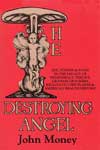
The Destroying Angel: Sex, Fitness & Food in the Legacy of Degeneracy Theory, Graham Crackers, Kellogg's Corn Flakes & American Health History


The Destroying Angel: Sex, Fitness & Food in the Legacy of Degeneracy Theory, Graham Crackers, Kellogg's Corn Flakes & American Health History. John Money

I have to admit that I was attracted to The Destroying Angel initially because I thought it was a history of the health food movement in the U.S. I had just read The Road to Wellville by T. C. Boyle and was interested in determining the accuracy of this fictional treatment of Dr. John Harvey Kellogg. So I was a bit surprised to discover that this is a book on the history of what the author, a sexologist, calls Degeneracy Theory. Now I feel like I need to read some more history to verify the facts of this book.

Anyway, I found out that Dr. Kellogg was accurately portrayed in The Road to Wellville. Congratulations Mr. Boyle for a job well done! However, while there is a very good treatment on the history of the health food movement in this book, it appears that the founders and major thinkers of this movement also had strong beliefs about sexuality. So while one third of this book is about corn flakes, whole grains and vegetarians, the rest of it is an outline of two pre-20th century mistaken theories on sexuality.

The first of these is that masturbation causes disease. According to the author this came about because, before the germ theory, people felt that the symptoms of syphilis and other sexually contracted diseases, could be traced to "self-abuse" rather than contagious transmission. The second sexual theory treated historically in the book is that sexual excitement and the corresponding sexual release are injurious to the human body and should be avoided as much as possible. The combination of these two is what John Money calls Degeneracy Theory, and he claims that their effects inhibit a sexually healthy society to this day.

In an Epilogue called Theory Of Sex, Love, And Health Without Degeneracy, which is the longest chapter in the book, Money provides a wonderfully concise outline of Sexology as it was understood twenty years ago. Thus, while nothing he says is out of date, you will not findrecent topics such as Viagra-like drugs mentioned.

This was an important book for me. I have never seen the history of sexuality theory so well portrayed. John Money is at his weakest when, towards the end of the book, he relies on technical terminology which may discourage a general readership that is most in need of this information.

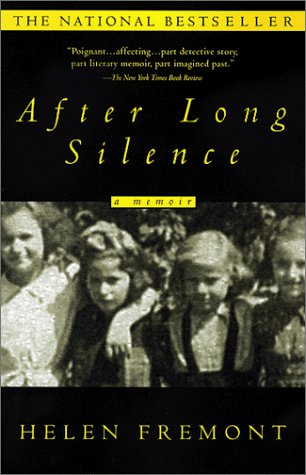
After Long Silence


After Long Silence. Helen Fremont

After Long Silence by Helen Fremont is a second generation Holocaust memoir. The author's mother and aunt survived the Holocaust by disguising themselves as Polish Catholics in Italy. Her father escaped from Soviet Siberia and walked across Europe at the end of the war to join the sisters in Rome.

What makes this story so interesting is that, after the war, the sisters never came out of hiding as Catholics and convinced the author's father to maintain the pretense as well. They migrated to the USA and had two daughters that they raised as Catholics. It is only when the daughters are in their 30s that they start to suspect that their parents are keeping something from them.

Helen Fremont blends together the two stories of her and her sister uncovering their parents Jewish past and their parents Holocaust survival tale in a wonderful way that shows the intergenerational impact of lies and deception in a way that is still sensitive to her parents' desire to put the past behind them.

The Norse Goddess. Monica Sjöö


The Norse Goddess. Monica Sjöö

The author starts this book with the sentence: "I am an Earth Mysteries Goddess artist of many years." Monica Sjöö, in addition to being an artist, was also the author of The Great Cosmic Mother, an influential book on Goddess religions published in 1987. As a writer and artist she was a major voice in feminist spirituality for the past 30 years. Monica Sjöö died in August 2005 after fighting cancer for several years.

In this book she turned her attention and thoughts to the ancient goddesses of her home country Sweden. We get a powerful and personal work on the feminist roots of Norse mythology and their impact on Scandinavian history and the Saami and Vanir peoples of the region. The book is illustrated with 15 black-and-white reproductions of her art. A color reproduction of the author's painting Nordic Mother of the Animals is on the front cover.

The book tells the story of how the author explored and researched the sites and myths of the northern goddesses and the native peoples of Scandinavia who worshipped them. As such it is more personal than scholarly in approach and I reccomend it more to artists and feminists than to theologians and historians. Although the book is predominantly a feminist look at Norse mythology, there is enough information about the Saami people of northern Sweden to make it interesting to readers seeking information about them.
The Norse goddess is examined in her various manifestations as Hel, Freya, Frigga, Nerthus, Ilmatar, the four Ahkkas (Madder-Ahkka, Sarahkka, Juksahkka, and Uksahkka), and the three Norns (Urd, Verdandi, and Skald). The relationship of the goddess with the ancient Saami and Vanir peoples is explored as well as her eventual displacement by the Nordic male gods of the invading Indo-Europeans.

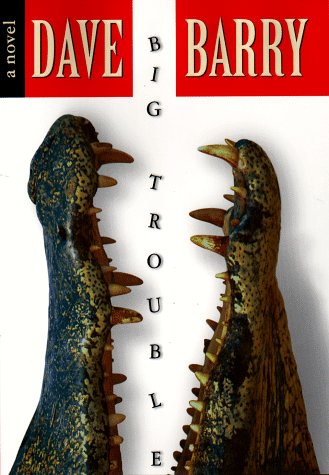
Big Trouble. Dave Barry

Dave Barry uses his vast knowledge of Miami Florida to bring this comic thriller to life. A tightly plotted tale that includes homeless people, parents and their teenage children, Russian arms dealers, New Jersey hitmen, the FBI, a poisonous toad, and a herd of stray goats. In the process there is a series of attempted murders, three love stories, and a tribute to the wacky people of south Florida. This is his first attempt at writing a novel and it succeeds in being a very funny and well-crafted work. Even funnier than his second novel, Tricky Business, but not by much. Big Trouble was made into a movie in 2002 that was directed by Barry Sonnenfeld and starred Tom Allen.
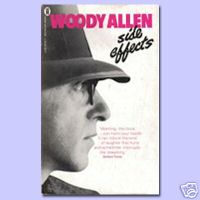
Side Effects. Woody Allen

Side Effects is a collection of short humorous essays written by Woody Allen 30 years ago. It is his third book and still very funny. Much of the humor is based in New York and Jewish cultural idioms with a sprinkling of mock intelligentsia - all with the neurotic, self-absorbed, and insecure point of view that he made famous.

The first piece, "Remembering Needleman," is a satirical take off on scholarly obituaries. Only Woody Allen would think of bringing marshmallows to a cremation and to donate the ashes to a university for research.

"The Condemned" takes a humorous look at Elie Weisel's Dawn where a man must decide whether to kill a truly evil person.

"By Destiny Denied" is 7 pages of notes for an 800 page novel that was never meant to be written.

"The UFO Menace" is Allen's take on the existence of UFOs.

"My Apology" puts Woody Allen in Socrates' place as he faces death by hemlock.

In "The Kugelmass Episode" the protagonist finds a magic way to cheat on his wife by going back in literature to have an affair with Emma Bovary.

In "My Speech to the Graduates" we find Allen's philosophy most succinctly spelled out: "We are a people who lack definite goals. We have never learned to love. We lack leaders and coherent programs. We have no spiritual center. We are adrift alone in the cosmos wreaking monstrous violence on one another out of frustration and pain. Fortunately, we have not lost our sense of proportion."

"The Diet" explores the insecurities often associated with working in corporate America. A person only identified as F. deals with his work problems by taking control of the only thing he can - his food intake.

"The Lunatic's Tale" is about a successful doctor who is driven crazy by his love for two different women. The ending is right out of a 1950's sci-fi movie.

"Reminiscences: Places and People" is composed of one-page memories of Brooklyn, New Orleans, Paris, Mexico, and a meeting with a famous author.

In "Nefarious Times We Live In" we are taken inside the mind of a person who attempts to assassinate a president.

"A Giant Step for Mankind" takes a humorous look at scientific research. How do scientists develop techniques like the Heimlich Maneuver for dinner table choking? See the actual research journals here.

"The Shallowest Man" reads like a Hasidic fable set in modern New York about death, love, and caring.

"The Query" is a short play in which Abraham Lincoln tells a joke that changes his life and saves the life of another man.

"Fabrizio's: Criticism and Response" treats the restaurant review as scholarly criticism, complete with reader responses.

"Retribution" reads a bit like the movie Annie Hall with ideal romance thwarted by human foible.

Woody Allen fans will love the book. Others will find some classic Allen humor that is still delightful to read, if neurosis, problematic human relationships, and death are things you like to read about.

The Prime of Miss Jean Brodie. Muriel Spark

Recently saw the movie The Prime of Miss Jean Brodie for which Maggie Smith won an Oscar. She was great and so was the movie. So I took a chance on the book.

The movie is very faithful to the book, but the point of view is different in each. While the movie is presented from Jean Brodie's point of view, the book gets more into the feelings of one of Miss Brodie's girls, Sandy Stranger. This change in perspective really helps the story because you see it from the point of view of a growing teenager whose perspective deepens and changes with age. Thus the shift that happens in Sandy from blind follower to rebellious foe, is much easier to understand in the book than in the movie.

If you liked the movie, or if you are, like me, a fan of 1930's fiction, I think you will find this a rewarding book.

Tricky Business. Dave Barry

Tricky Business is Dave Barry's second novel. Like his first novel, Big Trouble, this work is set in south Florida, has elements of a crime novel, and is filled with the eccentric people that Barry creates so well. Unlike his books of nonfiction, both these novels contain what Mr. Barry calls "bad words." This is because his novels contain "unsavory characters" and they use bad words. Not all the characters are unsavory. Most are just eccentric, funny, or inept.

Although this novel is not as laugh out loud funny as Big Trouble, it attempts to compensate for this by having much more actual violence and sex. Speaking of sex, the song "Sex Pootie" by the Seminal Fluids, which played a prominent role in Big Trouble, makes a cameo appearance in Tricky Business. It must be a personal favorite of Mr. Barry.

The story is about one of the gambling ships that leave Miami every day to go out three miles into international waters for a couple of hours of entertainment and return. It is the only ship to go out with a hurricane approaching. It does this because it is owned by a gangster who uses it to pick up smuggled drugs from boats coming from the Bahamas and he can't miss a delivery. All the events in the novel take place the day of the storm.

If you like Dave Barry's humor, you will love his novels.

Thursday, February 23, 2006


Fragments From The Delta Of Venus. Judy Chicago & Anais Nin

Fragments from The Delta of Venus is a collection of 20 watercolors by the famous feminist artist, Judy Chicago. The paintings were inspired by 20 fragments from the erotic short stories of Anais Nin published in the collection The Delta of Venus. These stories, written for a private collector of erotica in the 1940s, were published in 1974 at the height of both the Sexual and Feminist Revolutions.

Judy Chicago found short fragments, five to seven lines long, that she found "riveting" and they became the inspiration for these paintings that "articulate a feminine perspective on sex." The paintings depict genitalia and sexual activity, and use color and line to create an image of sexual excitement and passion.


Each painting is depicted on a page of its own, with the text from The Delta of Venus that inspired in on the facing page. These are preceded by a page that has the title of the story from which the text was taken. It is a very simple presentation with a list of the painting titles and the date of composition at the end of the book. The paintings were done over a three year period from 2001 - 2003.

At the beginning of the book are one page biographies of Anais Nin and Judy Chicago. These are followed by a nine page memoir of Anais Nin written by Judy Chicago that tells of their friendship and Nin's influence on her. It also goes into why she created this particular set of paintings.

This is a beautiful and erotic book. It is well-produced with a pink binding. PowerHouse Books has done a wonderful job of presenting these works.

Love Slave. Bertrice Small

Sexual slavery is a worldwide problem, even today in the 21st century, with hundreds of thousands of women and children subjected to this horror every year. It has been around for thousands of years and is not a problem to be taken lightly.

In Bertrice Small's The Love Slave, the author paints a picture of a woman whose life was so horrible, and whose slavery was so romantic that it is preferable to her original life. Set in the mid-tenth century, Regan is a Scottish girl whose family has been murdered by a neighboring clan. She is carried off by a Norse slaver to be sold in the slave markets of Dublin. Her outstanding beauty catches the attention of a Dublin trader who buys her as a present for the caliph of Cordoba. He must owe the caliph big time because, he not only fills a ship with goods, he also hires Karim the ship's owner, who is a Master at training love slaves, to train Regan to please the caliph.

In addition to this book being in the Historical Romance genre, it is for mature audiences. The author describes in detail the sexual behavior of her characters. She has also done enough research to create historically accurate settings and characters. The caliph of Cordoba is based on the real Abd ar-Rahman III (891-961), the greatest and the most successful of the princes of his dynasty in Spain. He is accused of having sunk in his later years into the self-indulgent habits of the harem. Which is where we find him with Regan, whose name has been changed to Zaynab, "the beautiful one."

Of course, Zaynab and Karim had fallen deeply into eternal love during her training. Their parting in Cordoba breaks both their hearts and the reader spends the rest of the book wondering if they can ever be reunited. If you can stand the sexual heat, this is a great example of historical romance.

The last words of the caliph Abd ar-Rahman III are said to have been "I have known only fourteen happy days in my life." After reading The Love Slave, you will have a good idea how those days were spent.

Wednesday, February 22, 2006


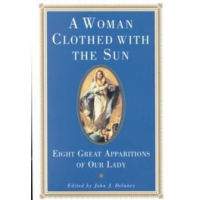
A Woman Clothed with the Sun. John J. Delaney

A series of 8 essays published in 1960 on Marian apparitions from Guadalupe to Fatima and beyond. The most recent sightings covered are Banneux and Beauraing from the 1930s. If you want some basic background on these earlier visits of Mary and don't mind the official Catholic version this is a very useful book.

Fathers and Daughters: In Their Own Words. Mariana Ruth Cook

Mariana Cook's book Fathers and Daughters is dedicated to her father who was eighty years old at the time, and was approaching the end of his life. Cook says "these pictures were made as an exploration" because she became fascinated with every father and daughter" she saw. She was "was anxious to understand their feelings for each other."

The book contains 70 full-page black and white photos each containing a father and his daughter(s). These are what one critic called "intimate yet still formal portrait photographs" in which the relationship of the subjects to each other is revealed through their placement, body language, points of contact, the setting, and the objects they chose to have with them in the pictures. In one, the subjects arise out of a sea of stuffed animals. In two others, the father and daughter have a book between them.

The subjects had the opportunity to write brief essays about their relationship, but not all chose to do so. These words range from simple to profound as these people delve into their understanding of the father-daughter bond or their own personal relationships. Jaques Seguela, a Parisian advertising executive, writes: "Men love women, as we all know, but actually they prefer girls, by which I mean daughters. Perhaps this is the crux of love, these father-daughter relationships that transcend tenderness and affection, in which admiration, too, transcends objectivity." One father writes about how his daughter saved his life. Often the essays seem to be a way for the person, especially the daughters, to express the inexpressible.

Fathers And Daughters begins with an introduction by William Saroyan, who appears in this book with his three daughters. He says:

Mariana Cook has in this portfolio of pictures encompassing so many fathers and daughters achieved a substantial miracle of photography. There is not only a remarkable clarity of technique and vision but an ability to capture the nuances or relationship; one can assume that these moments, electric and vivid, are created out of that intuitive grasp of the revealing instant possessed only by the most accomplished artist. There is nothing lax or dilatory in any of these pictures; each has both precision and luminosity, and in each of them one can percieve the nearly visible energy that flows from the intimacy of kinship. That all of these images and arrangements and not entirely harmonious, nor without emotional tension, adds to their appeal, and to their honesty. What matters is the poetic grace with which the artist has arrested for a moment the humor, the tenderness and, most often, the love that underlie one of the best of all human connections.

I bought this book for its portraits of famous people. Chinua Achebe, Harry Blackmun, Senator Bill Bradley, Vernon Jordan, Yo Yo Ma, Senator George McGovern, and General Colin Powell are among those depicted. I went on to love it for its honesty and its clear depiction of the best values obtainable in the father-daughter bond. This would make a great Father's Day gift to the man who is blessed to have daughters.

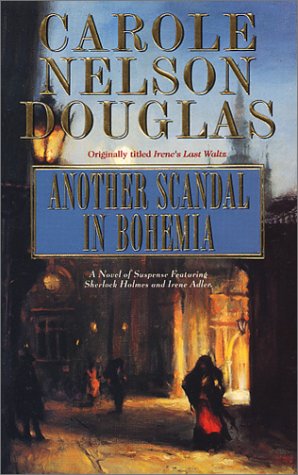
Another Scandal in Bohemia (aka Irene's Last Waltz). Carole Nelson Douglas

Originally titled Irene's Last Waltz, Another Scandal in Bohemia is the 4th in a series of historic mysteries based on a character from Sir Arthur Conan Doyle's Sherlock Holmes story, A Scandal In Bohemia. Carole Nelson Douglas takes this character, Irene Adler, the only woman to catch Holmes' romantic interests, and has her go on to pursue her own career as an investigating detective. With Penelope Huxley, a country parson's daughter, as her Dr. Watson to write down her exploits, Adler has married and lives in Paris.

In this novel Irene returns to Prague to once again help the Bohemian royal family with a vexing problem - the king has not consumated his marriage of 9 months. Also the legendary Golum is once again walking the streets of this ancient city. Along the way she becomes involved with the historic and literary personages of Charles Frederick Worth (the founder of Haute Couture), Sherlock Holmes, and Baron Alphonse de Rothschild (international financier).

Carole Nelson Douglas fills this series with wonderful historic detail - especially about the wardrobes of Irene and Penelope. She also livesn up the narrative by opposing the personalities her two main characters, the flamboyant and independent Irene and the fastidious and proper Penelope.

In this book she looks at the working conditions of young women in Paris and the position of Jews in late 19th century Europe. A wonderful volume in the series.

The Life and Times of Heidi Abramowitz. Joan Rivers

The Life and Times of Heidi Abramowitz is a humorous fictional biography of the author Joan River's loose woman alter-ego. With large print, lots of white space, and many drawings by James Sherman, this is really a quick read.

Imagine all the jokes and put downs you have ever heard about loose women. Then imagine that there are three times as many that you haven't heard because they were too bizarre or off-color. Joan Rivers has put all these and more that you could never dream up in this short biographical sketch of her quintessential loose woman Heidi Abromowitz.

Divided into twelve chapters with titles that range from Baby Bimbo to Hooker Housewife, Joan Rivers will introduce you to a wonderful collection of jokes about tramps, tarts, and teasers.

Written at the height of the sexual revolution just before the recognition of the AIDS epidemic, some of the references to penicillin-treatable STDs may seem a bit insensitive by today's standards. While there is much in this book that will be humorous to the liberated reader, there is still plenty to upset the proper reader and the politically-correct.

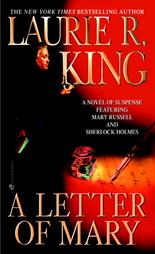
A Letter of Mary. Laurie R. King

Laurie King's A Letter of Mary is the third volume in a series of mystery novels that portray an older Sherlock Holmes who is still solving mysteries with his young bride Mary Russell Holmes. The time is 1923, and the couple lives in their country home in Sussex Downs. Mary is studying Theology at Oxford and busily involved in her research.

The couple is visited by Miss Dorothy Ruskin, an amateur archaeologist from Palestine, who has returned to England to seek funding for her work. During the visit she leaves with Russell an antique papyrus letter that appears to be written by Mary Magdalene, an apostle of Jesus. It was given to Ruskin by a Palestinian who claims the document has been in his family for ages. Soon after she leaves, she is hit by a car in London and dies. Holmes and Russell are drawn into what appears to be a murder, but have a devil of a time figuring out who did it.

What I like about this novel is the way that King creates the atmosphere of 1920's England. The old cars and trains, the buildings, the pace of life, and the people are all described in great detail. There is a lovely scene that is just filled with details about dress and manners at a party on an old estate where Mary meets and gets help from Lord Peter Whimsey, the fictional detective. Another wonderful description is of a woman witness's hair style as Mary interviews her.

However, it is a difficult stretch for me to envision Holmes falling in love with any woman, never mind a young orphan whose parents were killed in an auto accident. And although I feel that King develops and portrays a good partnership between Russell and Holmes (they call each other by their last names!), with each bringing their own strengths to their work together, I find it not believable when they close the door and are intimate together.

Also, the plot is a murder mystery but the book resembles real life more than fiction. There are lots of suspects, and trails that go cold or lead nowhere. I can't fault the author for this bit of realism, but it is an interesting approach to the mystery novel.

Overall, I liked the novel and plan to read the rest of the series. The friendship, based on mutual respect between Russell and Holmes, makes this a wonderful book, not so much as a mystery, but as a model of healthy male-female relationships.

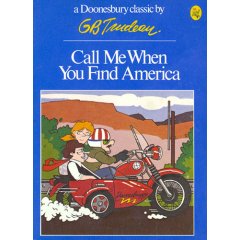
Call Me When You Find America. G. B. Trudeau

This is an early collection of Doonesbury strips from 1971-73. Mike Doonesbury, Mark Slackmeyer, Joanie Caucus, Zonker Harris, Boopsie Boopstein, B.D., and even Viet Nam Phred, join a host of other characters as they hang around their college town and face the follies of their time.

Nixon was in the White House, and US troops were still in Viet Nam. Telephones were land-based, and TVs had rabbit antennas. Mark tries his hand at being a computer operator, then quits, and goes on a tour of America with Mike in the sidecar of the motorcycle. They visit the Republican national convention, and later they campaign for McGovern. Joanie takes a job in a day-care center and tries to raise the consciousnes of the girls. B.D. even takes a trip to Viet Nam to visit his friend Phred in the last days of the war.

Lots of fun in this dated but still humorous view of life in the 1970s USA.

Tuesday, February 21, 2006


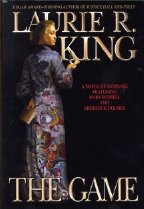
The Game. Laurie R. King

The Game is the best so far in this series that pits a young Mary Russell with a retired Sherlock Holmes. It is 1924 when the pair are asked by Holmes' brother Mycroft to go to India in search of Rudyard Kipling's fictional character Kim (Kimball O'Hara). It is one of the blessings of a fictional series that is supposedly based on recently discovered manuscripts that other fictional characters of the time can be treated as historic figures. Thus Kim jumps off the pages of Kipling's novel and into this story of intrigue in Ghandian India.

The hunt for Kim finds our heroes disguised as Moslem magicians wandering the roads north of Delhi seeking clues to his whereabouts. Eventually they end up in a Moghul kingdom in what is now Pakistan matching their wits against a strange and sinister monarch with a touch of megalomania. There are wild animal hunts, sumptuous parties, and an eclectic group of hangers-on.

King has really done her homework on this one. Her descriptions of the trip to India, the scenery, culture and people of India, and the political tensions of the time are so realistic and detailed that it feels like the author was truly there. Also the plot is well-developed and paced, keeping the excitement to the end. One just has to go into this series with the knowledge that these are Mary Russell novels, and Holmes is definitely not the major character. Anyone expecting Russell to play a later-day Watson may come away disappointed.