Friday, February 17, 2006


The Spy Who Loved Me. Ian Fleming

The Spy Who Loved Me is the 11th of thirteen James Bond novels Ian Fleming wrote before he died in 1965. It is only the second I have read. I am amazed at how little the book resembles the movie.

Fleming tells it from the point of view of the woman in the story. She is Vivienne Michel, a 23 year old Québécois Canadian, who, to get over two failed attempts at romance, has started out on an adventure to go to Florida on her Vespa. She only gets to Lake George, New York when she is offered a job at the motel she is staying at for the last 2 weeks it is open by the strange couple who manage it. They leave her to close up the last day and say the owner will come the next day to pay her and lock up for the winter. After they leave a fierce thunderstorm sets the mood for this young girl alone in a motel on a dirt road miles from the main road. She takes a couple of chapters to reminisce her sad lost loves in which we learn that she has trouble descriminating between love and physical desire, a trait the men she has met have taken advantage of.

Suddenly there is a knock on the door and two thugs who say they were sent by the owner to do inventory start threatening her. She is pretty scrappy but ineffectual in her attempts to hold them off. Things are just about to get really nasty when there is another knock at the door. Who should be looking for a room at such a time in such a storm and at such an out of the way location? Why, it's James Bond.

Her description of Bond is: "He was about six feet tall, slim and fit-looking. The eyes in the lean, slightly tanned face were a very clear gray-blue and as they observed the men they were cold and watchful. The narrowed watchful eyes gave his good looks the dangerous, almost cruel quality that had frightened me when I first set eyes on him, but now that I knew how he could smile, I thought his face only exciting, in a way that no man's face had ever excited me before."

This is probably the only time Ian Fleming tried to write from the female point of view. He appears to believe women are masochistic in their love for Bond. The author tries to soften the image by having her say Bond's "almost" cruel looks excited her. Later on she says: "All women love semi-rape. They love to be taken. It was his sweet brutality against my bruised body that had made his act of love so piercingly wonderful." Again Fleming attempts to soften her language by saying "semi"-rape and "sweet" brutality. Yet it is his cruelty, brutality and rape that turns her on.

To find out what the two thugs were sent to do and how Bond saves and beds the heroine read The Spy Who Loved Me. Only don't expect to find SPECTRE, SMURCH, "Q" or other Bondian characteristics that the movies have caricaturized him with because you will be disappointed. As a early 1960's thriller this will please, but a 007 blockbuster it is not.

Mr. Peabody's Apples. Madonna

Mr. Peabody's Apples is the second of five children's books written by Madonna. The story is a retelling of a 300 year old classic from the Jewish tradition of Ukraine. Set in a small American town in the 1950s, it uses a misunderstanding and rumor to show the importance of a person's good name and the ease with which it can carelessly be destroyed.

Mr. Peabody is a school teacher who is also the coach of the local little league team. One day a boy sees him take an apple from the green grocer without paying. How does the child react when he thinks this respected member of the community is a thief? How does Mr. Peabody clear his name? This is a tale that will appeal to the young at heart regardless of age.

The book is beautifully illustrated in a Depression era style by Loren Long. Full page color illustrations alternate with pages of text that are boxed in with monochrome drawings. A sumptuous treat to the eye as well as the soul.

The Moor. Laurie R. King

In The Moor by Laurie R. King, her fourth pairing of Mary Russell and Sherlock Holmes, the author has the husband and wife team return to the moors made famous in Arthur Conan Doyle's The Hound of the Baskervilles. This time they are summoned by the eccentric scholar Sabine Baring-Gould to explore some mysterious occurrences which includes two deaths and the appearance of a ghostly coach which is accompanied by a hellish hound with one glowing eye.

Laurie King claims in her Editor's Preface that these stories were found in a trunk that was mysteriously left at her front door. Purportedly the notes of the real Mary Russell, this story is set in 1924. Each chapter is introduced with a quote from one of Baring-Gould's many works.

Russell has her hands full with the aging and sexist Baring-Gould who has a close relationship with Holmes. The problems of a woman in male society are well portrayed, and she eventually wins the respect of the elderly scholar. It is a long story that is rich in local characters and legends. By the time of this novel Holmes and Russell have settled into a comfortable relationship based on mutual respect and the main dynamics are between them and the people of the moor.

A well-written tale with lots of atmosphere that will appeal to the historic mystery buff.

Justice Hall. Laurie R. King

Justice Hall starts out far-fetched but then develops quietly and consistently into a great mystery novel. Returning from weeks spent on the wild Moors (see her book The Moor), Mary Russell and Sherlock Holmes are ready to settle down in their Sussex cottage for a rest when there is a knock at the door. It is their Bedouin buddy Ali who, with his brother Mahmoud, had served as a guide to the disguised couple during their 1919 visit to Palestine (related in O Jerusalem).

It seems that Ali and Mahmoud aren't Middle Eastern at all. Their real names are Alistair and Marsh (Maurice). And they are not just British. Due to some heavy pruning of the family tree, Marsh is now to become the Seventh Duke of Beauville and is living in Justice Hall, the family mansion, with Ali residing down the road at Old Badger Place.

Holmes and Russell are invited to visit and are drawn slowly into the mysteries of the family and its bloodline. All of the classic British estate mystery novel cliches are here: the shot gone astray during a hunt, hidden staircases, obsequious servants, dressing for dinner, ne'er-do-well relatives, endless tromps through the estate grounds, and even a costume ball. Yet they seem vibrant and appropriate rather than tired and reheated.

Since this series is based on the author's claim of being an editor to a set of notebooks purportedly left by the mysterious Mary Russell, the reader expects these stories to be grounded in historic fact. Yet there seems to be no real Duke of Beauville, no Justice Hall, not even the local towns seem to exist in any online search. This is such a change from the previous book in the series, The Moor, where Russell and Holmes visit the very real Rev. Sabine Baring-Gould during his final year on earth. Also, when it turns out that Marsh's marriage was one of convenience for his lesbian wife, I kept waiting for Marsh and Ali to "come out" - which never happened. Instead we are left with them appearing to be sexless middle-aged Peter Pans wishing to return to their life or adventure rather than growing up.

It takes a while for a plot to develop, but for those patient enough to wait, the story is wonderfully rich and satisfying.

The Taming of the Screw. Dave Barry

In 15 hilarious chapters Dave Barry takes on the DIY topics of Tools, Wood, Electricity, Plumbing, Walls, Heating and Cooling, Insulation and Weatherproofing, Masonry, Easy Projects, Impossible Projects, Household Pests, The Lawn and Garden, Car Repair, Home Redecoration, and Building Your Own House.

He defines a tool as "an object that enables you to take advantage of the laws of physics and mechanics in such a way that you can seriously injure yourself."

Barry has the following to say about wood. "Wood has been the preferred building material for thousands of years, because it is one of the few materials that will rot as well as burn."

On electricity, Barry defines alternating current as "electricity [that] goes in one direction for a while, then goes the other direction. This prevents harmful buildup in the wires."

Mr. Barry says the first step in fixing a broken pipe is to "go down to the dankest corner of the basement and locate the valve that turns off all the water in the house. This will be the valve that is covered with slime and a spiderweb containing a spider and the festering bodies of dead insects."

According to Barry, walls "keep the roof from falling down and damaging your television set."

Barry on solar energy: "The easiest way to heat your house with solar energy is to move it to Central America, which is located directly under the sun."

Barry on Masonry: "Any kind of building material that can fall on you and kill you."

Barry on cockroaches: "The only surefire way to get rid of roaches is to remove all the liquor from your house. Roaches can mate only when drunk. Can you blame them? Would you mate with a roach if you were sober?"

Finally, a DIY book for people who don't know anything about the subject and don't want to learn. You can read this book and it's totally frivolous Index without learning anything about home repairs. You will have a good laugh and never be tempted to do any home projects. So relax and enjoy the outlandish humor of Dave Barry safe in the knowledge that this book has no socially redeeming value.

The Kommandant's Mistress. Sherri Szeman

The Kommandant's Mistress is not a novel for everyone. The setting is an Auschwitz-like Concentration Camp, and the topic is not love, but power and survival. Yet inside this hellish environment, Sherri Szeman wonderfully depicts two people who use each other for survival and whose humanity peaks out from behind their grim roles.

The novel is divided into his story, followed by her story, ending with an obituary-like objective statement of the facts of their lives. Told in a stream of consciousness style that is freed from the constraints of time, the novel is in story fragments from disjointed periods of the characters' lives. The different pieces are hinged together with transition words, phrases, or concepts that strengthen the stream of consciousness feeling.

The author is at her best depicting the lies each person tells themselves to hide from the truth. Both her characters are poets who life has put in a place of unspeakable horror. They are drawn to each other out of survival and, by comparing their stories, the reader is shown how each has twisted the truth to live.

The book ends with an Author's Note that lists a three page bibliography of sources used in the writing. A difficult, but ultimately rewarding and original first novel that is firmly based in the historic period. Szeman succeeds in bringing both characters to life and giving them a voice.

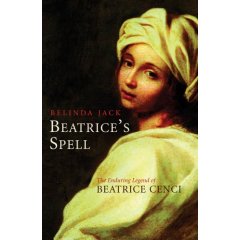
Beatrice's Spell: The Enduring Legacy of Beatrice Cenci. Belinda Jack


Not really about Beatrice Cenci, this book is a study of the sinister, and maybe fatal, fascination her story has had on a group of writers and artists.

The sad story of Beatrice Cenci is simply told. In 16th Century Rome, she was abused by her rich and powerful father. Her many appeals for justice and relief fell on the deaf ears of people afraid to intercede. Unable to escape or get help, she plots with her brother, her step mother and two servants to kill her father, end the abuse, and disguise the death as an accident. When the death is ruled a murder, they are tortured into confessions and then brutally executed for their crime. Almost 200 years later a painting by Guido Reni is found that many believe is a portrait of Beatrice painted on the eve of her death.

Her father's abuse of Beatrice is never specified, but he was a known sadist and a sodomite. In Rome, Beatrice, although convicted by the law, was popular both at the time of her death and for hundreds of years after. Reni's painting did much to extend her legend to the many foreign visitors to Rome.

But what Belinda Jack does is to look at how the story of the Cenci deeply affected the life and work of a group of authors and artists. This is a work of literary biography. The main focus is on the authors Percy Shelley, Herman Melville, and Nathaniel Hawthorne, the sculptor Harriet Hosmer, and the playright and actor Antonin Artaud.

The weakest part of this book is that Ms. Jack searches for the unspeakable in the lives of these people. What proof is there of the most secret of crimes? So while she is "grimly" engrossed in her study, all that she can truly point to is that these people "share various common traits and preoccupations."

These include a need to expose taboos, significant relationships with fathers or father figures, an interest in violence or even sadism, extreme responses to guilt, and bouts of severe depression or madness. In each case, learning the story of Beatrice Cenci exacerbates their imbalances, while compelling them to relate the story in their work.

This is a deeply disturbing book that hints at the profound impact of paternal sexual and physical abuse on people. Yet it is a book that brings to literary criticism itself an exposure of a hidden and unspoken tradition. For that reason, I feel this is an important work that will have lasting influence.

Thursday, February 16, 2006

The Adventuress. Carol Nelson Douglas.

The Adventuress is the second in a series of mystery novels based on the career of Irene Adler Norton, a character from one of the Sherlock Holmes stories by Arthur Conan Doyle. In Doyle's A Scandal In Bohemia Irene Adler outsmarts Holmes and wins his lasting admiration. Carol Nelson Douglas has taken this story as the basis for a series of delightful mystery novels that include Holmes and his companion Watson in mysteries that run parallel to the Holmes stories.

She has also created a framework for this continued series based on a current day historian Fiona Witherspoon who has supposedly discovered the diaries of Irene's companion Penelope "Nell" Huxleigh and unpublished memoirs of Holmes and Dr. Watson that she blends into the novels of the series.

This novel (which was originally published as Good Morning, Irene) takes an obscure reference in Doyle's story "The Sign of the Four" to Holmes going to France on a case involving a missing young woman as the basis for The Adventuress. Also worked into the plot is the 1889 marriage of Alice, Duchess of Richelieu to Prince Albert Grimaldi of Monaco. Anchored on these two points, Ms. Douglas spins a tale of lost treasure and a secret society of men marked with alphabetic tattoos who are drowning by jumping into rivers. The missing girl, Sarah Bernhardt, and Sherlock Holmes all help in solving the mystery of the drowning men and lost treasure.

The story is told through Nell's journals and her prudish country parson's daughter point of view. She is great at describing the details of Irene's lovely wardrobe and meticulously preserving the incidents of the case. A great read in a delightful series of novels. No prior knowledge of Sherlock Holmes is needed to enjoy this book.
The Last of the Just. Andre Schwarz-Bart


In 1959 The Last of the Just won the Prix Goncourt, the top literary award of France (the French Booker). A sweeping epic of a thousand years of Jewish life in Europe, the novel traces the fortunes and tragedies of one family with a special heritage. A member of each generation of the family is one of the 36 just men that Jewish tradition claims feel the suffering and pain of all the living, and without whom the world could not go on. Since the Jewish word for 36 is lamed vov, these men are often called Lamed Vovniks.

This strange and singular honor was attributed to the Levy family in 1085 following an attempt by the Bishop William of Nordhouse to massacre the Jewish citizens of York. To save his people, the Rabbi Yom Tov Levy leads them to an abandoned tower where they withhold a siege of six days by the local Christians. Rather than succumb to the indiginities of their captors, the Jews decide to take their own lives. As was done in Masada a thousand years earlier, the Rabbi takes on the role of blessing and killing each of the members of his community and then taking his own life. Some of the children, including the rabbi's son Solomon, survive. When Solomon becomes a man he has a vision from God where he is told that, because of his father's noble act, beginning with him, each generation of his family will contain one of the Lamed-Vovniks.

The first 140 pages of this book presents a history of the Levy family, their lineage of Lamed-Vovniks, and their fame in the Jewish community. The last three hundred pages tells the story of Ernie Levy, who is born in the Twentieth Century, during the events leading up to and in the Holocaust.

Sweeping in scope and yet focused on the life of a single man, this book presents the joys of Jewish community life and the accomodations they make to survive being a European minority marked for extermination by the Christian majority. It presents European history from a Jewish perspective and provides a detailed background to the insanity that is the Holocaust.

The point of view is that of a family of holy men whose compassion and wisdom gives the story great depth and understanding. Sadly, the Levy Lamed-Vovniks are all male. While the women of the story are well portrayed and strong personalities, they are never the main characters so the book has a decidedly male perspective. Sometimes funny, often sad, this is a great single volume introduction to Jewish history and culture, and a novel that is a classic in Jewish literature. I recommend it highly to anyone interested in the subject.