Wednesday, February 22, 2006


Call Me When You Find America. G. B. Trudeau

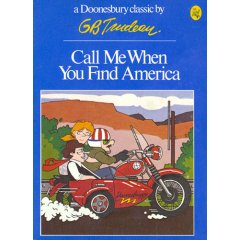
This is an early collection of Doonesbury strips from 1971-73. Mike Doonesbury, Mark Slackmeyer, Joanie Caucus, Zonker Harris, Boopsie Boopstein, B.D., and even Viet Nam Phred, join a host of other characters as they hang around their college town and face the follies of their time.

Nixon was in the White House, and US troops were still in Viet Nam. Telephones were land-based, and TVs had rabbit antennas. Mark tries his hand at being a computer operator, then quits, and goes on a tour of America with Mike in the sidecar of the motorcycle. They visit the Republican national convention, and later they campaign for McGovern. Joanie takes a job in a day-care center and tries to raise the consciousnes of the girls. B.D. even takes a trip to Viet Nam to visit his friend Phred in the last days of the war.

Lots of fun in this dated but still humorous view of life in the 1970s USA.

Tuesday, February 21, 2006


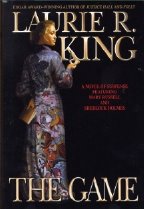
The Game. Laurie R. King

The Game is the best so far in this series that pits a young Mary Russell with a retired Sherlock Holmes. It is 1924 when the pair are asked by Holmes' brother Mycroft to go to India in search of Rudyard Kipling's fictional character Kim (Kimball O'Hara). It is one of the blessings of a fictional series that is supposedly based on recently discovered manuscripts that other fictional characters of the time can be treated as historic figures. Thus Kim jumps off the pages of Kipling's novel and into this story of intrigue in Ghandian India.

The hunt for Kim finds our heroes disguised as Moslem magicians wandering the roads north of Delhi seeking clues to his whereabouts. Eventually they end up in a Moghul kingdom in what is now Pakistan matching their wits against a strange and sinister monarch with a touch of megalomania. There are wild animal hunts, sumptuous parties, and an eclectic group of hangers-on.

King has really done her homework on this one. Her descriptions of the trip to India, the scenery, culture and people of India, and the political tensions of the time are so realistic and detailed that it feels like the author was truly there. Also the plot is well-developed and paced, keeping the excitement to the end. One just has to go into this series with the knowledge that these are Mary Russell novels, and Holmes is definitely not the major character. Anyone expecting Russell to play a later-day Watson may come away disappointed.

Leonardo to the Internet: Technology and Culture from the Renaissance to the Present. Thomas J. Misa

Leonardo to the Internet takes a broad historic look at the defining technologies of eight different eras between the 15th century and today. The author, Thomas Misa, is a professor in the Department of Humanities at the Illinois Institute of Technology in Chicago. He looks at the relationship between technology and the various cultures of these periods and shows that "technology is not only a force for but also a product of social and cultural change."

In the first chapter, "Technologies of the Court," he looks at the court engineers, including Leonardo da Vinci, the invention of perspective in painting, and the Gutenberg printing press to show how these technologies were used, not for economic gain, but to support the royal courts and city-states of the Renaissance era.

The second chapter is entitled "Techniques of Commerce" and looks at the period from 1588 to 1740 when Dutch merchants amassed fortunes using technologies like herring fishing boat factories, windmills, and fine textiles manufacture and developed an international trade second to none. They used their wealth to support fine artists and to speculate in tulip bulbs.

"Geographies of Industry" is the third chapter and it covers the period from 1740 to 1851, the time of the Industrial Revolution in England. Rather than looking at the cities normally considered the homes of industry in this period, Misa takes a close look at industry in London, using beer brewing as his focus. He then compares London to Manchester's textiles industry and Sheffield steel manufacture. He does this to create a much more complex image of the Industrial Revolution, and to show that there were many paths to industrialization in the period.

1840 to 1914 is the subject of "Instruments of Empire," the fourth chapter. Here Misa looks at how British Imperialism and the technologies of railroads, steamships, and telegraphy interacted to create a world-spanning empire.

Chapter five, "Science and Systems," covers a second industrial revolution that took place between 1870 and 1930. Here the German science-based chemical industry developed a synthetic-chemical empire based originally on fabric dyes. Also science and technological research became an integral part of industry, driving out the independent inventors of earlier times. The author also looks to America's electric lighting struggle between direct and alternating current systems. Out of these developments came modern German companies like IG Farben, BASF, Bayer, and AGFA, as well as the American firms of Westinghouse and General Electric. Misa also looks at the beginning of university industrial partnerships with the development of the MIT labs.

The first half of the 20th century is the focus of chapter six, "Materials of Modernism." Here the Italian Futurists, the German Bauhaus, and the Dutch Modernists take the modern materials of steel and glass to redefine architecture and aesthetic theories.

"The Means of Destruction," chapter seven, looks at the relationship between the military and technological innovation in the 20th century. Misa calls World War II a "war of innovation" and looks closely at the atomic programs on both sides of the war as an example of how this relationship developed. The author shows that after the war this military-technology relationship still held sway. He uses the examples of the development of solid-state electronics and digital computers to illustrate this.

In chapter 8, "Toward a Global Culture," the author shows how Globalization was the major trend in last 30 years of the 20th century. He uses the development of the international standards that made the fax machine an everyday commodity as a case study of how this happened. Then he turns his attention to the world-wide food chain McDonald's to show how culture and technology give and take together in globalization. He then ends up with a discussion of the global Internet culture, but with a nod back to the previous chapter as he shows the military influences that developed the Internet.

He ends up with a summary chapter called "The Question of Technology" where he discusses the dynamics between Science, Economics, Culture, and Change. It is here that Misa points out that the relationship between Technology and Society is a constant give and take. There is a sad note to this summation as he states that he feels the attacks of September 11, 2001 signalled an end to this era. He states that the reactions to these attacks do not fit a pattern of globalization, and goes on to say that the "vision of a peaceful world, economically integrated and culturally harmonious, knitted together by information technology, is dead." He looks forward to a new era where reformers, social movements and groups of citizens embrace technological solutions to shape a new future.

The Beekeeper's Apprentice. Laurie R. King

I was all set to dislike this mystery that matches up a retired Sherlock Holmes with a 15 year old orphan girl. However the book, told from the point of view of the young Mary Russell, is totally captivating. I have fallen in love with this odd couple team of detectives. The author, Laurie King, does a wonderful job of showing the developing relationship between these two brilliant people separated by a generation and gender, and at the same time tells a great detective story. The first in the Mary Russell series.

Getting Even. Woody Allen

Getting Even is one of three early collections of Woody Allen's short humorous articles. The others are Without Feathers and Side Effects. Many of the pieces in Getting Even appeared in magazines, mostly The New Yorker, but also Playboy and Evergreen Review. While others first appeared in this anthology. In total, there are 17 articles in the collection. As that they were written over 35 years ago, there are some references that do not come across well today. Yet as a group they are still quite funny.

"The Metterling Lists" is a piece of satirical literary criticism of The Collected Laundry Lists of Hans Metterling Vol. 1, a supposedly scholarly work of 437 pages that analyzes the first six laundry lists. Fortunately Mr. Allen only takes seven pages to mock this fictional piece of scholarship.

"A Look At Organized Crime" provides a very brief history of organized crime in America including the murder of Kid Lipsky by Albert (The Logical Positivist) Corillo who locked Lipsky in a closet and "sucked all the air out through a straw." It also provides a description of a Mafia initiation ceremony and ends with some tips on fighting mobsters.

"The Schmeed Memoirs" are represented as the recollections of Hitler's barber. Yet they can't be taken too seriously because he claims he didn't know Hitler was a Nazi, and thought he worked for the phone company. There is a funny section where Hitler fears that Churchill will grow sideburns before he can. It is humorous to view World War II from the perspective of Hitler's hair.

"My Philosophy" consists of the Critique of Pure Dread, the Eschatological Dialectics As a Means of Coping with Shingles, and The Cosmos on Five Dollars a Day. It ends with two Parables and a short list of Aphorisms.

"Yes, But Can The Steam Engine Do This?" provides a humorous take on the scientific research saga with a history of the Earl of Sandwich's research into developing the sandwich. Starting with his birth in 1718, the tale is filled with bread experiments, research into cold cuts and cheeses, and years of failures followed by his final success and lasting fame.

"Death Knocks" is a short play in which an inexperienced Angel of Death, who comes to claim Nat Ackerman's soul, is lured into a losing game of gin rummy and returns empty-handed.

"Spring Bulletin" is Woody Allen's satirical take on college course descriptions. It includes a course called Introduction to God which is described as "Confrontation with the Creator of the universe through informal lectures and field trips."

The next piece, a guide to the interpretation of Hassidic tales, includes tales like the following and Mr. Allen's interpretations of them.
A man journeyed to Chelm to seek the advice of Rabbi Ben Kaddish.
"Rabbi " the man asked, "where can I find peace?"
The Hassid surveyed him and said, "Quick, look behind you!"
The man turned around, and Rabbi Ben Kaddish smashed him in the back of the head with a candlestick. "Is that peaceful enough for you?" he chuckled.

There are six other tales and their interpretations in this piece.


"The Gossage-Varbedian Papers" tells the sad story of a chess game played at a distance via letters. The correspondence starts out with a missive from Gossage stating that one of his letters must have gotten lost in the mail since his chess board is set up differently than Verbedian's. The insults and the confusion worsen as the letters go back and forth. A must for any chess fan.

"Notes From The Overfed," Mr. Allen claims, was inspired by reading Dostoyevski and a Weight Watchers magazine on an airplane trip. In it an Atheist is converted when he decides that, if God is everywhere, He must be in food. Then consuming everything in sight, he achieves sanctity and obesity through compulsive eating.

"A Twenties Memory" mocks the name-dropping memoirs of the post-war lost generation. Filled with references to Gertrude Stein, Picasso, Earnest Hemingway, Alice B. Toklas, and many others, a non-entity tries to gain fame by the shared light of his famous contemporaries.

In "Count Dracula" the famous vampire wakes up early due to confusion caused by a solar eclipse, and visits the baker and his wife for what he thinks is an evening snack with disastrous consequences.

In "A Little Louder, Please" a true afficionato of the arts confesses his one failing - an inability to understand the gestures of mimes.

"Conversations With Helmholtz" consists of notes taken by the student of a famous elderly psychoanalyst of their conversations together. Senility has certainly gotten the better of the older man, but his reputation and fame keep the younger man from realizing this with humorous results.

"Viva Vargas" is subtitled "Excepts From The Diary of A Revolutionary," and reveals much of the same humor that the author later used in the movie Bananas.

"The Discovery And Use of The Fake Ink Blot" provides a humorous social history of a device used in practical jokes.

The last story in the volume, "Mr. Big", is my favorite. It is narrated by a Philip Marlowesque detective who is hired by a lovely woman claiming to be a Vassar student. She wants him to find a missing person, God. The mixture of Raymond Chandler's format with the existential search for the meaning of life is extremely funny even after the passage of many years.

All in all, if you like the early Woody Allen movies, you will love this book - even though some of the material is no longer as fresh.

Sunday, February 19, 2006


Kink. Dave Davies

Kink is subtitled "The Outrageous Story of My Wild Years as the Founder and Lead Guitarist of the Kinks." Dave Davies is the younger brother who spent most of his life living in the shadow of Ray Davies, the lead singer of the Kinks and writer of most of their songs. Dave started playing in a band when he was 15 and quickly became addicted to their success and the R&R lifestyle of the 60's. While there is plenty of sex, drugs and rock and roll, this memoir has much added depth. There is a poignant "there but for fortune" scene about half-way through the book where Dave meets Keith Moon in a bar for the last time before Moon dies.

What saved Dave from the fatal excesses of his peers was a strong sense of family, that even extended to his troubled relationship with Ray. They are not the Everley Brothers. Dave knows he is being abused, but he also knows that Ray loves him as much as he loves Ray. He doesn't give up on Ray even when their mom and Ray's shrink tell him that Ray will destroy him.

The other saving grace for this hard-drinking rocker is Spiritualism, a faith that grows stronger as Dave ages and sees him through his bad times. It is surprising and very touching to find such a strong belief in UFOs, psychic energy, yoga, and universal love in a person who has led such a excessive life. Yet his deep compassion, love, and faith shine through his friendships with band members, his close relationships with the women in his life, and his love of his children.

One is left with the picture of a simple working-class man who rises to a whole new level of consciousness and spirit through the medium of music. This is required reading for any Kinks fan, but is also a delightful tale of the power of hope and love that will inspire many others.

Apartheid: A Graphic Guide. Donald Woods

Written by Donald Woods, a white South African who was editor of the Daily Dispatch until he was forced into exile, Apartheid: A Graphic Guide is a great introduction to the history of Apartheid in South Africa. Woods is famous for his biography of Steve Biko which was made into the feature film Biko. While not a graphic novel, each page is illustrated with black and white drawings by Mike Bostock, mostly depictions of the major historical figures.

This book follows the complicated history of the region starting from the first contact with white Europeans. The first Dutch settlers are described, including their strange corruption of Calvinist beliefs that they used to deny the rights of the non-white population. Their transition into a separate group, Afrikaners, with a unique language and culture, is also detailed.

The conflicts with the British over diamond and gold mines, which culminate in the Boer War, are described, as well as the strange Anglo-Afrikaner white people collaboration that comes into existence after the war to suppress the non-whites of the area.

The history of black and non-white opposition to the infringements on their rights is also described. Their attempts at non-violent solutions, and the brutal massacres by the white government in response are presented.

The book is limited because, having been written 20 years ago, it doesn't portray the final ending of Apartheid and the aftermath. However, for someone trying to come to grips with how such a despicable policy existed into the late 20th century, this is a great place to start.

I found out that the British general Kitchener developed the first Concentration Camps during the Boer War to "concentrate" the Afrikaner women, children, and servants so he could burn and raze the farms that were the source of enemy supplies. Many thousands died in these camps from unsanitary conditions and overcrowding. Also, I learned that Ronald Reagan's policy of constructive engagement in the 1980's actually encouraged the white regime to continue in their doomed course of continued Apartheid. Highly recommended for anyone interested in the roots of racial discrimination.

The Seven-Per-Cent Solution. Nicholas Meyer

The Seven-Per-Cent Solution is a Sherlock Holmes novel, but not by Sir Arthur Conan Doyle. Nicholas Meyer, the author claims to be the editor of these reminiscences of Dr. John H. Watson. In his Foreward he tells how the original manuscript was found in an attic in 1970. Then in an introductory chapter Dr. Watson relates why, in his 87th year (1939), he undertook the task of writing once more of the exploits of Sherlock Holmes. He claims he was sworn to secrecy until one of the main characters of the story passed away. Thus begins a post-Doyle Holmes tale which tries to give the fictional characters of Holmes and Watson a greater claim to reality by entangling them with actual real people of their time.

The story begins with Holmes seeking out Watson, convinced that his arch-enemy Professor Moriarty is hot on his trail and out to kill him with air guns. Dr. Watson finds that Holmes cocaine habit has become worse and, instead of being in danger of attack, he is delusional from his addiction. Seeking help from Sherlock's brother Mycroft, they devise a plan to lure Holmes to Vienna and into the care of Dr. Sigmund Freud. Freud successfully uses hypnosis to break the addiction, but it takes the strange case of a catatonic woman who escaped abduction and captivity only to attempt suicide to revive Holmes's spirit.

Written with a sense of humor that will upset traditionalists, this story is a rousing, if not accurate, portrayal of Holmes that will entertain readers of post-Doyle Holmesiana. The Freud-Holmes relationship is well-portrayed as is the character of Dr. Watson. Serious Holmes scholars may find the author's portrayals of Mycroft Holmes and Professor Moriarty shocking, but I don't think this book was written with them in mind.

Later made into a movie that was nominated for two Academy Awards, this novel is an enjoyable read, but the visual effects of the movie really brought it to life. While I liked the book, I enjoyed the movie more.

Songs & Poems of Queen Salote. Edited by Elizabeth Wood-Ellem

Translated by a linguist rather than a poet, these poems tend to be more literal than poetic. Also many of the poems are very formal because they were written for stately occasions. The bilingual text is filled with a lot of details about Tongan royal family affairs and local history mostly of interest to other Tongans. Left pages are in Tongan with the English text on the right. There are lots of black and white pictures from the royal family archives that have never been published before which create an interesting image of early 20th century life on Tonga.

The actual poems and songs begin on page 148. Full of references to islands, tropical plants, ocean winds, and the surrounding seas, yet also filled with references to local places and events. The very Tongan context can frustrate off-islanders. Also the translation, while correct, is sometimes difficult to follow and filled with local terms and customs. The volume has a series of glossaries and sub-glossaries at the back that can make finding a definition difficult.

The early songs are full of either happiness at being in love, or sadness brought about by the death of her consort Tungi Mailefihi in 1941. I have chosen to select small sections of the poems that have a universal appeal to illustrate the work.

"Oh, happy is the wind
That blows wherever it pleases
While I live a prisoner
To love with its silver lock." (p. 148)

The poem Leiola starts out:

"Heart obsessed, dying of sorrow
Ever seeking the road to consolation
Groping in case there is hope
I call amid the desolation"

and ends with:

"My mind will not be consoled
Leiola mine, where can you be" (p. 173)

Sea of Death describes

"Rain falling on the mountain-top
Descends to the valley of sorrow
Flowing into the ocean
Turning into bitterness"

and the Chorus states

"Tears flowing steadily
As dew in your flower garden
Or fountain water falling on the crystals" (p. 179)

Many of her images are of the natural world reflecting her feelings:

"The moon shone like a second daylight
My heart was captured and obsessed" (p. 195)

The Lullabies don't have the intense emotional impact of the Songs, but tend to be more contemplative.

"Oh, I am weary, let us sit here a while
Rest a little and sleep" (p. 207)

"When the waves break far out at sea
My fond memories are aroused" (p. 212)

"Of all the splendour in this life
Supreme is the love between true friends" (p. 213)

The Laments are again full of sadness and loss.

"Friday dawned
And word came
The war had begun
At evening came the shock
The army of death had won
Disbanding the centre of my pitiful house" (p. 232)

"Happy is the native bird
That takes to wing and flies
While I can only breathe my longings
For magic to empower me
Oh, to be the foam on the waves" (p. 256)

A wedding song states:

"Let me attempt to climb
The tower of my joy.
The cloudless sky beholds
The grounds of Nuku'alofa [the capital city]
Its being astir and carried away
Like a flock of pigeons swiftly gliding
In the warm zone of love." (p. 295)

A lovely way to end this review is with this description of Tonga:

"The sun rises in a clear sky
And it is talked about as a treasure
Whose fortune I shall relate
Love still reigns
Enveloping beloved Tonga" (p. 310)
THATCH Featuring Politically Correct Man (I.e.: Person). Jeffrey Shesol

Jeff Shesol has been a Rhodes Scholar, the author of Mutual Contempt, a political history of the antagonism between Robert Kennedy and Lyndon Johnson, and a speech writer for President Clinton. Yet before he did all these things, while he was a student at Brown University, he was a cartoonist.

This collection of his Thatch cartoon series, published in 1991, has a Doonesbury-esque collection of college students who attend a fictional Wayland University. These include the politically correct Thatch, named for his unusual cowlick, and his roomate Tripp Biscuit, an insensitive womanizer. They are joined by Kate, the editor of the school paper, Sumner, a rich kid turned Deadhead, Woodie, who teaches Modern American Cultural History, and Reed, a misanthropic geek. Last but not least is the shallow but rich Sloane Wharton, whom Tripp covets without success.

The first President Bush and his war in Iraq are part of the background as these young people try to fit into the cultural wasteland of post-Reagan America. Maybe this book deserves a comeback. After all, there is another Bush in the White House and another war in Iraq.

The humor is timeless and the characters are well developed. An enjoyable read for anyone wanting a bit of nostalgic humor.

The Donkey Inside. Ludwig Bemelmans

Ludwig Bemelmans is most famous for his wonderfully illustrated children's book series based on the character Madeline. This is one of his non-fiction books for adults based upon his travels in South America.

Originally published in 1941, The Donkey Inside contains chapters that originally appeared in Town & Country, Vogue, Globe, and The New Yorker. Presented as a trip to Ecuador, this book is actually based on notes taken during several voyages through South America. Bemelmans says: "In a sense it is a portrait of that continent, from Chile to the Panama Canal, but it is focused on Ecuador, because there I found, in stronger outline than anywhere else, the things particular to South America." He claims that the characters in the book are by and large amalgams put together from several folks "to spare the reader the fatigue of meeting too many people."

As a tourist, Bemelmans is the outsider looking in. His depiction of the native population is of a servant class to his main characters: the rich Ecuadorians and emigrants from Europe. His focus on the rich and Europeans makes this book an interesting contrast to Ernesto Che Guevera's Motorcycle Diaries, written 10 years later by a native South American, which has a much more insightful and sympathetic view of the indigenous population. Both books are based on journals of trips along the west coast of South America.

My favorite chapter is called "Prison Visit" where Bemelmans lies his way into Pichincha Prison in Quito. He has heard such terrible stories of conditions there, but the reality is that it is the most idyllic of situations where prisoners play music, paint their cells, and earn wages for their work that pays for their keep, provides them and their families with spending money, and creates a nest-egg for their release. The warden is portrayed as concerned and respectful, and the prisoners are grateful for the solicitous care.

I found that Bemelmans is great at telling stories and describing people's behavior. Yet he relies on his illustrations to describe places and the environment, and the reader comes away with a limited view of the place. The book is illustrated with four two-page color illustrations and line drawing end papers in the distinctive Bemelmans style. One of the paintings, however, is a portrayal of Luchow's Restaurant in New York City that he dreams about when the local food gets monotinous.

This description of a classist society before World War II may not appeal to most modern readers, but the wonderful stories that Bemelemans tells and the characters that he creates are eternal. Those who choose to read this book will be rewarded with something much more than a travelogue; they will find timeless stories set in a quaint and idyllic country.

The Cenci. Percy Bysshe Shelley

Shelley's The Cenci is just one of many tellings of a true story that captures the imagination and the heart of almost everybody who hears of it. The story has been retold in many novels, even in opera.

It is the tale of the lovely and innocent Beatrice Cenci, who in late 16th century Rome was molested by a corrupt and powerful father, Count Francesco Cenci. Her father was so well-connected that there was no one, not even the Pope, to whom she could turn for protection. So, with the help of her mother and her brother, she seeks the ultimate revenge and pays the price.

Shelley's poetic drama is considered one of the best works of his short life. His treatment is more Shakespearean than poetic, but without the immortal bard's light comic touches. The Cenci is true tragedy through and through with a poetic touch that will capture the soul of the reader. I found myself reading passages aloud to myself to both hear the dramatic content and to better understand the meaning of dialogs broken into lines of poetry. This is not an easy book to read, both for its subject and its writing style, yet the reward is well worth the effort. Some of Shelley's greatest lines are in this work. Here is a brief segment from the 5th Act of Beatrice's words in contemplating her fate:

Oh, trample out that thought! Worse than Despair,
Worse than the bitterness of death, is hope;
It is the only ill which can find place
Upon the giddy, sharp and narrow hour
Tottering beneath us. Plead with the swift frost
That it should spare the eldest flower of spring;
Plead with awakening earthquake, o'er whose couch
Even now a city stands, strong, fair, and free;
Now stench and blackness yawn, like death. Oh, plead
with famine, or wind-walking Pestilence,
Blind lightning, or the deaf sea, not with man!
Cruel, cold, formal man; righteous in words,
In deeds a Cain.

The Well of Loneliness. Radclyffe Hall

The Well of Loneliness is called the first undisguised lesbian novel in the English language, which makes it required reading for a women's studies class or scholarly lesbians. Yet, though written in 1928, it is still relevant to all people interested in issues of inclusiveness and diversity. Also, with its arguments based on Christian morality, it should get serious consideration by the religious right before they condemn homosexuality.

The novel is a fictionalized biography of a lesbian born in the 1890s to a well-to-do couple on a country estate in England. They were desiring a son and name their only daughter Stephen, the name they had selected for their heir. Her mother finds it difficult to get close to this girl whose favorite game is dressing up as Admiral Nelson, but her father treats her like the son he was denied. He teaches her horseback riding, and takes her on the local fox hunts where she excels.

Yet as she reaches puberty and young adulthood, her mannish behavior and dress starts to cause her problems. But this is Victorian England and certain things are just not spoken about, so Stephan grows up ignorant of what she is and how society feels about people like her. When her father dies her protection from the prejudices of society also disappears. She is ostracised and eventually forced out of her home by her mother.

This isn't an easy book to read. With such a title, you know that it isn't going to be a lot of fun. Yet Hall wonderfully represents Stephen's life and the adversity she faces because of a situation beyond her control. She argues that "inversion" is natural because lesbians exist in nature. Since nature is God's creation, so are lesbians and all other inverts of society. She is morally strong and wants to take her inherited place in society, but is blocked by mean-spirited and close-minded people. The book would be like Pride and Prejudice if there was only one daughter and she was gay.

The social turmoil and change in society that takes place because of World War I is well portrayed by the author. Stephen becomes an ambulance driver in France, and stays on in Paris seeking a community of like-minded people. Yet even there she cannot find peace and acceptance.

This is an important book because it takes a serious look at the role of gay people in society. All the issues that face this community today are raised by Radclyffe Hall. Social and religious condemnation, internalized oppression, and even the question of gay marriage are all addressed in clear and persuasive prose. The style is a bit formal and introspective, yet this glimpse into the individual is superbly portrayed and excellently developed. I found it slow moving, but with great emotional and intellectual impact.

Casino Royale. Ian Fleming

This is the first James Bond novel written by Ian Fleming, so it provides a delightful view of the character before he became an iconic figure. While Bond is particular about getting his drink right and which car he drives, they are not the same drink and car we have come to identify with him from the movies. Also, although his boss is a mysterious character referred to as M, there are no Moneypenny or Q in sight. Without Q's inventions, Bond relies more on his wit than his toys to stay alive.

Originally published in 1953, Casino Royale takes a young Bond who is questioning, rather than convinced, of the righteousness of his tasks, and puts him in what I see as an improbable situation. Le Chiffre, a French Communist labor leader, was embezzling union funds to purchase a string of whore houses only to have them closed when they are outlawed by a new law. He needs to earn back his lost funds and decides to do it through casino gambling. Eager to discredit Le Chiffre before SMERSH hitmen can kill him, Bond's superiors send him to Monte Carlo to beat Le Chiffre at Baccarat. The game between these two is described wonderfully so that even someone who has never gambled can get caught up in the excitement. However, it is hard to believe that the British government would bankroll someone to defeat an enemy agent at a game of chance that wasn't fixed.

Unlike the movies, much of what is in Bond's mind is revealed in this novel. His sexism is fully-developed with thoughts like this: "These blithering women who thought they could do a man's work. Why the hell couldn't they stay at home and mind their pots and pans and stick to their frocks and gossip and leave men's work to men?" Even with an attitude like this, he manages to develop a romantic interest in his partner Vesper Lynd.

This first Bond novel is exciting and well-written. The premise seems far-fetched, but once past that it is an enjoyable introduction to the greatest spy in 20th century literature.

Saturday, February 18, 2006


A Song in His Heart. John Jay Daly

A Song in His Heart was written in 1951 before modern sensibilities on race. So there are many references to "coloreds" and Negroes. Amazingly it is the only book written about the famous composer and African-American minstrel James A. Bland. The writing is at the young adult biography level and the book is illustrated predominantly with black and white drawings. There must have been a body of research on which the book is based, but without footnotes or a bibliography it is lost to the reader seeking more information.

Reproduced at the end of the book is the sheet music for eight of Bland's better known songs:

*Carry Me Back to Old Virginny
*You Could Have Been True
*In the Evening by the Moonlight
*Dancing on de Kitchen Floor
*Gabriel's Band
*Oh! Lucinda
*Oh, Dem Golden Slippers
*The Old Fashioned Cottage

There is some controversy over who invented the 5-string banjo. Mr. Daly is one of those who attributes it to James Bland. Regardless of who is responsible for the 5-string, Bland was a composer second only to Steven Foster, and the most famous African-American performer of his day.

The Introduction was written by Harry F. Byrd Sr. Senator and Governor of Virginia. It is interesting that he was one of the most vocal proponents of racial segregation of his day.

The book glosses over the racial problems and idealizes the age of minstrelsy. There is one reference on page 50 to the prejudice Bland must have faced his whole life. It is when John Ford, the owner of Ford's Theater in Washington wants his star performer George Primrose to listen to Bland perform. Primrose doesn't want to do it because "It would just be a wasting his time and mine." He goes on to tell Ford:
"Here we are all blacked up with burnt cork to look like Negroes, but we can't have a real colored man in our show. John, these people have music in their soul. They've given us the Negro spirituals, which have become part of this country's music. In spite of this, we're not far enough advanced in our thinking to admit this by placing him in our show."

The author sums up his point of view on black minstrelsy with the following statement on page 60:

"For many years Negro minstrels were not permitted in the professional theater. The end men, Mr. Bones and Mr. Sambo, as well as the fellow members of the troupe, were white men, their faces blackened with burnt cork. But the innate sense of humor, the love of laughter, and the rhythm of the Negro people had set the pattern for the minstrel show itself, which for almost fifty years was the most popular form of entertainment in America. When Negroes were eventually admitted to the professional stage, they literally took over the entire minstrel convention. Like their white imitators, they used burnt cork and thickened lips in an attempt to imitate their plantation forefathers."

It is sad that such a talented man's life is only represented by such an outdated and simplistic biography. We may never know the true story of James Bland, but we will always have his music.

A Monstrous Regiment of Women. Laurie R. King

A Monstrous Regiment of Women is the second novel in a series that features the female detective Mary Russell. In this volume Russell, who is an Oxford theology scholar, meets Margery Childe, a natural religious mystic, who is the charismatic leader of the Temple of God in 1921 London. Drawn together by their feminist leanings, and attracted to each other by their different approaches to the spiritual, these two women become close. Yet Mary becomes even more involved when rich women start dying in suspicious ways, and their wills show they are leaving large sums to the Temple.

Mary has been a close friend to the retired Sherlock Holmes. Their meeting and early years together are described in the first volume of the series: The Beekeeper's Apprentice. He has been teaching her his skills as a detective. The Temple deaths become her first case.

There is a subplot of romance as Mary and the elderly Holmes develop a sexual attraction towards each other. How they deal with it, and how it transforms their professional and personal relationship is quite interesting.

I have been a fan of another set of feminist mystery novels that features a female detective working with Sherlock Holmes, the Irene Adler series by Carol Nelson Douglas. Both series feature a feminist and assertively brilliant American woman with a strong personal career. While Mary Russell is a biblical scholar, Irene Adler is an opera singer. While Laurie King pits a teenage girl against a retired older Holmes, Douglas lifts right out of A Scandal in Bohemia a woman of his own age that Holmes was attracted to, and weaves her novels around the existing Arthur Conan Doyle stories. Where Mary Russell is serious and Tom-boyish, Irene Adler is flamboyantly female. Yet both feel comfortable donning a male disguise in their work. Laurie King roots her novels in Mary's theological research which leaves little room for light humor. Douglas's series is much lighter with a minister's daughter playing it straight to Adler's theatrics. Mary Russell's close relationship with Holmes allows a lot more character development than does the more distant relationship between Douglas's married Adler and Holmes. Yet both series are delightful reads in their own ways.

Friday, February 17, 2006


Chronicles: Volume One. Bob Dylan

Bob Dylan's Chronicles: Volume One is a chance for Dylan's fans to hear a part of the story of his life from his own point of view. What appears to be the first volume of an autobiography consists of five chapters. The first two and the last one tell the story of Dylan's early career in New York City in 1961 and 1962. He names lots of names and provides a deep recall of details that will satisfy the interested reader.

Dylan talks about how he lived on other people's couches, listened to their records, and read their books. His description of his relationships with Dave Van Ronk and his wife, and Suze Rotolo are high points for me. Dylan's respect for John Hammond, his producer at Columbia, shines through his narrative about their meetings.

The two middle chapters describe later periods in his life and are centered around the production of two of his albums: New Morning (1970) and Oh Mercy (1989). While initially a jarring break in the continuity, these two chapters are wonderful insights into the man learning to cope with the destructive aspects of fame. He talks a lot about the songwriting process and the dynamics of the recording studio.

Dylan is more of a poet than a biographer and, while providing exciting and descriptive details, he skimps on the logical flow that most people expect from a biography. For example he tells of hearing Jack Elliott records in Minnesota but never mentions meeting him in New York. Also, in the two middle chapters he makes reference to his wife but never mentions her name even though she is a different person in each chapter. There is no index in the back of the book, which one would expect to find in a biography.

Overall readers who love Dylan's songs will find this a rewarding and revealing glimpse into his thoughts. Those looking for an autobiography may feel short-changed by the episodic nature of this work.

American Splendor: The Life and Times of Harvey Pekar. Harvey Pekar

American Splendor: The Life and Times of Harvey Pekar is the largest published collection of the comic series, containing the complete text of American Splendor and More American Splendor. With an introduction by R. Crumb, and art by Kevin Brown, Gregory Budgett, Sean Carroll, Sue Cavey, R. Crumb, Gary Drumm, Val Materick, and Gerry Shamray this is 320 pages of a classic American comic.

Pekar's work is a cerebral approach to the comic medium. Many of the panels have no dialog and only illustrate the external while the text reveals the thought stream of Pekar's mind. His ability to portray the inner workings of his thoughts, in a humorous and sympathetic manner, is the key to the success of his writings. The comic is a working class version of Seinfeld with a populist self-made intellectual as the leading character. Yet there is a Existentialist angst to this work that puts it in a class by itself.

American Psycho. Bret Easton Ellis

American Psycho is a novel about Patrick Bateman, a successful Wall Street broker in the 1980's, as seen from his own point of view. He is a 27 year old Harvard grad, independently wealthy and totally self-involved. He judges everyone by the clothes they wear, and he knows clothing better than anyone in the fashion industry. He spends his days at the gym and the tanning salon, and his nights drinking and snorting cocaine with his rich friends at the trendiest restaurants. He is racist, classist, and sexist, and lies with ease about everything.

The novel is filled with an increasing tempo of images of violence as Bateman descends into a psychological prison of his own design. You get the feeling that he is telling this story to try to break out, but towards the end he sees that it will not work. He lashes out against the poor, other races, and women in increasingly violent portayals that are difficult to read.

I was hoping that the author would come to some epiphany or solution to this escalating spiral of violence. Instead he hints that Bateman is totally psychotic and imagining the violence. Instead of a brick wall, the author just turns out the light, leaving Bateman and the reader in the dark.

Totto-Chan: the Little Girl at the Window. Tetsuko Kuroyanagi

Totto-Chan: the Little Girl at the Window is a delightful memoir by a Japanese TV personality and philanthropist on her earliest education experience at a non-traditional school in Tokyo just before and during what she calls The Pacific War.

The book's simple prose, suitable for older elementary school children, reveals lasting pedagogical attitudes of self-respect, freedom of expression, joy of discovery, and community of scholars that are timeless lessons for parents and teachers as well as students. They show the best side of a Japan that was lost forever in the war. The saccharine innocence of the narration may turn some people off and appeal to others, but it is just a thin veneer for a substantive work on the lasting values of any educational system.

Originally a Japanese bestseller, this English version by Dorothy Britton does an excellent job of translating the child-like writing into beautiful English prose. The book is told from the child's point of view in 61 brief chapters averaging just over 3 pages, and is illustrated with 19 of Chihiro Iwasaki's delightful pictures of children.

The chapters follow the author through 4 years of her life at the Tomoe Gakuen an elementary school headed by Sosaku Kobayashi. He had gone to Europe twice to study the Eurythmics method of teaching music of Jaques-Dalcroze (not to be confused with the similarly named movement theory Eurythmy of Rudolf Steiner). He started his school in six abandoned railroad cars in 1937 only to see it destroyed in the American bombing of Tokyo in 1945.

At the end of the book is a Postscript that tells the background of Tomoe Gakuen and its founder and how the author came to write the book. This is followed by an Epilogue that tells what happened later in life to some of the people in the book.

Although now over 20 years old, this is a highly-recommended title for elementary school teachers and parents of young children.