Sunday, August 03, 2014

The Executioner's Knife; or, Joan of Arc

The Executioner's Knife; or, Joan of Arc by Eugene Sue

The Executioner's Knife; or, Joan of Arc is the 15th book of Eugene Sue's 21 volume series The Mysteries of the People; or History of a Proletarian Family Across the Age. The series was created to depict the struggle between the ruling and the ruled classes in European history. One family, the descendants of a Gallic chief named Joel, represent the oppressed and the descendants of a Frankish chief Neroweg, typifies the oppressors. Down through the ages the successive struggles between oppressors and oppressed are depicted as each generation of Joel's family writes the story of their lives and adds it to the collective story gathered so far.

The Executioner's Knife is set in the early 15th Century and tells the famous story of Joan of Arc, the Maid of Orleans. Written in the mid-19th Century and translated into English in 1910, the book portrays Joan as guided by inner voices and an ancient legend to save France. The author depicts her as an inspirational figure to the downtrodden French who are caught in the conflict between an invading British army and a divided France. She herself is drawn as a heroine of the people who is betrayed by the ruling classes.

The book only tangentially fits into the series as neither Joan nor her major accusers are related to Eugene Sue's fictional families. He has one of the series' family members present at Joan's execution to tell the story of her death. One drawback for me, a modern reader in the USA, is that the author tells his French readers who each of Joan's enemies were and what they said against her. I found myself wanting to skip over pages in the last section of the book that deals with her capture, trial and execution as each person in her trial is identified by name, position and home city and quoted. As a result this book has over 100 footnotes, most to the transcript of the trial or other historic documents. Each book in the English translation series has a Preface written by the translator Daniel De Leon.

TRANSLATOR'S PREFACE. Whether one will be satisfied with nothing but a scientific diagnosis in psychology, or a less ponderous and infinitely more lyric presentation of certain mental phenomena will do for him; whether the student of history insist on strict chronology, or whether he prize at its true value the meat and coloring of history; whether a reader prefer in matters canonical the rigid presentation of dogma, or whether the tragic fruits of theocracy offer a more attractive starting point for his contemplation;—whichever the case might be, The Executioner's Knife; or, Joan of Arc will gratify his intellectual cravings on all the three heads. This, the fifteenth story of the series of Eugene Sue's matchless historic novels entitled The Mysteries of the People; or, History of a Proletarian Family Across the Ages, presents the picture of the Fifteenth Century—a historic elevation climbed up to from the hills of the era sketched in the preceding story, The Iron Trevet; or Jocelyn the Champion, and from which, in turn, the outlines become vaguely visible of the critically historic era that forms the subject of the next story, The Pocket Bible; or, Christian the Printer. As in all the stories of this stupendous series bestowed by the genius of Sue upon posterity, the leading characters are historic, the leading events are historic, and the coloring is true to history. How true to the facts are the historic revelations made by the author in this series, and how historically true are the conclusions he draws, as they rise in relief on the canvas of these novels, appears with peculiar conspicuousness in The Executioner's Knife; or, Joan of Arc, above all in this century, when the science of history has remodeled its theory, and, instead of, as in former days, basing man's acts upon impulse, has learned to plant impulse upon material facts. In the pages of this story the central figure is the charming one generally known to history as the Maid of Orleans. If ever there was in the annals of man a figure that superstitious mysticism combined with grovelling interests to annihilate, it was the figure of the pure-minded, self-sacrificing, intrepid shepherdess of Domremy. Even the genius of a Voltaire succumbed. In righteous revolt against man-degrading superstition, his satire "La Pucelle" in fact contributed, by the slur it placed upon Joan, to vindicate the very lay and prelatical interests he fought, and whose predecessors dragged her name through the ditch and had consigned her body to the flames. Harried by the political interests whom her integrity of purpose menaced and actually thwarted; insulted and put to death by the allies of these, ambushed behind religion; the successors of both elements perpetuating the wrong with false history; and even the enlightened contributing their sneers out of just repugnance for supernaturalism;—all this notwithstanding, the figure of Joan triumphed. Even the head of the prelatic political machine, which had presumed to speak in the name of the Deity with Anathema over Joan's head, has felt constrained to fall in line with the awakened popular knowledge. The Papal beatification of Joan of Arc in this century is a public retraction and apology to the heroine born from the lowly. Of the many works of art—poetic, dramatic, pictorial—that have contributed to this conspicuous "reversal of judgment" Sue's The Executioner's Knife; or, Joan of Arc has been the most powerful. The pathetic story cleanses Joan of the miraculous, uncovers the grovelling influences she had to contend against, exposes the sordid ambitions she had to overcome and that finally slaked their vengeance in her blood. The master's hand weaves together and draws, in the garb of fiction, a picture that is monumental—at once as a work of science, of history and of art. DANIEL DE LEON. Milford, Conn., October, 1909.

Saturday, July 19, 2014

Utterly Gross Jokes Volume III

Utterly Gross Jokes Volume III by Julius Alvin
This book is one in a series of collections of off-color and ethnically offensive jokes written under the name Julius Alvin, "America's favorite gross-out king." It was marketed as "These jokes are so sick... they're UTTERLY GROSS!" As such it appeals to a certain audience who will not be offended, in fact, who want to read offensive material. For that select group these jokes will please.

The others books in the series are all also written by "Julius Alvin". Here is a list compiled from WorldCat and Amazon:

Gross Gifts (1983)
Gross Limericks (1983)
Gross Jokes (1983)
Totally Gross Jokes, Volume II (1983)
Gross Jokers Box set (1983)
Utterly Gross Jokes, Volume III (1984)
Extremely Gross Jokes, Volume IV (1985)
Gross Limericks, Volume II (1985)
Doubly Gross Jokes, Volume V (1986)
Awesomely Gross Joke, Volume VI (1988)
Extremely Gross Jokes (1989)
Fresh Gross Jokes, Volume VII (1989)
Painfully Gross Jokes, Volume VIII (1989)
Agonizingly Gross Jokes, Volume IX (1990)
Excruciatingly Gross Jokes, Volume X (1990)
Astonishingly Gross Jokes (1990)
Painfully Gross Jokes, Volume VIII 2d ed. (1991)
Rude Gross Jokes, Volume XI (1991)
Totally Gross Jokes (1991)
Extremely Gross Jokes Volume IV 2nd ed (1991)
Relentlessly Gross Jokes, Volume XII (1992)
Disgustingly Gross Jokes, Volume XIV (1993)
Incredibly Gross Jokes, Volume XV (1993)
Intensely Gross Jokes (1993)
Repulsively Gross Jokes, Volume XVI (1994)
Hopelessly Gross Jokes, Volume XVII (1994)
Infinitely Gross Jokes, Volume XVIII (1994)
Terribly Gross Jokes, Volume XIX (1995)
Unspeakably Gross Jokes, Volume XX (1995)
Savagely Gross Jokes, Volume XXI (1995)
Unbearably Gross Jokes, Volume XXII (1996)
Wildly Gross Jokes, Volume XXIII (1996)
The Best Of Gross Jokes, Volume I (1996)
The Big Book Of Gross Jokes (1997)
Best Of Gross Jokes, Volume II (1997)
Insanely Gross Jokes, Volume XXV (1997)
Outrageously Gross Jokes Volume XXVI (1997)
Brutally Gross Jokes, Volume XXVI (1998)
Unbelievably Gross Jokes, Volume XXVII (1998)
Obnoxiously Gross Jokes, Volume XXVIII (1998)
The Bigger Book Of Gross Jokes (1998)
Hilariously Gross Jokes, Volume XXIX (1999)
Frightfully Gross Jokes, Volume XXX (1999)
Grossest Jokes of the Century (1999)
Fiendishly Gross Jokes, Volume XXXI (2000)
Offensively Gross Jokes, Volume XXXII (2000)
The Even Bigger Book Of Gross Jokes (2000)
Gross Baseball Jokes (2001)
Gross Football Jokes (2001)
Grossly Gross Jokes, Volume XXXIII (2001)
Twistedly Gross Jokes, Volume XXXIV (2001)
Ruthlessly Gross Jokes, Volume XXXV (2002)
A Treasury Of Gross Jokes (2003)
The New Treasury Of Gross Jokes (2004)

Lest one think these are a just the quirky output of a self-publishing eccentric, the series was published by Kensington Publishers under their Zebra Books imprint. Kensington's current website describes Zebra Books as their "flagship imprint [that] publishes nationally bestselling women's fiction, romantic suspense and bestselling historical, paranormal and contemporary romances." While no longer in print, the publisher characterized the jokes in this series as politically incorrect, raunchy jokes about ethnic groups, homosexuals, women, animals, politicians, celebrities and other unwitting targets."

The author has painstakingly collected thousands of such jokes and preserved them in print. While out of print, most are available used from Amazon resellers as $0.01 books. A valuable resource if one is studying such humor. I put the author's name in quotes because I believe it is a nom de plume for the person who holds the copyright for these books. Julius Alvin only appears on the Internet as the author of these works with no further biographical information.

Sunday, July 13, 2014

The Stone Diaries by Carol Shields

The Stone Diaries by Carol Shields
I first became interested and aware of Carol Shields' writing when I read and was enthralled with her last book Unless. Written while she was dying of breast cancer, Unless is a powerful novel that asks big questions and doesn't give easy answers. So I wanted to read Shields' earlier novel The Stone Diaries which was her most famous work, winning a Pulitzer Prize and numerous other honors.
I was not disappointed. This book is the life of a 20th century woman Daisy Goodwill Flett laid out chronologically in chapters named Birth 1905, Childhood 1916, Marriage 1927, Love 1936, Motherhood 1947, Work 1955-1964, Sorrow 1965, Ease 1977, Illness and Decline 1985, and Death. Shields brings each decade and location to life using a combination of Daisy's own perspective, that of those around her, bits of writing, and even photos. The characters are beautifully portrayed and complex, turning an ordinary life into rich reading.
I have become a fan and look forward to reading more from this talented author.

Sunday, June 22, 2014

A Stricken Field by Martha Gellhorn

A Stricken Field by Martha Gellhorn
With the signing of the 1938 Munich Agreement, Nazi Germany annexed portions of Czechoslovakia inhabited by German speakers, an area that came to be known as the Sudetenland. A Stricken Field is a novel based on a week Martha Gellhorn spent in Prague in 1938. She had gone as a reporter on an assignment to interview President Benes, but got caught up in the plight of the refugees fleeing the German occupation. No longer citizens of Czechoslovakia, they were being forced to return to German controlled territory where they feared for their lives. While trying to write an objective piece on the effects of the Munich Agreement on the economy, she is confronted all around by the terrible problems of good citizens hiding and being forced to return to the brutal oppression of the Nazis.
She never wrote that news report. Instead she wrote this novel about two refugees Rita and Peter who, for a brief period of time, have found refuge in each other's love. Gellhorn is there too as Mary, an American reporter who observes a great injustice and is powerless to help.
Gellhorn admits she never read the published book until she had to write an Afterword to this 1985 edition. In that Afterword she concludes "I am proud of it. I am glad I wrote it. Novels can't 'accomplish' anything. Novels don't decide the course of history or change it but they can show what history is like for people who have no choice except to live through it or die from it. I remembered for them."
Today as Russia casts greedy eyes on eastern Ukraine and Russian-speaking Ukrainians seek to reunite with their homeland, this novel has a strangely modern relevance. Not that Putin is a new Hitler, but it points out the indifference and powerlessness of world governments to situations like these.

Saturday, June 21, 2014

Nettie's Trip South by Ann Turner

Nettie's Trip South by Ann Turner

Nettie's Trip South is a large format children's book with pencil illustrations on every page by Ronald Himler. It is based on diary entries of the author's great-grandmother. The book tells the story of 10 year old Nettie (Henrietta) and her sister accompanying their older brother on a trip from Albany New York to Richmond Virginia in the year 1859. Nettie has never seen slavery before and relates her encounters with Virginia slaves in a letter to her friend when she returns. A simple yet profound condemnation of the South's Peculiar Institution.

Feiffer's Children by Jules Feiffer

Feiffer's Children by Jules Feiffer

Feiffer's Children was published in 1986, the year Jules Feiffer won the Pulitzer Prize for Editorial Cartooning in The Village Voice. It is a collection of his one page cartoon strips on children and parenting. Each comic strip takes up one page of and includes 6-10 frameless panels of his line-drawn black and white characters. One reviewer wrote that Feiffer writes of "the postwar Age of Anxiety in the big city." Be prepared for page after page of hilarious looks at anxious urban children and parents.
Included is his classic anti-war short graphic story Munro which was made into a film that won the Academy Award for Animated Short Film in 1961. Wikipedia described Munro as "a rebellious little boy who is accidentally drafted into the United States Army. No matter which adult he tells "I'm only four", they all fail to notice his age."
The book ends with "Movie-Child: An Afterword" which is a three page autobiographical sketch on Feiffer's growing up in a poor Jewish family in the Bronx. He talks about how his only escape from the dark, dingy and dangerous world around him was the movie house three blocks from his home. His heroes were Shirley Temple, Douglas Fairbanks, Henry Fonda, James Cagney, John Garfield, and Mickey Rooney.

Sunday, April 20, 2014

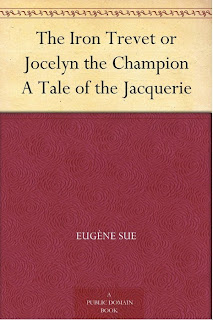
The Iron Trevet

The Iron Trevet; or, Jocelyn the Champion; A Tale of the Jacquerie by Eugene Sue

The Iron Trevet is the 13th book of Eugene Sue's 21 volume series The Mysteries of the People; or History of a Proletarian Family Across the Age. The series was created to be a European history that depicts the struggle between the ruling and the ruled classes. One family, the descendants of a Gallic chief named Joel, represent the oppressed and the descendants of a Frankish chief Neroweg, typifies the oppressors. Down through the ages the successive struggles between oppressors and oppressed are depicted as each generation of Joel's family writes the story of their lives and adds it to the collective story gathered so far.
This book is set in the year 1356, a time when feudalism is at its peak and the rights of the lords were never questioned, and their serfs had none. This period is known to us today as the Hundred Years' War, but Eugene Sue presents it from the point of view of the peasants of the countryside and the merchant class of Paris, both struggling for more rights during the unrest of the times. He tells of bravery, boldness and betrayal in a sweeping story that moves between The peasant revolt known as the Jacquerie and the intrigue in Paris between Etienne Marcel and Jean Maillart to create a limited monarchy.

TRANSLATOR'S PREFACE.
Etienne Marcel, John Maillart, William Caillet, Adam the Devil and Charles the Wicked, King of Navarre, are the five leading personages in this story. Their figures and actions, the virtues and foibles of the ones, the vices of the others, the errors of all, are drawn with strict historic accuracy, all the five being historic characters. Seeing the historic importance of the epoch in which they figured, and the types that these five men represent, the story of "The Iron Trevet; or, Jocelyn, the Champion" is more than an historic narrative, it is more than a treatise on the philosophy of history, it is a treatise on human nature, it is a compendium of lessons inestimable to whomsoever his or her good or evil genius throws into the clash of human currents, and to those who, though not themselves participants, still may wish to understand that which they are spectators of and which, some way or other, they are themselves affected by and, some way or other, are bound to either support or resist. In a way, "The Iron Trevet; or, Jocelyn the Champion" is the uniquest of the series of brilliant stories that the genius of Eugene Sue has enriched the world with under the collective title of "The Mysteries of the People" we can recall no other instance in which so much profound and practical instruction is so skillfully clad in the pleasing drapery of fiction, and one within so small a compass. To America whose youthful years deprive her of historic perspective, this little story, or rather work, can not but be of service. To that vast English-speaking world at large, now throbbing with the pulse of awakening aspirations, this translation discloses another treasure trove, long and deliberately held closed to it in the wrappage of the foreign tongue in which the original appeared. DANIEL DE LEON. New York, April 13, 1904.

Tuesday, April 15, 2014

Son of a Witch

Son of a Witch by Gregory Maguire

In Wicked Gregory Maguire retells L. Frank Baum's The Wonderful Wizard of Oz from the point of view of the Wicked Witch of the West. He restructures Oz into a complex society with limited technology and complex religious beliefs. One of the minor characters is the boy Liir who lives with her, but due to a large gap in her memory, no one knows if he is her son.
Written 10 years later, Son of a Witch picks up where Wicked leaves off and begins a series of three sequels to the original novel called The Wicked Years. I found it helpful to reread Wicked before starting this book.
The second book is a coming of age novel where Liir starts out as a child and grows to be a man, fulfilling his destiny in the strange world that Maguire created. However, with Dorothy and the Wizard gone and the witch sisters dead, it is an Oz that relies very little on Baum's writings for support. This is Maguire creating an Oz of his own.
I enjoyed this book very much and am looking forward to seeing if Maguire can continue creating compelling drama in A Lion Among Men and Out of Oz, the final two volumes of the series.

Wednesday, April 02, 2014

Cobalt Blue

Cobalt Blue by Peggy Payne

Peggy Payne's Cobalt Blue is about what happens to a down on her luck North Carolina artist when is struck one night with the grace of kundalini energy. While she struggles with the sexual and creative urges of her rising kundalini, she also has to negotiate her biggest commission ever, the official portrait of a right-wing US Senator from North Carolina whose political values are abhorrent to her. Filled with lots of local details, great North Carolina personalities, and a commanding knowledge of Kundalini Yoga, Cobalt Blue is a joyous and affirming book about our inner ability to grow and change.

Monday, March 17, 2014

Tall, Slim & Erect: Portraits of the Presidents

Tall, Slim & Erect: Portraits of the Presidents by Alex Forman

These brief biographies provide a few little known facts, normally about personal habits, love life, unusual beliefs or behaviors, hand shaking techniques, and last words. Rather than write biographic sketches, Alex Forman collected phrases from other books, and illustrated each presidential chapter with a black and white photo of that president's toy figurine from the Miniature Figures of U. S. Presidents collection of toys created by the Marx Toy Company.
This is an amusement that will be useful to someone like me who knows little about the presidents' lives.

Here are memorable lines from each brief bio:
"Nixon asked Pat Ryan to marry him the first night they went out."
"His secretary revealed that LBJ would wash and reuse Styrofoam cups."
"In 1963, JFK confided that he got a headache if he went too long without a woman."
"In 1959, Robert Woodruff, president of the CocaCola Company, scolded Eisenhower for appearing in a photograph sipping Coke from a bottle through a straw -- a sissy way to imbibe."
"Truman gave strong approval for a judicial process and said in support of the Nuremberg Trials: Never again can men say, I was following orders. And never again can men in power give such orders."
"In the fall of 1900, FDR entered Harvard and went all out to make the football team. He was turned down when he weighed in at a brittle 146 pounds. He became, instead, a cheerleader."
"Hoover's parents were poor, and he was orphaned at nine, but he amassed a fortune as a mine engineer and owner."
"A few days after Coolidge entered the White House, he wrote to Jim Lucey, a cobbler from his hometown, I want you to know, he said, that if it were not for you I should not be here and I want to tell you how much I love you." When Coolidge died in 1933 "Jim Lucey was heartbroken... He was the best friend I ever had, said the cobbler of the former president."
"Harding's wife Florence worried incessantly about Harding's grasp of events and had the cabinet report to her."
"All his life, Wilson insisted on his intensity and his strong passions. But at the age of twenty-eight he was almost certainly a virgin. His pleasures were all connected with the use of his mouth."
"Taft owned a Holstein cow, Pauline Wayne, which he let graze freely on the White House lawn. Pauline was the last cow to live at the White House."
"Roosevelt said, Our first duty, our most important work, is setting our own house in order. We must be true to ourselves, or else, in the long run, we shall be false to all others."
"McKinley had told Chicago newspaper publisher, H.H. Kohlstaat, that they were trying to force him into declaring war with Spain. As he said this, He broke down and wept as I have never seen anyone weep in my life. His whole body was shaken with convulsive sobs."
"Illness and depression caused his wife, Carrie, to imagine that Harrison was falling in love with her niece, the widow Mary Lord Dimmick. After his wife's death from tuberculosis, Harrison married his niece. He was healthy and vigorous and enjoyed again the pleasures of fatherhood."
"Charged with seduction and bastardy, Cleveland said, It is true. Tell the Truth! To the surprise and dismay of mentors and opponents alike, he remained incorruptible."
"Arthur did not like to dress himself but preferred to be dressed by boys. He kept eighty pairs of pants in his wardrobe and changed them several times a day."
"Garfield was one of the few scholarly men of the presidency. A lover of poetry and the classics, he wrote passable verse, could read and write in Latin and Greek, and used to entertain his friends by simultaneously writing Latin with one hand and Greek with the other."
"Hayes and his sister, Fanny, had affection for each other that spilled over the customary bounds of sibling devotion."
"Julia Dent Grant was by no means a beauty. As First Lady, she considered an operation to correct an eye defect, but the president liked her, he said, with her eyes crossed and would not have her different."
"Johnson did not master the basics of reading, grammar, or math until he met his wife, Eliza, at the age of seventeen. Determined that her husband should amount to something, Eliza hired a man to read to him as he worked, and she taught him writing and arithmetic at night."
"Lincoln was of Melungeon descent. Cartoonists nicknamed him, Abraham Africanus the First."
"Buchanan enjoyed a twenty-year intimate friendship with Senator William Rufus de Vane King. He referred to King as Aunt Nancy."
"In 1853, while in office, Pierce was arrested for running over an old woman with his horse. The case was dropped due to insufficient evidence."
"Fillmore was seventeen before he saw a dictionary. He was illiterate until adulthood. In 1826, he married Abigail Powers, a schoolteacher, who helped him with his education."
"Zachary Taylor had little schooling, no knowledge of law, government, or politics, and had never cast a vote in his life."
"Polk suffered from chronic diarrhea, succumbing to it three months out of office."
"Tyler is the only president to have three different First Ladies during his time in office."
"Harrison ate only cheese and milk products."
"Van Buren is the only president for whom English was not his first language. He grew up speaking Dutch."
"Jackson was called a Jackass. He liked the name and used it for a while; later it became the symbol of the Democratic Party."
"J.Q. Adams rose at five, read the bible, and took a nude swim in the Potomac." "In private,Monroe and his wife, Elizabeth, spoke only in French."
"James Madison was our smallest president, standing only 5 feet 4 inches and weighing about 100 pounds."
"Jefferson ate little animal meat. Vegetables were his principle diet."
"John Adams started smoking and chewing tobacco at age eight and continued throughout his life."
"Washington's 900-volume library was filled with all the get-rich-quick handbooks of the day."

[I have sometimes replaced a pronoun with the president's name for clarity.]

Tuesday, March 11, 2014

The Book of Dragons

The Book of Dragons by Edith Nesbit

The Book of Dragons contains eight short stories by Edith Nesbit that have a dragon or dragons as the main plot element. Originally published in 1900 for British children, modern American readers may find many of the references charming or confusing. However, Nesbit's imagination and writing skills are well represented in these children's stories. Being in the Public Domain, this and many other books by Nesbit are now freely available online through sites like Internet Archive, Amazon, Google Books, and others.
"The Book of Beasts" tells how young Lionel inherits a kingdom and find the in the palace library a magic Book of Beasts where the animals fly off the pages when viewed in daylight. All goes well until he gets to the page with a dragon.
In "Uncle James, or the Purple Stranger" Princess Mary Ann lives on a topsy turvy island and plans to marry Tom the gardener when she grows up. However when a dragon crash lands on the island, her evil Uncle James devises a plot to rid the island of the dragon and Mary Ann that Tom must find a way to stop.
"The Deliverers of Their Country" tells the story of two young siblings Effie and Harry who respond to an invasion of dragons by attempting to waken England's ancient hero St. George the Dragonslayer.
In "The Ice Dragon" George and his younger sister Jane go out in their backyard one cold wintery night to see the fireworks. In the northern sky they see something much more amazing, the Aurora Borealis, and decide to go get a closer look by going to the North Pole.
A mean-hearted king imprisons his daughter in the Lone Tower on "The Island of the Nine Whirlpools" which is guarded by a dragon, a griffin and dangerous whirlpools. Can she be saved by an observant young man with a talent for maths?
In "The Dragon Tamers" John the blacksmith is so poor that he lives with his family in the ruins of an old castle. One day he awakens the dragon that lives in the dungeon beneath the ruins.
When her parents die a young princess is imprisoned by her evil cousin so he can rule the land. Then "The Fiery Dragon" attacks the kingdom, and the princess with the help of a pig herder outsmart both the prince and the dragon to set things right.
"Kind Little Edmund" is a boy with an inquiring mind who wants to learn things no one else knows. His quest leads him deep into a dragon's lair where he must figure out how to trick the dragon to save his village.

Sunday, February 09, 2014

Helen and Desire

Helen and Desire by Alexander Trocchi
While living in Paris in the 1950s Alexander Trocchi was commissioned by Maurice Girodias, publisher of Olympia Press, to write "dirty books." Trocchi wrote Helen and Desire in one week in December 1953 and it was published under the pen name Frances Lengel. The book is the diary of Helen, daughter of a fishing boat captain in a rural village in Northwest Australia, who plans to use her natural enjoyment of sex to have adventures and travel the world. Determined to flout convention and chronicle her life, Helen writes of her loss of innocence on the eve of her 18th birthday, her use of men and their use of her, and her travels to Sydney, Singapore, India, France, and finally the deserts of North Africa. It is here that two officers of the French Foreign Legion who find Helen's journal make it public.

Saturday, February 01, 2014

Fairy Tale

Fairy Tale by Erich Segal
This is a modern fairy tale about the Kertuffel family of moonshiners who live on Poop's Peak in the Ozarks. Told by Erich Segal of Love Story fame and illustrated by Dino Kotopoulis, this is a playful look at the stereotype of simple mountain people who live off the grid and outside the system. They are so far from the normal cares of modern life that something magic might happen to them without their batting an eye. And so it does when Jake Kertuffle goes down the mountain to The Big City to buy a new car. Segal obviously enjoyed the alliteration, puns, and rhymes that fill the text and make reading this short tale a joy. This book cries out to be read aloud.

Saturday, January 25, 2014

Valley of the Dolls

Valley of the Dolls by Jacqueline Susann
Jaqueline Susann tells the story of three women in the entertainment industry in the 20 years following World War II. Each struggles in her own way with the demands of working in a field where beauty and talent are the keys to admission, but where cut-throat competition and ruthless self-promotion are the path to success. The "Dolls" of the title is a term Susann coined for the pills like Seconal and Benzedrine that are used, and then abused, to deal with the pressures of objectification in the industry and deteriorating personal relationships. While the book was shocking when first published, the sex is tame by modern standards. Yet the story has aged well and is still a fast-paced and enjoyable read today.

Monday, December 30, 2013

Tobacco Road

Tobacco Road by Erskine Caldwell
Tobacco Road is Erskine Caldwell's classic about the poverty of farmers in the American Southeast during the Depression. Jeeter Lester is a typical Georgia farmer: his grandfather owned a plantation, and his father was a sharecropper. He just wants to plant cotton as the spring is coming on, but he has no education, no food, no land, no credit, and no hope. All he has left is faith in God and an instinctual desire to farm the land as he lives for free in an abandoned shack on a deserted farm.

While Jeeter blames God, Caldwell blames Jeeter's problems on rich people who have withdrawn their financial support of the rural farmers, leaving them poor, hungry and illiterate. At the end of the book Lov says "It looks like the Lord don't care about crops being raised no more like He used to, or He would be more helpful to the poor. He could make the rich people lend out their money, and stop holding it up. I can't figure how they got hold of all the money in the country, anyhow. Looks like it ought to be spread out among everybody."

It is this callous indifference of the Southern rich to the poor people of their states that makes this book seem relevant in my mind to modern readers. Once again today we have rich people in power gutting the enlightened policies that helped raise the Depression era poor out of their squalid conditions. Will today's politicians create the conditions for a new generation of Jeeter Lesters to suffer in poverty and neglect?

Thursday, December 26, 2013

Drawings from the Gulag

Drawings from the Gulag by Danzig Baldaev
Disturbing series of drawings depicting cruelty inside the gulags of Soviet Russia drawn by a prison guard. The original Russian text is translated, and notes are added to explain or verify incidents depicted. Not for the squeamish.

Thursday, December 19, 2013

The Iron Pincers: Or, Mylio and Karvel, a Tale of the Albigensian Crusades

The Iron Pincers: Or, Mylio and Karvel, a Tale of the Albigensian Crusades by Eugene Sue

The Iron Pincers is the thirteenth volume of a nineteen volume series that Eugene Sue called The Mysteries of the People, or, History of a Proletarian Family Across the Ages. Each volume is written as if by a member of the family set down the events of their life. This volume is set in the beginning of the 13th century where Mylio is a troubadour who sings love songs to the ladies of the town while their husbands are away at the last Crusade.
In the opening scenes, Mylio is successful at both singing and wooing the ladies of the town, but when their husbands return from the Crusades they have a new mission from the priests. They are being told to take their armies south to slaughter the Albigensian non-Catholics, plunder their riches, and take their lands. When Mylio hears this he rushes south to warn his brother Karvel of the impending invasion. While they put up a good resistance, they are greatly outnumbered as city after city falls before the Catholic army.
This was one of the most difficult of the books in this series to read. The author has always depicted the invading ruling class as greedy, cruel and amoral, but this slaughter is one of the worst in French history and he doesn't spare the details to protect the readers.

Wednesday, December 18, 2013

A Scandalous Life: The Biography of Jane Digby el Mezrab

A Scandalous Life: The Biography of Jane Digby el Mezrab by Mary S. Lovell
Mary Lovell presents the scandalous life of Jane Digby in a detailed yet respectful way. She had access to family papers, so we get the inside personal view that her letters and journals provide, not the scandals and gossip of the press. It is a fascinating life for a 19th century British woman. At 17 she marries a wealthy but unloving husband, only to leave him when she falls in love with another man. After a divorce she is abandoned by her lover who cannot marry a divorced woman. She proceeds through continental Europe making a few more attempts at finding a place to call home. Always her famous beauty and outstanding personality wins her the devotion of men she doesn't love while the men she loves cannot provide her the legitimacy of marriage. Jane finally goes to Syria and marries a desert nomad half her age, living a strange double life as a muslim wife and an English lady expat spending months at a time in desert tents, but having houses in Damascus and Homs, places known to us today from news reports of the violent civil war.

Tuesday, November 05, 2013

Woman at Point Zero

Woman at Point Zero by Nawal El Saadawi

Written in 1975 by an Egyptian doctor who was once the Minister of Health, but who lost her job and spent time in jail once she started fighting for women's rights, Woman at Point Zero is a powerful tale of the oppression of women by men and society. According to the Preface El Saadawi had lost her job in the Egyptian government and as a journal editor because of her feminist novels and was researching women in prison as a faculty member of Ain Shams University when she met Firdaus, a female prisoner convicted of murder at Qanatir Prison. Her interviews of Firdaus eventually became the source material for the novel Woman at Point Zero.

The novel begins with a short introductory chapter told in the voice of a woman psychiatrist studying female criminals at a prison. She is told of one extraordinary woman who is to be executed for committing murder but who will not see anyone. After many attempts to see her, Firdaus finally sends for her the day before her execution.

The main body of the book is Firdaus telling the story of her life to the psychiatrist. As she tells of the many ways she has been oppressed my men and society, her voice is sparse and coldly logical . She tells of a loveless life ruled by men. All of her attempts to take control of her situation are thwarted by men and societal norms. As a last resort she kills rather than submit any longer and, for this, society will execute her.

In the final two page chapter of the book the doctor realizes that Firdaus has more courage than she will ever have.

Sunday, October 20, 2013

Canone Inverso

Canone Inverso by Paolo Maurensig

A man buys a unique violin "with a tiny anthropomorphic head carved into the top of the pegboard" at an auction in London. Soon after the instrument arrives at his hotel room, another man comes to his hotel offering to pay him twice or three times the price for it. He claims to know its terrible story, and the violin's new owner asks him to tell his tale. He says he is a writer and tells of meeting Jenő Varga as a street musician in Vienna playing for tips in a tavern. After befriending the strange musician, Jenő tells him the story of two young Central European violinists of extremely different circumstance who meet and establish a special bond at a Kafkaesque music academy in the years prior to World War II. Kuno Blau is from a aristocratic Austrian family, and Jenő is a bastard son of unknown paternity raised by a sausage-maker step-father. The one thing that holds a clue to their relationship is the unique violin that has a special meaning to each of them.

Just before their final year at the academy, Jenő falls hopelessly in love with the famous violinist Sophie Hirschbaum, and then accepts Kuno's offer to spend the summer with his family in Innsbruck. The twisted lives of Kuno's family, and a deteriorating friendship between the two boys transforms their lives and their music forever.

It is Jenő's tale that has driven this man to seek the violin, hoping to confirm some part of the fabulous story he has heard. How can the new owner of the instrument make sense of all of this, and what can he contribute to its meaning?

In addition to telling the story of a talented musician and his instrument, this book addresses the following questions. Where does the exceptional talent come from that makes a great musician? What is the relationship between musicians and the music they create. Is there a bit of madness necessary to bring music to life? At what point does there cease to be a division between the music and the musician?

Sunday, September 29, 2013

Fractured Fairy Tales


Fractured Fairy Tales by A. J. Jacobs

As part of The Rocky and Bullwinkle Show, Jay Ward produced 91 cartoons between 1953 and 1964 in a series called "Fractured Fairy Tales," humorous retellings of classic fairy tales narrated by Edward Everett Horton and written by the staff writers for the show. This book, written by A. J. Jacobs in 1997, takes 25 of those cartoons and adapts them as short fairy tales. Some references are updated for a new audience but he is fairly faithful to the scripts and does well at turning them into stories. While Jacobs' retellings are funny and faithful to the originals, they have a limited appeal now that all of the original cartoons are available on DVD or YouTube.

Sunday, September 15, 2013

The Witch of Cologne

The Witch of Cologne by Tobsha Learner

Set in the second half of the 17th Century in the city of Cologne Germany, this book tells the story of two people seeking rational truth in an age of religious superstition, political turmoil, and economic change. Ruth, the only child and daughter of the local rabbi, is a midwife trying to perfect her craft through scientific observation. She has returned from Amsterdam, the center of modern thinking, where, disguised as a young man, she studied under the great philosopher Benedict Spinoza. Detlef von Tennen, the younger brother of a local count, is the canon of the cathedral of Cologne. He has wealth, beauty and privilege, but he seeks truth and longs to study the forbidden books of the modern philosophers of Amsterdam. They are brought together when Ruth is accused of witchcraft by a sadistic monk of the Inquisition. While the monk sees black magic in her birthing skills, Detlef understands that her skill comes from the scientific method rather than a deal with the devil.
Although the book is about an impossible love between two people, it is more a historic thriller than a romance, Tobsha Learner has named the chapters after the ten Sefiroth of the Kabbalistic Tree of Life. She includes a Historic Backdrop, Glossary, List of Characters, and Bibliography of reference books used in her research to help readers not up to date on German history. Weaving together the rich cultural, philosophic and religious differences of the times into an exciting adventure that keeps the plot changes coming, I found this an adventure and a romance that touched me deeply. Yet it provided a wealth of historic detail that satisfied my desire for historical accuracy and depth.

Saturday, July 20, 2013

The Pilgrim's Shell by Eugène Sue

The Pilgrim's Shell; Or, Fergan The Quarryman, A Tale From The Feudal Times; by Eugène Sue & translated by Daniel De Leon. New York Labor News Company, 1904.

The Pilgrim's Shell is the 12th volume in a series called The Mysteries of the People; or History of a Proletarian Family Across the Ages that was written between 1849-1857. Eugène Sue created this series to be a European history that depicted the struggle between the ruling and the ruled classes. One family, the descendants of a Gallic chief named Joel, represent the oppressed and the descendants of a Frankish chief Neroweg, typify the oppressors. Down through the ages the successive struggles between oppressors and oppressed are depicted in a series of stories that culminate in the European Revolutions of 1848.

Considered classics of Marxist/Socialist thought, these books are mostly forgotten today, and the English-language editions published at the beginning of the 20th Century have only recently become available through large-scale digitization projects of Public Domain books. Daniel DeLeon, leader of the Socialist Labor Party of America and translator of this series into English, writes a Preface to each volume as an introduction.

The story of this volume is told in three parts. Part I, "The Feudal Castle" is set in the year 1094 when the Gallic descendent of Joel, Fergan the Quarryman, is a serf of the Manor of Plouernel, ruled by Neroweg VI. Serfs had no rights and were property to be disposed at the will of the lord of the manor. Most of the people of Gaul have become submissive to their ststus, but Fergan still carries the ancient fire of independence in his heart. When he learns that Neroweg has kidnapped his son, Fergan seeks to free the child by entering the castle through a secret tunnel his father built for Neroweg's father.

Part II, "The Crusade" is set in the year 1099 during the first of the European Crusades to the Middle East. Fergan and his family escape Neroweg's vengeance by leaving with the Crusade's peasant army. This section is an account of the hardships and atrocities of the Crusade as seen through Fergan's eyes, the eyes of a common working man.

In "The Commune of Laon" Part III, set in the year 1112, the disruption of war has left the Bourgeois middle class with the power to negotiate from strength with the lords and bishops. City communes have begun to replace the feudal system, at least in the cities. Fergan's son now runs a tannery, and a union of the businessmen and workers are struggling to maintain control of their newly-won independence against the attempts of the bishops and lords to destroy the Commune.

TRANSLATOR'S PREFACE.
In my introduction to "The Silver Cross; or, The Carpenter of Nazareth," I said: "Eugene Sue wrote in French a monumental work--the Mysteries of the People; or, History of a Proletarian Family. It is a 'work of fiction'; yet it is the best universal history extant. Better than any work, avowedly on history, it graphically traces the special features of the several systems of class-rule as they succeeded each other from epoch to epoch, together with the nature of the struggle between the contending classes. The 'Law,' 'Order,' 'Patriotism,' 'Religion,' etc., etc., that each successive tyrant class, despite its change of form, hysterically has sought refuge in in order to justify its criminal existence whenever threatened; the varying economic causes of the oppression of the toilers; the mistakes incurred by these in their struggles for redress; the varying fortunes of the conflict;--all these social dramas are therein reproduced in a majestic series of 'historic novels,' that cover leading and successive episodes in the history of the race."
The present story--The Pilgrim's Shell; or, Fergan the Quarryman--is one of that majestic series, among the most majestic of the set, and, with regard to the social period that it describes--its institutions, its classes, its manners, its virtues and its crimes, and the characters that it builds--the most instructive treatise on feudalism, at the very time when the bourgeois or capitalist class was struggling for a foot-hold, and beginning to break through the thick feudal incrustation above. More fully than Molière's plays, and strangely supplemental of the best passages on the subject in the novels of George Eliot, The Pilgrim's Shell; or, Fergan the Quarryman chisels the struggling bourgeois on the feudal groundwork and background, in lines so sharp and true that both the present fully developed and ruling capitalist, inheritor of the feudal attribute of plundering, is seen in the historic ancestor of his class, and his class' refuse, the modern middle class man, is foreshadowed, now also struggling like his prototype of feudal days, to keep his head above water, but, differently from his prototype, who had his future before him, now with his future behind. This double development, inestimable in the comprehension of the tactical laws that the Labor or Socialist Movement demands, stands out clear with the aid of this work.
Eugene Sue has been termed a colorist, the Titian of French literature. It does not detract from his merits, it rather adds thereto, that his brush was also photographic. The leading characters in the story--Fergan, the type of the physically and mentally clean workingman; Bezenecq the Rich, the type of the embryonic bourgeois, visionary, craven and grasping; Martin the Prudent, the type of the "conservative workingman"; the Bishop of Laon, the type of usurping power in the mantle of religion; the seigneur of Plouernel, the type of the ingrain stupidity and prejudices that characterize the class grounded on might; a dazzling procession of women--Joan the Hunchback and Azenor the Pale, Perrette the Ribald and the dame of Haut-Pourcin, Yolande and Simonne, etc.--types of the variations in the form of woman's crucifixion under social systems grounded on class rule; Walter the Pennyless, the type of dispositions too indolent to oppose the wrongs they perceive, and crafty enough to dupe both dupers and duped; Garin, the type of the master's human sleuth--are figures, clad in historic garb, that either hurry or stalk imposingly over the boards, followed by mobs of their respective classes, and presenting a picture that thrills the heart from stage to stage, and leaves upon the mind rich deposits of solid information and crystalline thought. As a novel, The Pilgrim's Shell; or, Fergan the Quarryman pleases, entertains and elevates; as an imparter of historic information and knowledge, it incites to thought and intelligent action. Whether as literature of pleasure or of study, the work deserves the broader field of the Socialist or Labor Movements of the English-speaking world, hereby afforded to it; and inversely, the Socialist or Labor Movements of the English-speaking world, entitled to the best, and none too good, that the Movements in other languages produce, can not but profit by the work, hereby rendered accessible to them.
DANIEL DE LEON.
New York, January 1, 1904.

Sunday, June 16, 2013

Girls

Girls written by Joshua Luna and illustrated by Jonathan Luna

A small town is cut off from the rest of the world by a transparent dome. The fifty six townspeople find themselves threatened by a giant glowing sperm and a horde of naked women who kill the local women and reproduce through sexual intercourse with the men. The invaders' different reaction to males and females pits the women against the men for survival. The authors have created a community much more diverse than normal, creating a microcosm of the USA to show how people react to crisis.

Originally published in 24 separate issues, there is plenty of room for character development and cliff-hanging moments. The main characters are two men, a low self esteem cashier and the town cop, and the female bartender they both love. As the naked women multiply and townspeople are brutally slain, there is lots of graphic content that is handled surprisingly well. The story provides enough detail to convey the plot while relying on gory or titillating imagery too much.

The setting seems strangely similar to Stephen King's novel Under The Dome, only he doesn't use naked alien women and a giant spermatozoa to accelerate the plot of his 1000+ page book. The similarities are enough to make me think he read Girls and saw a good plot device.

Saturday, June 15, 2013

Manon Lescaut

Manon Lescaut by Abbe Prevost

Manon Lescaut is a story of a young man, the Chevalier des Grieux, and his lover, Manon Lescaut. Set in the year 1721 and first published in 1731, this story of uninhibited love and its dire consequences was both quickly banned and widely read. The novel begins when a narrator, spending the night in a small town, who sees the townspeople gathered around two large wagons loaded with women criminals who are being banished to the colony of New Orleans. Amongst this "frail sisterhood" sits Manon "whose whole air and figure seemed so ill-suited to her present condition, that under other circumstances I should not have hesitated to pronounce her a person of high birth. Her excessive grief, and even the wretchedness of her attire, detracted so little from her surpassing beauty... " Asking one of the guards about this rare beauty, the guard points to a man who has followed them from Paris, crying all the way and says that he knows her. Asked about Manon, the despondent stranger replies that he is completely in love with her and having failed at all attempts to free her, he plans to follow her to the ends of the Earth. Seeing that the stranger has no money and is in desperate need, the narrator gives him 4 gold louis-d'ors and 2 more to the lead guard, and goes on his way.
Two years later he again sees the young man, poorly dressed and walking the street of Calais, having just returned from America. Greeting him and learning he is still destitute, the narrator offers him a room for the night at the inn where he is staying. That night the stranger, who is the Chevalier des Grieux, tells the story of his tragic three year love affair with the beautiful and charming Manon Lescaut.
Manon is poor but beautiful and the 17 year old Chevalier's love for her is instantaneous and intense. He must have her, and runs off with her to Paris in spite of the disapproval of his father and brother. Losing his savings through various circumstances, he relies on the generosity of friends and his skill at gambling to support their existence. Manon, while she professes love for the Chevalier, uses her beauty and charm to attract the generosity of other men. Instead of her loose virtue turning him away, their mutual love keeps him faithful to her. Eventually they run into trouble with the law and he follows her into exile.
Told completely from his point of view, Manon's life and motives are at best poorly understood. We see her through the filter of 300 years, a translation into another language, and the eyes of a deeply infatuated young man. It is believed that the story is in part based upon an early love affair of the author Prevost.
Manon's story and the Chevalier's love for her has inspired several operas, and, 100 years later, the novel and play Camille by Alexandre Dumas. Both Manon and Camille have been made into movies again and again. I am glad that I have read the original version of this classic love story.

Dancing Naked in the Material World

Dancing Naked in the Material World by Marilyn Suriani Futterman

Marilyn Suriani Futterman is a photographer and this is a book published in 1992 of her photographs, taken while she went "undercover" as a waitress in an Atlanta nightclub. Almost every other page contains a photograph or photographs and most of them are of women dancers in revealing costumes. Yet seldom are the pictures eroticized. They are documentary in nature. All are black-and-white and many use available light. Other were taken with on-camera flash, and still others were taken in a studio setting.
The text accompanying the pictures are the dancers own words. They talk about why they do this work and how they feel about dancing and the customers they dance for. Some are more articulate and insightful than others, but all are thoughtful and personal.
The book ends with an article, "Stripping for a Living," by Dr. Jacqueline Boles, a Sociology professor. It describes the history and setting of nude dancing in American society. All in all, this is a well-conceived and executed documentary on exotic dancers, an occupation halfway between entertainer and sex worker.
In writing this review I came across a video that was made recently of the photographer, Marilyn Suriani, talking about creating and publishing the book.

AUNT EM and UNCLE HENRY in OZ

AUNT EM and UNCLE HENRY in OZ by MARCH LAUMER


Published in 1983 Aunt Em and Uncle Henry in Oz is one of 20 books about the land of Oz published by March Laumer between 1983 and 1999. While print editions are rare (the first edition consisted of 500 numbered copies), I found the text file online at T.E.A.M.L.O.A.D.: THOROUGHLY ENTHUSIASTIC ADMIRERS OF MARCH LAUMER'S OZ ACTION DRAMAS, The Official March Laumer Online Oz Books Website and was able to read the book (sadly, without the illustrations by David Maxine) using my iPhone's Kindle app and Amazon's Send to Kindle utility.

The land of OZ and its main characters were created by American author L. Frank Baum in his first Oz book The Wonderful Wizard of Oz published in 1900. Most people know this story through the 1939 MGM movie starring Judy Garland, The Wizard of Oz. Baum's Oz books were phenomenally successful (he went on to write 13 sequels). At his death, Baum's publisher hired a young writer Ruth Plumly Thompson to continue the series. She and others after her, went on to write official Oz books for the publisher until 1963.

March Laumer takes the characters of Baum's land of Oz, and writes novels that are not necessarily for children where he speculates on what would happen to them over time. The story of this book takes place 81 years after Dorothy, Aunt Em and Uncle Henry move to Oz (told in Baum's 1910 book The Emerald City of Oz). Having adjusted to life in a fairy land where no one ages or dies, there is one small thing that still bothers Em: she lost her thimble years ago in the tornado that took Dorothy and their original Kansas home to Oz. No other thimble would ever do, and Henry has patiently listened to her complain and regret the loss of the special mother-of-pearl thimble her brother gave her.

The adventure begins when Henry suggests that Em's thimble might still be in the house that has been turned into a museum where it fell in Munchkinland. They decide to take a second honeymoon and go visit their old house to search for the thimble. Things get interesting when they get there and the remains of the wicked witch of the east, who died and turned to dust when the house fell on her, start to influence Em. Meanwhile the remains of the wicked witch of the west, melted when Dorothy poured a bucket of water on her so long ago, having settled to the bottom of the Pond of Peculiar Powers just outside the Tin Woodman's castle in Winkieland, are starting to have unexpected effects on the pond life.

Laumer's novel asks the question: since they lived in a land where people do not die or age, what happened to the two wicked witches that Dorothy destroyed. He also questions the concepts of good and evil that Baum played lightly with in his children's books, but that later writers like Gregory Maguire in his book Wicked would use effectively to bring the Oz stories to new mature audiences. Laumer appears to be a transitional author in the genre of Ozian fiction, being the first to ask the question as to whether these two sisters were truly wicked, or just misunderstood.

I found the novel confusing at first, with characters from Alexander Melentyevich Volkov's Russian novels about Magic Land mixed into Baum's Oz, but, as the story develops, it brings new maturity and wisdom to Oz. Growing up can sometimes be awkward, even for a literary genre. Laumer brings us through a transition from the official Oz series for children to something more by showing us his vision of what happens to Oz and its people in the many years since L. Frank Baum died. Nowhere near as polished as Maguire's work, but charming in its own way, I am pleased to have found Laumer's first book and look forward to reading more of this little known Ozian author.

Sunday, June 02, 2013

Flight Behavior

Flight Behavior by Barbara Kingsolver

Flight Behavior is in a new genre of fiction that is called Cli-Fi, or climate fiction (Wikipedia defines Cli-Fi as "a subgenre of science fiction that focuses on the Earth's climate, in particular emphasizing the effects of anthropogenic climate change and global warming..."). Here Barbara Kingsolver looks at the effects of climate change on a small rural community in the Appalachian mountains of Tennessee. The story is told from the point of view of a disgruntled married mother of two living with her docile, slow-witted husband and his parents on a small sheep farm. Into their lives appears a "miracle" in the form of a swarm of Monarch butterflies that come to spend the winter, instead of in their normal winter home in Mexico, in the pine forest above their house. When the news of the butterflies gets out, reporters, tourists, environmental advocates, and a team of university scientists also wind up on their hillside. But the changes that sent them the butterflies are also wrecking their livelihoods and their town.
The title relates to how we behave when we take flight from a bad situation in hopes of survival or growth.

Wednesday, May 29, 2013

Building Big

Building Big by David Macaulay

David Macaulay takes the reader on a tour of some of the really big civil engineering structures of our time. Building Big has sections on Bridges, Tunnels, Dams, Domes, and Skyscrapers. Each part of the book describes the design and construction of from four to ten outstanding examples of the structure highlighted. The examples in each category are described in chronological order with some going back to the time of ancient Rome. The drawings that accompany the text are excellent at focusing on the details and techniques described. The integration of text and graphics is wonderful. In each case, Macaulay describes the design objectives, the interplay between the structure and the environment, and the engineering solutions used to bring the structures into being. This is a wonderful book for anyone interested in structural engineering and design. I have not seen the related PBS video series, but I can say that the book stands on its own very well. Highly recommended.

Letters to Vanessa: On Love, Science and Awareness in an Enchanted World

Letters to Vanessa: On Love, Science and Awareness in an Enchanted World by Jeremy W. Hayward

Although written in the form of letters from a father to his daughter, this book is a great read for anyone interested in modern physics, neuroscience, and biology and their relationship to spirituality. If the "Dear Vanessa" is removed from the beginning of each chapter the letters take on a universal audience. By writing as if to a teenage daughter, the explanations of advanced scientific concepts and mindfulness practices become accessible to the general reader. Hayward re-enchants our world by showing how something he calls awareness-feeling-energy fills all of space. He shows how changing the way we think about the world can allow us to see the universe as alive and full of awareness. Three of the chapters in the book are what Hayward calls Interludes where he describes meditation practices derived from Buddhism that are aimed at helping the reader make the concepts described intellectually become integrated into consciousness. The bibliography is divided into chapters so the reader can pursue any concept discussed as far as desired. A great book for anyone interested in the topic.

Sunday, May 26, 2013

The 85 Ways to Tie a Tie

The 85 Ways to Tie a Tie: The Science and Aesthetics of Tie Knots by Thomas Fink & Yong Mao


THIS BOOK CHANGED MY LIFE...
Well, maybe not my WHOLE life, but it has done wonders for that minute each weekday morning when I tie my tie. Before this book the most interesting part of this ritual was picking a colorful tie to match my clothes. Then came the boring task of getting one of the two knots I knew tied correctly. Now I can chose a knot that fits my collar line and the thickness of the tie.
What this book doesn't cover is the art of the tie. Ties are the most artistic part of a man's wardrobe and yet this book ignores the design element of the fabric and focuses on the knot tied about the neck to hold the tie in place. There is an introductory section on the history of neck cloths that traces them back to an ancient Chinese emperor and discusses all the major precursors to the "long tie." Then the authors, who are both physicists, give a brief introduction to Topology and its branch, Knot Theory, and we are off to the fun. Using higher mathematics and a few basic assumptions about ties that they call "constraints" they come up with (you guessed it) 85 ways to tie a tie.
Although I have read the whole book, I have not tied all the knots so I can't vouch for this next part. They added additional "constraints" for balance and symmetry, and narrowed these 85 down to 13 that meet their demanding criteria. Even if they are right and none of the others are superb, 13 is enough to make a boring routine into an exciting choice. Still there is the thrill of the undiscovered in the 72 they rejected. One of them may be the perfect knot for that beautiful silk Indian block print tie that hasn't looked good with either of my two knots, but that I love too much to throw away. I have finally learned the names of my two original knots and learned enough about tie knots to recognize some of the more famous knots I see on others.
The book is illustrated with black-and-white photos of the famous and not-so-famous wearing various knots in their ties and has the most wonderful diagrams that make tie knots a joy to learn. A great book for any man who wears a tie on a regular basis.

A Tale for Midnight

A Tale for Midnight by Frederic Prokosch

This is a great story and the best part is that it is true. It is a novel based on historic fact, and Prokosch did a considerable amount of research to be sure he got the facts right. The story is of a famous murder in Rome that occurred in 1598. Beatrice Cenci, the young daughter of a wealthy Roman count, killed her father with the help of her brother, her stepmother and her lover. A year later they were all found guilty and executed for the crime. The story has been told many times before in history books, fiction, plays, poems, and even music. Probably the most famous version in English is Percy B. Shelley's play, The Cenci, written in 1819. Although a great play, Shelley doesn't always get the facts straight.
This is the first novel that Frederic Prokosch wrote based on historic fact and he did a lot of research to ensure the accuracy of what he wrote. Prokosch was highly regarded in his time but now, a generation later, he has been mostly forgotten. This is sad because he is a great writer with an engaging style. His descriptive prose reveals his background as a poet, yet his dialog is crisp and direct. He writes mostly about the aftermath of the murder and the events leading up to the trial, detailing the tangled web of hearsay, rumor and fact that always follows a crime of national interest.
Highly recommended for lovers of historic fiction.

The Tough Winter

The Tough Winter by Robert Lawson


In The Tough Winter, written in 1954, Robert Lawson brings us back to the setting of his Newbery Medal winning 1945 book Rabbit Hill. Set on a small hillside near Danbury Connecticut, the book tells the story of a rabbit family and their animal neighbors as they face a tough winter. The kind Folks, who live in the Big House and love and respect the animals, are going south for the winter, and all the animals are concerned about how the Caretakers, who will spend the winter in the house, will treat them. In addition, Uncle Analdas has predicted that they are in for a tough winter.
Analdas' prediction takes on increasing importance at defining events as bad things start to happen. A major ice storm starts the winter off badly, and the uncaring Caretakers arrive with a dog who threatens the animals and their homes. Yet they show a response of communal support to all hardships that prevents tragedy from overcoming them. Lawson lovingly contrasts the wisdom of the older rabbits to the exuberance of the young Little Georgie and his friend Willie the field mouse.
Written three years before the author's death at the age of 64, this book is about threats and obstacles overcome and how community and cooperation are vital to this process. Its portrayal of a tough Connecticut winter is excellently done. Beautifully illustrated with black and white drawings of rabbits, this was a book I enjoyed reading.

Saturday, May 18, 2013

Sex and Punishment: Four Thousand Years of Judging Desire

Sex and Punishment: Four Thousand Years of Judging Desire by Eric Berkowitz


Disputes over sexual behavior are not new, nor is our attempt to use the legal system to resolve differences involving sex. But Eric Berkowitz has looked at the legal disputes involving sex and has found that the behavior considered a crime and the punishments administered to those found guilty have varied quite a lot. Not only over time, and he has decided to look at a 4,000 year time period, but also between different cultures of the same time, what is considered criminal sexual behavior can vary significantly.
Eric Berkowitz is a writer and a lawyer and he takes us on a historic survey of documented sex crimes and their punishments from the Mesopotamia of 4,000 years ago up to the dawn of the 20th century. He felt to do justice to the 20th and 21st centuries in such a broad survey would require a second volume. His treatment is chronological with chapters on the Ancient World, Greece, Rome, the Middle Ages, 1500-1700, the New World, the 18th, and the 19th centuries.
His treatment is not prurient, but it is quite descriptive as legal documents often have to be, yet his writing is lively and enjoyable. While there are 20 pages of notes and a 20 page Bibliography for those who want them, the book can be easily read without referring to them. A large part of sexual abuse has to do with men of privilege and power having their way with those less fortunate than themselves, both male and female. Sometimes these wrongs against the powerless are judged and condemned by our legal systems, often they are not. While the author does not take a stance in the book, the amount of injustice presented may be upsetting to the reader.

Sunday, April 28, 2013

THE INFANT'S SKULL


THE INFANT'S SKULL: OR, THE END OF THE WORLD, A Tale of the Millennium by EUGENE SUE
Translated From The Original French By DANIEL DELEON
NEW YORK LABOR NEWS COMPANY, I904

The Infant's Skull is the 11th book of Eugene Sue's 21 volume series The Mysteries of the People; or History of a Proletarian Family Across the Age. The series was created to be a European history that depicts the struggle between the ruling and the ruled classes. One family, the descendants of a Gallic chief named Joel, represent the oppressed and the descendants of a Frankish chief Neroweg, typifies the oppressors. Down through the ages the successive struggles between oppressors and oppressed are depicted as each generation of Joel's family writes the story of their lives and adds it to the collective story gathered so far.

In this book Joel's descendant is Yvon, the son of a forester, who disguises himself as an idiot called "The Calf" to avoid being oppressed into serfdom. When the book opens in 987, Yvon lives in the castle of Louis V, the last Carolingian King of France who was called Louis the Do-Nothing. Yvon uses his wits to craft a miracle cure that gets him his father's job as forester.

There are historic topics that are touched on but not developed related regicide and the Millennial hysteria of Christians believing the world is to end. The rich give their wealth and lands to a greedy church to obtain heavenly peace. The poor stop working the land thinking the end of their misery is at hand. After orgiastic revelry sweeps the land on New Year's Eve 999, the poor wake up to just another day worse than those before, with famine sweeping the land. Yvon and his family are driven by hunger and misery to leave for Anjou, where his son is at last forced into the serfdom that Yvon spent his life avoiding.

This is the shortest book in the series, and it has great dramatic moments. Sue's moralizing was designed to make this a proletarian statement, but there is no silver lining to the dark cloud he has created. Serfdom has taken its hold on France and there is no escape for the poor.

Translator's Preface
Among the historic phenomena of what may be called "modern antiquity," there is none comparable to that which was witnessed on the first day of the year 1000, together with its second or adjourned catastrophe thirty-two years later. The end of the world, at first daily expected by the Apostles, then postponed— upon the authority of Judaic apocalyptic writings, together with the Eevelations of St. John the Divine,—to the year 1000, and then again to thirty-two years later, until it was finally adjourned sine die, was one of those beliefs, called "theologic," that have had vast and disastrous mundane effect. The Infant's Skull; or, The End of the World, figures at that period. It is one of that series of charming stories by Eugene Sue in which historic personages and events are so artistically grouped that, without the fiction losing by the otherwise solid facts, and without the solid facts suffering by the fiction, both are enhanced, and combinedly act as a flash-light upon the past — and no less so upon the future.
As with all the stories of this series by the talented Sue, The Infant's Skull; or, The End of the World, although one of the shortest, rescues invaluable historic facts from the dark and dusty recesses where only the privileged few can otherwise reach them. Thus its educational value is equal to its entertaining merit. It is a gem in the necklace of gems that the distinguished author has felicitously named The Mysteries of the People; or The History of a Proletarian Family Across the Ages.
DANIEL DE LEON. New York, April 30,1904.

Sunday, April 21, 2013

Woman, Church and State by Matilda Joslyn Gage

Woman, Church and State by Matilda Joslyn Gage

I am currently re-reading in PDF downloaded from Google Books Woman, Church and State by Matilda Joslyn Gage on a tablet computer.

Matilda Joslyn Gage was raised in an Abolitionist home that was a stop on the Underground Railroad. A mother of four, she was a founding member of the National Woman Suffrage Association along with Susan B. Anthony and Elizabeth Cady Stanton. Her life's work was the struggle for the complete liberation of women. Carved on her gravestone are the words she lived by: "There is a word sweeter than Mother, Home or Heaven; that word is Liberty."

Originally published in 1893, this book is a major feminist work of the Nineteenth Century that identifies the sources of women's oppression as the church and its offspring, the state. Alarmed by the conservative religious movement of the time that tried to amend the Constitution to declare the U.S. a Christian state, Gage wrote this book to articulate her views that christianity was the oppressor of women.

In the first chapter called The Matriarchate, the author tells of the rights women had in pagan pre-christian times. She talks of the Mother-rule, that preceded Patriarchy. She then shows that christianity from its beginning has worked to undermine women's rights.

The following seven chapters outline the oppression of women in the west and its sources in first the church, and later in the state that developed its ruling principles from canon law. These chapters deal with Celibacy, Canon Law, Marquette (a term that Gage uses for jus primae noctis, the right of lords to the sexual favors of their peasant women), Witchcraft, Wives, Polygamy, and Work. These chapters are filled with examples from history as well as the contemporary 19th century. The documented examples of women's oppression at the hands of ministers of the church and the law in this section are an impressive collection that makes this book a valuable source for feminist herstory.

In the last two chapters, Gage looks at the church of her day and shows that it is still bogged down in the same dogma of women's oppression. She predicts a great revolution which will liberate women and give them equal rights with men in both religion and society. I am sure the women's movement of the 1970s with its emphasis on women's spirituality and the Equal Rights Amendment would have convinced her that she was right.

Tuesday, April 09, 2013

The Iron Arrow Head: or The Buckler Maiden, A Tale of the Northman Invasion


The Iron Arrow Head: Or, The Buckler Maiden, a Tale of the Northman Invasion, Volume 10 of The Mysteries of the People, by Eugene Sue

The Iron Arrow-Head by Eugene Sue is the 10th volume of a history of France in novel form. The series tells the story of two groups: the original Gauls and the conquering Franks who invade from the northern lands of Germany and become a ruling class.
The setting of this volume is the year 911 in the city of Paris. France is controlled by Frankish lords and Catholic bishops, while the native Gauls are conquered people in their own land. Count Rothbert rules Paris, but fears invasion from Norse vikings who plunder in fleets of swift ships. He can control the Gallic people with his own troops, but fears they will join the vikings rather than fight them off.
The viking invaders, sensing that the Frankish rulers are divided and weak, have started making land claims as well as taking plunder and settling in parts of France. In The Iron Arrow Head, the viking leader Rolf (also known in history as Rollo or Robert I) attacks with over 1,000 ships and wants, in addition to plunder, the land now known as Normandy, and to wed Ghisele, the daughter of the French King, Charles the Simple. What makes this interesting to the modern reader is that Rollo's descendants were the Dukes of Normandy, and following the Norman conquest of England in 1066, kings of England.
TRANSLATOR'S PREFACE
The invasion of the Normans, or Northmen, or Norsemen—called throughout this brilliant story the Northmans—bears characteristics that distinguish it markedly from all the other European invasions. With all the others the migrations were brought on by home changes of soil and waterways that drove the invaders westward. War was only a means, the goal was bread. With the Northman invasion it was otherwise. The goal was war and adventure. This simple circumstance places a wholly different stamp upon the Northman invaders. It explains the impulse they gave to oratory, poetry, music and the fine arts. Their rush from the frozen north through Europe—conquering and transforming England; carving for themselves large domains out of the French territory, then held in the imbecile hands of the imbecile successors of Charlemagne; startling the populations of southern Italy and Sicily—acted like a leaven through all the territories that they traversed. And they traversed none without raising its tone with their poetic-barbarian spirit.
This story, the tenth of the Eugene Sue series "The Mysteries of the People; or, History of a Proletarian Family Across the Ages," is a matchless sketch of the Northman. It reproduces his uncouthness illumined with his brilliant latent qualities. The characteristics of the Northman invader have for their setting the physical and intellectual dullness of the Frankish conquerors of Gaul. The clash of the two reproduces a historic picture, or a page of history, that is unique.
The fears entertained by Charlemagne and expressed in the preceding story—"The Carlovingian Coins; or, The Daughters of Charlemagne"—are verified in this. A race of bold and adventurous invaders steps upon the scene of France, shocking the ruling class, arousing the ruled, and introducing a fresh breath into the land.
The Northman invasion of France reads, even in the driest work of history, like a rollicking Norse tale. That spirit is preserved in this charming historic novel, which is as instructive as it is entertaining, and in which again a descendant of the conquered race of Joel witnesses the degradation of the second royal house of France preparatorily to the witnessing, a few generations later, by another descendant of Joel, of the downfall of that second dynasty and the rise of the third, narrated in the following story, "The Infant's Skull; or, The End of the World."
DANIEL DE LEON.
New York, July, 1908.