Thursday, May 04, 2006

Bittersweet : The Story of Sugar. Peter Macinnis

Bittersweet is a wonderfully interesting and engrossing history of a major food crop filled with interesting details concerning people and events. Although Peter Macinnis traces the story of sugar from its prehistoric origins in New Guinea through to the 20th century, he does so in a very entertaining rather than comprehensive way. As such, this is a good introduction, but will leave the reader with many questions unanswered.

The subtitle, The Story of Sugar could really have been The Story of Sugar and Slavery since, according to the author, this form of forced labor has been so integral to the success of the crop. In fact I am sure that the "Bitter" half of the title is a reference to slavery. Macinnis states that not only the institution of slavery, but also the global politics of Colonialism, has its foundation in the global production of sugar.

So as you can see, the world as we know it has to a large extent been molded by the story of sugar. Thus this book, or some other like it, is important reading for a good understanding of modern world history. Being an Australian gives the author just enough distance from the European and American sugar empires to tell the story with a balanced and somewhat objective point of view.

The book is illustrated with black-and-white maps and each chapter ends with a historic sugar recipe. There is a two page glossary of terms related to sugar production as well as a seven page bibliography of further readings. There are no footnotes to break the narrative.
This is a great introduction to the story of one of the most important cash crops in world history.

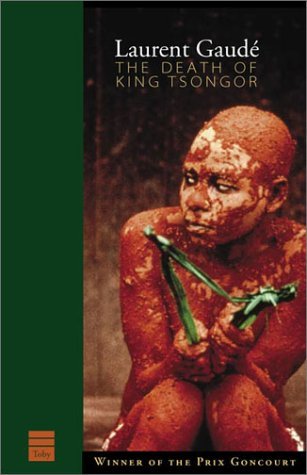
The Death of King Tsongor. Laurent Gaude

In his youth King Tsongor inherited a small kingdom from his father. Through war and courage he built a vast empire. But now Tsongor is an old man. He is about to marry his only daughter to the prince of a neighboring land. The prince, at the head of a vast army, has arrived at the city gates loaded down with presents. At this moment of supreme happiness for Tsongor and his kingdom, another suitor shows up leading a second army. He is the childhood love of the princess who has been away building his fortune and power. He has rushed back to claim her based on her long-ago promise to be his bride.

Two men, each with an army outside his gates, have been promised his daughter. Tsongor is tired of war. He stays up the whole night to decide what to do.

What does his daughter Samilia do now that she has two men to decide between? What of these men who cannot lose face before their armies? And lastly, whose side does Samilia's father and brothers take?

This is the story of Tsongor's decision and the events that follow from it. It is an epic tale filled with tragedy, told in a sparse yet hypnotic style fairy tale style.

The translation from the French is excellent. This is Gaude's first work to be translated into English. I hope we will see more.

Bungalow Nation. Diane Maddex & Alexander Vertikoff

Bungalow Nation is a truly sumptuous and detailed look at American bungalows.With color pictures on every page, this book is a wonderful balance of text and graphics. The author's text and the photographs by Alexander Vertikoff together present a well-rounded introduction to bungalow style through brief looks at over 75 specific examples of bungalow architecture.

In a chapter called "In The Land Of The Bungalow" the book starts with a brief history of the origins and growth of the architectural style and its place in American history. This chapter is followed by brief treatments of specific aspects of bungalow style: the outside, porches, the inside, fireplaces, built-ins, and furnishings.

Then the author and photographer take us to five different cities to look at examples of bungalows in each. Sample bungalows in Los Angeles, Seattle, Minneapolis-St. Paul, Chicago, and Washington DC are highlighted in two to four page spreads. Each house has a description and history of the house and some information on the current owners. This is followed by some photographs of specific features with captions describing each.

The book ends with a bibliography and lists of organizations and architects in each of the five areas highlighted.

This is a lovely book. The bugalows are beautifully photographed. The endpapers are sheet music for the song "In The Land Of the Bungalow" by George F. Devereaux. The cover has a color print of a crewel embroidery of dragonflies. It is a labor of love that is a delight to read and a treat to the eyes. If you love bungalows, this is the book for you.

I got this book because of my plans to remodel the kitchen and bath of my 1930 bungalow and was looking for ways to do so while retaining the original integrity of the house. This book has given me many good ideas.
Strangers in Paradise - Pocket Book 5. Terry Moore

This fifth volume of the Pocket Book compilation edition of the Strangers in Paradise comic books contains the original comics numbered Volume III, issues #61 - #76 plus issues #46, #49, and #73. The author plans to bring the series to an end with comic #90 so there is probably envisioned eventually a Strangers in Paradise Pocket Book 6 that will bring the series to completion.

This volume starts with a lengthy flashback to David and Darcy's youth and adventures leading up to the time where the first volume begins. This is followed by a glimpse into Katchoo's successful career as an artist in Dallas. She is seeing a psychiatrist who encourages her to keep a journal as a way to explore her buried emotions. Another sequence explores Francine's relationship with her father and her mother's past. Then the story switches over to Casey who has decided to put aside her gym training career and become a Las Vegas showgirl. David and Katchoo go to Vegas with her and rekindle their romance. Freddie has fallen for a pathologist at the Dallas morgue but has a hard time with her work. Meanwhile Francine and her doctor husband move to Dallas which causes Katchoo to long for Francine again. Just when the reader thinks that there may be some closure on this three-way romance, the author leaves our characters and ends the book with a very long digression called Molly & Poo: A Collection of Moments, a 19th century Gothic mystery romance with two women.

With nine issues of the original comics yet to be written and published, it will be over a year before we the readers ever get a chance to buy the final Volume 6 of this Pocket Book series. For the impatient, the author's website does offer a subscription to the final issues of the comic books.

Sunday, April 30, 2006

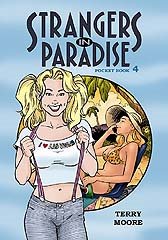
Strangers in Paradise: Pocket Book 4. Terry Moore

This volume 4 of the Strangers in Paradise Pocket Books contains the original comic books Volume II, #41-#41, #47-#48, and #50-#60. Francine has gone home to her mom in Tennessee, and David and Katchoo are living in a cottage in Hawaii. Casey breaks up with Freddie and visits them in Hawaii. Eventually, Katchoo fights with David and he goes back to Japan. There Katchoo's half-sister Tambi catches up with him. Also remnants of the old mob try to seek revenge against Katchoo, while the FBI is also closing in on her.

Not as violent as the last volume, this is a somewhat introspective volume where the characters explore their feelings for each other. Each is eager to bring closure to their pasts and to get on with their life. Yet the readers know we are only in volume 4 of a 5 volume book version of a comic series that is still being published. So the odds of "happily ever after" any time soon are very slim.

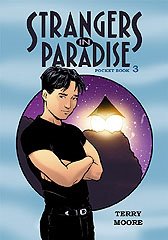
Strangers in Paradise: Pocket Book 3. Terry Moore

Volume 3 of the PocketBook edition of Strangers in Paradise contains the original comic book issues numbered Volume III issues #18-#24, #26-#32, #34-#38. In this volume, Katchoo's art career takes off with an exhibition that includes nudes of Francine. Her ex-boyfriend Freddie and his wife Casey get into a fight over these highly-desirable paintings. Also, with Darcy dead, her mob organization becomes the center of a rivalry between Veronica Pace and Tambi. Katchoo, Francine and David are caught up in this conflict as they struggle to work out their jumbled relationships. Being the middle volume of the five now released, there is lots of action but little resolution in this book. For the romantically inclined readers there is a flash forward to Katchoo and Francine together ten years on.

Thursday, April 27, 2006


Briar Rose. Robert Coover

Briar Rose is the name of the princess in Sleeping Beauty and the name of the Grimm brothers version of the story is Little Briar Rose. Robert Coover tells the story from three points of view. First is the point of view of the prince entering and cutting his way through the briars on a heroic/erotic quest. Then there is the princess dreaming of her rescue by a kiss from the spell induced by a spindle prick and the promised handsome prince who will do the kissing. Lastly, is the evil fairy who cast the spell and who keeps the princess company by telling her stories during her 100 year slumber. The story keeps switching between these three perspectives, with much repetition. Each character explores their own expectations and fears through this process.

This is a story rich in mythic and erotic symbolism, and Coover explores these in depth as each character relives the event in their mind from slightly different perspectives over and over again. As a study in the symbolism and possible overtones of the brief story, Coover's work is excellent. People looking for a romantic retelling of the original tale should definitely look elsewhere because some of the variations include disturbing elements like incest, cannibalism, adultery, and rape. While nowhere near as much an erotic fantasy as Anne Rice's three volume Beauty series, this book is still not appropriate for the faint of heart or children.

Tuesday, April 25, 2006


ISBN-13 For Dummies. Zoe Wykes

ISBN-13 For Dummies is a great introduction to a sweeping change in the numbering system for books. Starting in January 2007 all books will be issued a 13 character ISBN rather than the traditional 10 character number that has been in use for over 30 years. This short 16 page guide also talks about how the ISBN relates to EANs (International Article Numbers) that are used on non-book items for sale and the 14 digit Global Trade Identification Numbers (GTIN). It also shows you how to compute the last digit of the new 13-digit ISBNs so you can convert your existing 10-digit ISBNs to the new 13-digit ones.

Admittedly, this is primarily for the book publishing and selling crowd and their programming staff. So most of us buyers don't need to think about it. However, with desk-top publishing, more and more of us are becoming small independent publishers, and then all this will be extremely helpful. This publication even tells you where to get ISBNs for your books (no, you can't just make them up!).

Even the casual book buyer may want to know a little about the secret inner workings of the book industry and this is the answer. Best of all it is free: http://www.bisg.org/isbn-13/ISBN13%5FFor%5FDummies.pdf

Saturday, April 22, 2006


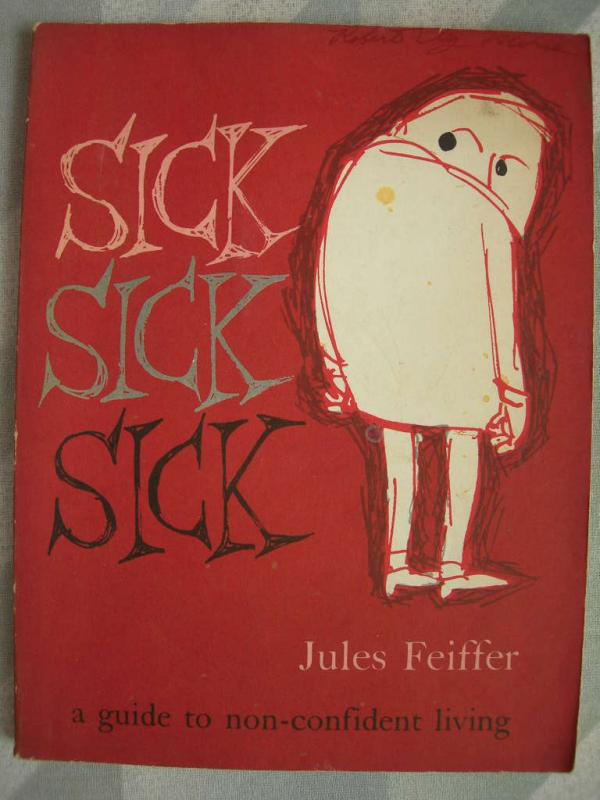
SICK SICK SICK. Jules Feiffer

Sick Sick Sick is the very first compilation of Jules Feiffer's cartoons ever published. Starting in 1956 he wrote his cartoons weekly for The Village Voice, something he continued to do until 1997. In 1958 there were enough to put them out in book form.

Subtitled" A Guide to Non-Confident Living," this collection shows the angst of Feiffer's characters in its earliest manifestations. Here you will find an 11 year old boy who feels that life has already passed him by, insecure Village artists and Bohemians, a dancer who performs her homages to Spring and Fall, corporate executives caught up in the rat race, single women who fret that men are only interested in one thing, conformists who seek individuality, and individualists who secretly desire conformity.


Most of the material still has relevance, even though there is one story about U.S. insecurity over the Soviet Sputnik that may require explaining to some readers.

Feiffer has gone on to win the Pulitzer Prize, an Oscar, and even the Milton Caniff Award for Lifetime Achievement. This book provides a chance to see how he began writing for The Voice back in the 1950s. A treat for any serious cartoon reader.

Wednesday, April 19, 2006


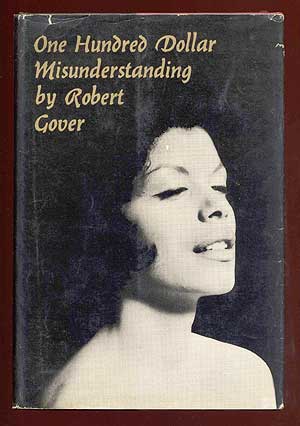
One Hundred Dollar Misunderstanding. Robert Gover

I picked up Robert Gover's One Hundred Dollar Misunderstanding to read because of the recent events in Durham, North Carolina where a black stripper, hired to perform at a Duke University lacrosse team party, has accused three white males at the party of raping her. Published 45 years ago this book has nothing to do with rape, but it does deal a lot with issues of sexuality as it relates to class and race, privilege and poverty in the southern United States.

Jim is a white college sophomore in a Southern college on a Friday night with a hundred dollars in his pocket. Kitten is a 14 year old African-American prostitute. Their paths cross as Jim visits a "Negro house of ill repute." The book proceeds with Jim and Kitten narrating alternate chapters. Each sees the other as an answer to their needs, and their encounter builds into a weekend of misunderstandings as their different backgrounds and expectations keep them from having meaningful communication. Yet, despite the insurmountable cultural chasm that separates them, their determination eventually makes small inroads possible.

This book made history at the time because of the frank discussion of sexuality and racial differences. Today, the terminology seems remarkably tame, even quaint. Yet the issues raised about sexual morality and class privilege are as relevant as ever.

Gore Vidal said: "There is always a division between what a society does and what it says it does, and what it feels about what it says it does. But nowhere is this conflict more vividly revealed than in the American middle class's attitude toward sex, that continuing pleasure and sometimes duty we have, with the genius of true pioneers, managed to tie in knots. Robert Gover unties no knots but he shows them plain and I hope this book will be read by every adolescent in the country, which is most of the population."

To truly appreciate this story it is important to remember that it is fiction. No 14 year old girls were lured into prostitution in the writing or reading of this book. Robert Gover states it as follows: "The caricatures in this story never were and aren't. If a reader happens to transmute them from typo-alphabetic symbols to figments of his imagination, they will continue to not exist, except as figments of his imagination. This also applies to the events which are this story - they didn't happen and don't. Any reader who imagines them happening I asked to please remember he is doing just that - imagining. In other words, the following is a made-up, untrue story."

As an untrue story, this book still does a great job of pointing out, through caricature, some of the seemingly timeless problems of class and privilege in American society, especially as they relate to the sexual behavior of the middle class.

Sunday, April 09, 2006


Wonder Woman. Charles Moulton

Wonder Woman is a 1978 paperback book republishing of 6 stories from the DC's Wonder Woman comics of the 1950s. While it offers a delightful glimpse into the original Golden Age comics, the paperback lacks the color graphics and full size of the originals. Five of the six stories represented in this volume were copyrighted between 1953 and 1955.

The first story, "Wonder Woman's Lasso," is dated 1942 and was written by Charles Moulton (a pseudonym for Dr. William Moulton Marston) with art by Harry G. Peter. It tells the story of how Wonder Woman won her unbreakable magic lasso with mind-controlling powers. Written prior to the 1954 Comic Book Code, it contains lots of depictions of scantily clad women in various forms of bondage. In addition to winning her lasso, Wonder Woman saves the chief of American intelligence from a Nazi plot which includes an invisible ray and a cruel baroness.


"The Bird Who Revealed Wonder Woman's Identity," the second story, is about a talkative pet mynah bird that causes some awkward moments for Diana Prince when it reveals her secret identity.

In the third story, "Wonder Woman's Wedding Day" is ruined when Prof. Uxo's time dimension transfer machine turns her into an invisible wraith. Using only the power of suggestion, she convinces the evil scientist to return her to normal.

In "The Secret Invasion," Orlusians from the planet Orbus use mind control to confuse Wonder Woman while they plan their attack of Earth. Fortunately, she is able to use brute force to combat their nefarious scheme.

The last stories in the book are origin stories for two of her fascinating weapons. In "The Talking Tiara" Wonder Woman fights a Tyranosaurus, a Roc and a giant Octopus to win the right to wear the Linguagraph Tiara which allows her to understand and speak any language past, present or future.

"The Origin of the Amazon Plane" is the final entry in this collection. When she finds the plane it is in three parts protected by a giant underwater carniverous plant, an electrified tree, and a fiery volcano. She must defeat these three obstacles to put the plane together and use it to combat evil.

Interestingly, she uses her Amazon Plane in the first story to go to Paradise Island to get her famous lasso, then in this last story she uses her lasso to overcome the volcano and retrieve the last part of her plane. So it becomes an amazing chicken and egg paradox as to which came first, unless there were two Amazon Planes. The first 1942 plane is shown with a propeller, while the plane in the last story, written in 1955, has no propeller.

These stories provide a wonderful glimpse into the origins of a 20th century icon. They also provide a contrast between pre- and post-Comic Code depictions of the same super hero. If you can live without the color graphics, this is a good introduction to Wonder Woman.

Friday, April 07, 2006


Strangers in Paradise: Pocket Book 2. Terry Moore

Katchoo and Francine are roomates, and Katchoo has a crush on Francine. Francine loves Katchoo but prefers men. David is in love with Katchoo, but she hates men. This is the love triangle that anchors this multivolume series. In volume one we learned that prior to living with Francine, Katchoo worked for David's gang boss sister, Darcy Parker, as a call girl and also was her lover. She went into hiding when she ran away from Darcy with a whole lot of Darcy's money.

Now in Volume 2 Darcy has found Katchoo and forces her back into her mob with threats on Francine's life. Darcy needs Katchoo in her biggest blackmail project to date. The main theme of the volume is how Katchoo and David, with help from Francine, escape Darcy's nefarious plans.

Terry Moore takes us through three different time periods in this book. The main story takes place in the time when Darcy's plans are foiled by Katchoo. Then Mr. Moore takes us back to when Francine and Katchoo first met in high school. It is in there that we learn about the troubles that have shaped their current inability to develop loving relationships. Then we find that the high school flashback is just a reminiscence of Francine who hasn't seen Katchoo for ten years and is a wife and mother in a loveless marriage. If she ever needed Katchoo's love, it is at this moment.

The book ends with a short fantasy piece where Francine and Katchoo role play Zena, Warrior Princess. All in all, a delightful book with lots of twists and turns to keep you wanting more.
Love: The Legacy of Cain. Leopold Von Sacher-Masoch

Love: The Legacy of Cain contains new translations of three love stories by the infamous author of Venus in Furs, whose name has come down to us primarily as the term for a variety of sexual behaviour. But do not expect to find women with whips standing over cringing men in these tales. Sacher-Masoch was a much more complex writer who was considered a new Goethe by some of his contemporaries.

This book is a very good English-language introduction to the writings of Leopold von Sacher-Masoch. Not only does it provide new translations of three of his novellas, but it also has a six page Afterword by the translator that shows how these works fit into Sacher-Masoch's body of literature and literary themes. The author was planning a series of 36 novellas to be collectively called The Legacy of Cain. It was to consist of six stories on each of six themes: Love, Property, The State, War, Work, and Death. Only the two cycles on Love and Property were finished and finding English translations of any of them besides Venus in Furs requires the resources of major university libraries. This book contains the first three novellas of the Love sextet along with the prologue to the series which is called "The Wanderer." There appears to be an awakening scholarly interest in Sacher-Masoch's writings. This is the second book of translations by Michael O'Pecko, and Virginia Lewis has also recently translated a new book of the author's Jewish stories.

"The Wanderer" is the prolog to the whole Legacy of Cain series. In it a civilized man who is out hunting comes across a holy mystic wandering in the Carpathian mountains. The holy man attacks the narrator for being a hunter, a killer. A discussion begins in which the mystic claims we are all infected with the legacy of Cain's sin. The just person can only flee the world and its enticements to avoid the six things that are Cain's legacy: Love, Property, The State, War, Work, and Death. Confronted with this "Truth" the narrator returns to his village to ponder. The prolog ends and the stories begin.

Don Juan of Kolomea tells the tale of a man who falls in love and marries. He is blissfully happy until his wife has children. Feeling neglected by her, now that she spends her time with them, he seeks out lovers. But he can never recover the feelings of true love that he first had with his wife.

The Man Who Re-Enlisted tells another story of true love led astray. This time the lovers are young and poor. They are deeply in love, but her great beauty draws the attention of a rich man. She chooses security and wealth over true love and poverty. Yet this is a small town and the two must see each other in passing as the years go on. We see the man's unending love yearning for the unattainable through the eyes of his fellow villagers.

In Moonlight, a married woman becomes bored with her life in the country and takes her husband's friend as a lover. Everything comes crashing down when her husband finds out, and she is left only a shadow of her former self, playing Beethoven's Moonlight Sonata night after night.

These stories take us into another world. This is the 19th century in the Carpathian Mountains of rural Austria-Hungary. The people who live here were called "Little Russians" because they spoke a dialect of Ukrainian. Today we know them as Rusyns or Western Ukrainians. If you are looking for the Hollywood version of love that conquers all, these are not the stories for you. But if you want to see how the impulse of love plays out against the realities of 19th century life and, despite the intensity, doesn't always have a happy ending, you will find much to enjoy here. Sacher-Masoch will take you to another time and place and fill your soul with the poignancy of his characters.

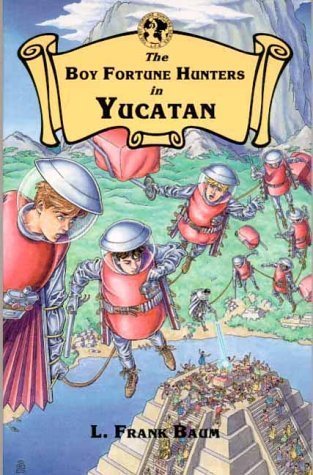
The Boy Fortune Hunters in Yucatan. L. Frank Baum

Originally published in 1910 under the pseudonym Floyd Akers, Hungry Tiger press makes this volume in The Boy Fortune Hunters Series by L. Frank Baum available again with a new Foreward by David Maxine and a new cover illustration by Eric Shanower. The author wrote various adventure series under pseudonyms, while publishing his more famous Oz novels under his own name.

In this volume the boy fortune hunters team up with a Navy Lieutenant and a Central American Indian prince to find Tcha, a hidden Atlantean city in the heart of the Yucatan jungle. Equipped with lighter-than-air flying suits and electric stun-guns, fanciful inventions of Baum's fertile imagination, the group of nine adventurers take on two native Indian tribes and the secretive Atlantean culture to garner some of their fabulous wealth of gold and rubies. They overcome mosquitoes, warrior bands, blood sacrifices, and even an earthquake on their way to their goal.

The white male chauvenism of the early 20th century is evident in the writing, but can more interesting than offensive as a period piece that illustrates the prejudices of the time. Baum's take on Atlantean culture is certainly the most intriguing part of this standard boys' adventure. David Maxine in his Foreward draws some interesting parallels between this real world fantasy and Baum's magical land of Oz. Most outstanding of these are that the Tcha people are ruled by a teenage girl and live in a communist society in peace and happiness. This is a book that will interest Baum fans like me and those interested in adventure stories of the past.

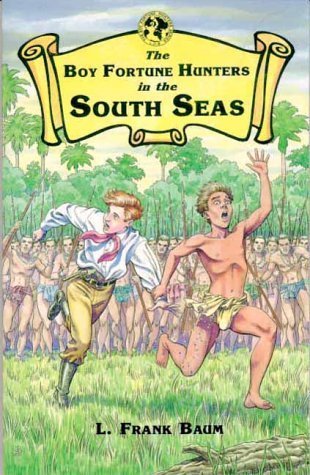
The Boy Fortune Hunters in the South Seas. L. Frank Baum

Originally published in 1911 under the pseudonym Floyd Akers, Hungry Tiger press makes this volume in The Boy Fortune Hunters Series by L. Frank Baum available again with a new Foreward by David Maxine and a new cover illustration by Eric Shanower. The author wrote various adventure series under pseudonyms, while publishing his more famous Oz novels under his own name.

In this volume the boy fortune hunters take a job running guns from Australia for wealthy Colombians who are planning a revolution. The guns come in handy when they end up run aground during a typhoon on a tropical island full of hostile natives who worship a Pearl God. They have the richest pearl beds in the world and keep them secret by killing anyone who lands there.

Fortunately the Columbians have a Louis Bleriot Antoinette biplane in crates below deck. Louis Bleriot was famous in Baum's time because in 1909 he was the first person to fly across the English Channel. Using the biplane to fly themselves in and out of trouble with the local islanders, the boys have life-threatening adventures and stuff their pockets with lovely pearls.

The book's leading characters are full of White supremacist attitudes that jar the sensibilities of modern readers. However Baum relates these with an innocence that would be difficult to recreate today. In addition to being an adventure tale for young white boys, the book provides an interesting look into how racial stereotypes were presented at the beginning of the 20th century.

Dogbert's Top Secret Management Handbook. Scott Adams

If you think you can learn management skills from a character in a newspaper comic strip, this book is not for you. On the other hand, if you read Scott Adams' Dilbert comic strip before you read the headlines of your local paper, or if you find yourself LOL at most of his cartoons, you have already committed this book to memory and don't need this review.

Dogbert's Top Secret Management Handbook is a combination of reprinted Dilbert comic strips from the first half of the 1990's and a management handbook written as if it were the work of a cartoon dog named Dogbert. The cartoons are funnier than the handbook. I gave up reading the book linearly and read the cartoons first. Then I went back and read the management handbook.

The cartoons work better because you get to see Scott Adams' view of management both from the manager's point of view and also from that of the dumbfounded workers. It is this juxtaposition of manager logic and worker reality that makes the Dilbert strips so funny.

The text of the handbook is entirely one-sided. You get to see the world from the unrelenting point of view of the demented management expert. The cruel logic is there, but you, the gentle reader, are forced into the role of Dilbert facing the twisted thinking of middle management. You may laugh on the outside, but you may be crying inside. I do not recommend reading this book before spending lots of time with your own manager.

Tuesday, April 04, 2006


Strangers in Paradise: Pocket Book 1. Terry Moore

Katchoo and Francine are roomates, and Katchoo has a crush on Francine. Francine thinks she loves Freddie who is only out to get what he can, which he can't since Francine won't sleep with him. David is in love with Katchoo, but she hates men. Thus begins Strangers in Paradise which is a tightly scripted graphic comic that is now being released in a paperpack book series.

In volume one we learn the secret of Katchoo's past, and the three main characters struggle with their feelings for each other. Having been written for comics, similar to 19th century novels of Dickens and Dumas that began life as serializations in the magazines of the time, the plot keeps coming up with surprises. In book form this comes across as lots of plot twists and surprising revelations.

The drawings are fantastically well-drawn and expressive, and they are broken up by occasional pages of poetry and text (as if the artist got tired of drawing in her rush to fill in detail and get back to the story).

Despite the strong characterization, the true hero of the book is Love, the motivator and inner spark of all the main characters. In reality the book is about the healing power of Love. The title comes from a play of the same name that Francine was in while she was in high school. The book provides a flashback to the stage when one of the actors is saying "Without Love, we're never more than Strangers in Paradise."

Monday, April 03, 2006


Onions, Onions. Toni Hormann

Onions, Onions
is a story of love conquering fear. A young married woman is afraid of evil spirits and believes that onions will keep them at bay. So she serves onions at every meal. When her husband protests and tries to make light of her fears, she starts hiding her compulsion. It is only when he leaves her that they both realize that their love is true and stronger than their obsessions. Do they live happily ever after? Well, they ARE in love.

Sunday, April 02, 2006

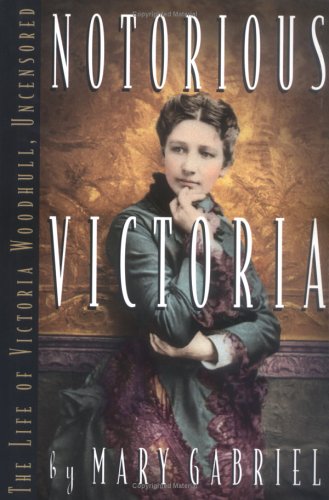
Notorious Victoria: the Life of Victoria Woodhull, Uncensored. Mary Gabriel

Victoria Woodhull was one of the boldest, most renowned, and most villified woman of the United States in the 19th century . Yet today many people have never heard of her. Also, what has been written about her has been so biased by attempts to either deify her or demonize her. Thus today's reader is well-served by this factual and chronological presentation of what can be known of the life of Victoria Woodhull. Mary Gabriel puts her background in journalism to good use in putting together this unbiased account of the woman and her times.

With chapter titles that consist of place names, months and years Ms. Gabriel takes the reader on a trip through Victoria's live from her birth in Homer, Ohio to her last days on her country estate in Glooucestershire, England. More than half the book is focused on the years 1971-1973 when Victoria, with her sister Tennie C. Claflin, rose to fame in a meteoric fashion. In this brief time they opened a brokerage house on Wall Street and published a news weekly on topics of social and political reform. In addition Victoria was the first woman to address a committee of Congress; she ran for president of the United States with Frederick Douglas as her running mate; and she presided over the women's suffrage movement, a New York chapter of the International Workingmen's Association, and the American Spiritualists Association.

Her stated goal was to rescue the women of America from sexual slavery and guarantee their rights to their own sexuality. When she found out that the famous minister Henry Ward Beecher was sleeping with members of his congregation during the week and condemning her politics from the pulpit on Sundays, she exposed his hypocricy. He was never condemned for his duplicity, but she was hounded into jail and ruin until her only recourse was to leave the country.

Mary Gabriel does a wonderful job of presenting the complex story, picking through the slanders and exagerations, and creating a readable history of this social reformer and her impact on her times. This is the best account of the life of Victoria Woodhull that I have read and I recommend it highly.

Sunday, March 19, 2006


Beatrice Cenci. Alberto Moravia

Beatrice Cenci is a play based on a true story. In 1598 20 year old Beatrice Cenci, with help from her step-mother and two servants, killed her father Frencesco while he held her prisoner in the remote castle of La Petrella, in the Abruzzi, north of Rome. The historic facts are well-presented in Charles Nicholl's 1998 London Review of Books article "Screaming in the Castle". The play focuses on the interactions of these five people leading up to and immediately following the murder. All of the scenes take place in the main room of the castle.

Francesco is of an ancient Roman family who has turned to bebauchery and immorality as a cure for his boredom. He has taken his second wife Lucrezia and his youngest daughter Beatrice to this isolated castle and keeps them isolated from everyone but two male servants: Olimpio, the manager of the castle, and Marzio, a musician. He has isolated them and amuses himself by toying with them.

Moravia is a major figure in 20th century Italian literature better known for his novels, short stories, and journalism. This play is a play of dialog with characters coming in and out of the one scene and interacting. All of the action occurs off-stage. So the dialog is essential, and the translation becomes critical. Beatrice Cenci was translated by Angus Davidson, who has translated many of Moravia's works into English.

The play opens when Beatrice is waiting with Lucrezia. She has secretly through Marzio sent a letter to her brother in Rome pleading with him to rescue her from her captivity or she will be forced to do something foolish. Marzio, however, has been forced to give the letter to Olimpio, who sees in Beatrice's desperation a chance to force himself on her as her last hope. Olimpio has in turn givent he letter to Francesco to dash Beatrice's only hope other than him for relief.

The play shows people who, desperate to seek the fulfillment of their own needs, resort to subterfuge and sexual manipulation. Throughout the play Beatrice compares human justice that deals in lies and corruption to a higher justice which is based on trust and love. She knows that she has acted properly in ending the injustice done to her, but she also knows that human justice, which kept her prisoner for two years, will not condone her act.

By using the genre of a play Moravia tries through dialog to breathe life into these fascinating characters of Roman history. The play is well writtenalthough a little heavy. I believe that it leaves much to the actors to bring life to the words in their mouths.

Little is really known of what happened in that castle 400 years ago and many authors and artists have attempted to bring the story of Beatrice to life in their work. Moravia does a good job of pointing out the power dynamics of the situation.

Friday, March 17, 2006


Victoria Woodhull's Sexual Revolution: Political Theater and the Popular Press in Nineteenth-Century America

Victoria Woodhull was one of the most outrageous and influential of the 19th century social reformers of the United States. Yet today many people do not know who she is.

This book, which is based on Amanda Frisken's doctoral dissertation, takes a detailed look at the most important period of Woodhull's career while glossing over the periods before and after. Another interesting aspect of the work is that it uses primarily the reports published in men's illustrated newspapers of the time, called sporting news, as a source. Other sources are used to provide a rich and detailed picture of Woodhull's life, beliefs, and activities, but the unique perspective of this work comes from this original use of these popular newspapers as a source for images and opinions about Woodhull.

There may be better biographies that look at her whole life, but for those interested in Woodhull's impact on the USA, this is a great book to read. Included are her free love sexual philosophy, her campaign for president of the United States, her brokerage firm on Wall Street, her newspaper, her influence on American socialism, and her leadership of the Spiritualism community. There are tons of footnotes, but the text can be read without reference to them, so it has relevance to both the popular and the scholarly reader.

The Motorcycle Diaries: A Journey Around South America. Ernesto "Che" Guevara

The hooks are obvious: charismatic revolutionary Che Guevara on a continent spanning motorcycle trip of South America. However, this book is by Ernesto Guevera, a 23 year old middle-class medical student looking for a break from his studies, and the motorcycle doesn't last through two countries. It is a rare glimpse into the young mind of a major cultural revolutionary. The book is also a unique look into the everyday life of South America in the middle of the 20th century. The point of view is of sons of privilege wandering the countryside and living off the land. Sometimes they are encountering the workers and experiencing their simple hospitality and honest struggles. At other times, they rely on their social class and education to open doors to more polite society. What I found compelling about this book is that in such a brief work the author was able to present a sweeping portrait of South American life. it was, for me, a wonderfully human introduction to the people and lands of this vast continent.

Slave. Mende Nazer

Sudan is in the headlines these days. This book provides a very personal glimpse into the story behind those headlines. The book tells the story of Mende Nazer in three basic parts: her early life in the Nuba mountains; her capture and life as a domestic slave in Khartoum and London, and her escape from slavery and attempts to establish asylum.

Her life in the Nuba tribes of southern Sudan reveals much about the culture and values of these people. Mende Nazer portrays the Nuba as simple farmers with a proud culture who are at the mercy of the Arab Sudanese of the north. Although slavery is technically against the law, there seems to be a lively black market which the Nuba appear helpless to stop.

The family that buys Mende when she is 12 takes great caution to hide her condition from officials while they brag about their slave to family and friends. Mende's perspective as a child wrenched from her tight family structure and seeking to comprehend the world through the eyes of a slave, makes for compelling reading. Reading this book is a great way to put a human face on what is happening in Sudan. Highly recommended.

Letters from Rifka. Karen Hesse

I started reading this book because it won an impressive number of awards:

National Jewish Book Award
International Reading Association Children's Book Award
Sydney Taylor Book Award
American Library Association Notable Book
School Library journal Best Book of the Year
Horn Book Outstanding Book of the Year, and
Booklist Editor's Choice.

However once I started reading it, I was taken with the simple and compelling story.

The book consists of a series of letters written by 12 year old Rifka to her cousin in Russia. They start when in 1919, to avoid persecution, Rifka and her parents and two older brothers have to suddenly leave Russia in the middle of the night with just a small backpack and the clothes on her back. One of these few possessions is a book of Pushkin's poetry given to her by her cousin Tovah. Their destination is the United States where two of her brothers already live.

To calm her fears and give her something to do during the lonely hours of travel, Rifka starts to write letters to Tovah in the blank spaces in the book. The story evolves through these letters which Rifka knows she will not be able to mail until she reaches the U. S. In the book, each letter is preceded by a quote from a Pushkin poem.

Rifka's trip is not easy. She gets separated from her family and it takes over a year before she learns if she will be reunited with them. At a time when Jewish children are normally surrounded with family celebrating their coming of age, Rifka is alone and in charge of her own destiny.

The book excels in character development, historic accuracy, and plot. I highly recommend this book for anyone interested in immigration stories, Jewish history, or young women's literature.

The Coming of Conan the Cimmerian. Robert E. Howard

I saw Renee Zelweger and Vincent Dinofrio in The Whole Wide World and was fascinated by the story of Robert Howard. My only contact with the Conan stories have been through the late 20th century caricatures rather than the author's original works. Having felt that Conan has become such a cultural stereotype, I wanted to see the source material.

Howard portrays Conan as a man outside of the civilization of his time. Cimmeria is portrayed geographically as being where Scotland is today, only at some remote time in Prehistory before the forming of the North Sea. His normal costume is a silk loincloth and a sword. When it is cold he will take up a red cloak and in battle, he often adds chain mail.

In Black Colossus, Howard describes him as tigerish, elemental, and untamed. His profession in these stories is predominantly a mercenary. When he can't find work fighting, he tends to resort to thievery. Occasionally his leadership skills propel him into the role of King, Pirate Captain or War Chief, but his direct approach doesn't find a happy home in situations where diplomacy and discretion are important traits.

He appeals to women through his elemental nature and his protective strength. Women of his acquaintance normally wear fairly revealing and diaphenous clothing that they tend to lose a lot. Nudity seems to be a fairly common situation for women of his time since this lack of attire seldom causes much of a stir.

Then there is the swashbuckling. Do not read these stories if you're not a big fan of it. Conan tends to fight his way out of most situations, and the combination of his large broadsword and his amazing strength causes a lot of bloodshed and dismemberment. I had to take these stories in small doses for this reason.

The end of the book has some really wonderful items for those who want something more. The editors have included an early draft of the first Conan story, The Phoenix on the Sword, an untitled draft, and a couple of synopses written by Howard. There are also some writings by Howard on the Hyborian Age, the mythic time he created for these tales. These added touches make this a wonderful book for the more serious reader. However, all fans of this genre will find these stories essential reading. The black and white illustrations by Mark Schultz are wonderful additions to these stories which bring the Hyborian Age to life.

Good Night, Mr. Holmes. Carole Nelson Douglas

Carol Nelson Douglas has created a series of detective novels based on Irene Adler, a character from Arthur Conan Doyle's short story A Scandal In Bohemia. Adler is a feminist alternative to the pipe-smoking Sherlock Holmes, complete with a female sidekick, Penelope Huxleigh, who documents her exploits as Dr. Watson did for Holmes.

In Good Night, Mr. Holmes, the first novel of the series, Ms. Douglas has written a prequel to A Scandal In Bohemia in which we learn how Irene and Penelope met and how they got caught up in the scandal that introduces Sherlock Holmes to their lives.

The pairing of the ultra-respectable Penelope, the country parson's daughter, with Irene, the convention breaking American singer, provides for entertaining situations that liven up the investigative plot. Historic details are handled competently and many famous personages of the time make cameo appearances in the story. Overall, this is a delightful introduction to a great series of entertaining historic mystery novels.

Thursday, March 16, 2006


A Roman Scandal. Susanne Kircher

A Roman Scandal is historical fiction based on the true story of Beatrice Cenci who killed her father, Francesco Cenci, and was executed for her crime in 1599. Based on the 1925 two volume biography of Beatrice written by Corrado Ricci, the book is an accurate retelling of what is known about this sad story.

Told from the point of view of Ginevra Cenci, the wife of Francesco's cousin, the novel is presented as her true account written to dispel the rumors and exaggerations that sprung up in Rome after Beatrice's execution. The presentation is chronological with the first section devoted to Beatrice's early life and her father's scandalous life in Rome. After being arrested and fined three times for sodomy, Francesco decides to leave Rome with his second wife Lucrezia and his 18 year old daughter Beatrice to live in a secluded castle called La Rocca in the small village of Petrella del Salto, north of Rome. Their stay at La Rocca, which Beatrice calls imprisonment, makes up the second part of the book, and ends with the murder of her father with the help of two of the servants. The novel's third part consists of the investigation of the murder, the trials of Lucrezia, Beatrice and her two brothers, and their execution.

This is only one of many accounts of the famous story of Beatrice Cenci that have made it into print over the 400 years since her death. A Roman Scandal is good at presenting the facts in an interesting and straightforward manner. The author was a newspaper woman and the narrative is clear and detailed. Not being told from the point of view of the main characters, however, the story fails to bring them and their motivations to life. We the readers know that something terrible was happening at La Rocca that caused Beatrice to plot her father's death, but outside of one whipping we do not really know why she was driven to such desperation. She and her step-mother were prisoners, and the man seemed to have a skin condition that required them to wipe his body with a towel. Although other tellings of this story lead readers to believe that Francesco sodomized the two women, Ms. Kircher avoids this conclusion. She sticks to the recorded official version and actually seems to be unable to come down on one side or the other on this crucial, but unverified, aspect of the story. Her descriptions of people and places are accurate and her presentation of the upper class Roman life of the time is well done. Yet, for a historical novel, she skimps on the details of 16th century life that bring such stories to life. Thus this novel is best for its historic accuracy, but is not that successful in bringing these two outstanding characters to life.

Interestingly, Ms. Kircher never mentions the famous painting of Beatrice that is attributed to Guido Reni which was purportedly painted in her prison cell as she awaited her execution. The cover of this book has a drawing of Beatrice done by Tony Destefano.

Thursday, March 09, 2006


The Miracle Detective: An Investigation of Holy Visions. Randall Sullivan

Randall Sullivan spent eight years researching and examining the miraculous apparitions at Boardman Oregon, Scottsdale Arizona and Medjugorje in Bosnia. The results is one of the best books on the phenomenon of miraculous apparitions ever to be written. Although he starts locally with Boardman, he spends most of his time in Medjugorje and Rome.

Medjugorje is undeniably the most important miraculous appearance of our time and is often compared to those at Lourdes and Fatima. Sullivan provides wonderfully balanced reporting, while at the same time he is open enough to show how his interviews have personally influenced him. He does a wonderful job of presenting the many points of view on these events, yet is always reaching for the objective truth behind the presentations of the seers, the Church, the theologians, the believers, and the scientists.

My favorite chapter comes towards the end of the book when he interviews Father Benedict Groeschel. He quotes Groeschel as saying:

"If you no more than dismiss these things, you're simple an obscurantist. If you mindlessly embrace them, you're just a dope. we have to resist the obsessive-compulsive demand for a clear, definitive answer to these questions. This is a field for people who don't have to have it all figured out, who don't need it cast in black and white. There's a lotta gray mist around this stuff, and you have to be prepared to deal with that. Once in a while a bright, shining lightcomes through, and we should be grateful for it. Because the rest of the time we have to feel our way through the twilight."

If you have an open mind, I recommend this book. However, if you come to it to either prove or disprove a preconceived idea, you will probably feel upset with the author's approach.

Bungalow Bathrooms. Linda Svendsen

I bought this book to get ideas on renovating my 1930 bungalow bathroom. Although the book focuses more on restoration than renovation, I still found it a wonderful source of ideas. Filled with lots of full color pictures of restored and well-preserved bathrooms, the book is worth its price for the pictures alone. The text covers both historic and current issues and is a wealth of information. Each section of the book has a chapter called "Obsessive Restoration" for those serious about historic integrity, but also offers a "Compromise Solution" for those of us who need to balance 21st century demands.

We found the book extremely valuable in picking layout, hardware, fixtures, walls, and flooring. It really helped us to design a bathroom that meets the needs of a modern family, yet which blends in with the historic values of our home.

Bungalow Kitchens. Linda Svendsen

I bought this book to get ideas on renovating my 1930 bungalow kitchen. Although the book focuses more on restoration than renovation, I still found it a wonderful source of ideas. Filled with lots of full color pictures of restored and well-preserved kitchens, the book is worth its price for the pictures alone.

The text covers both historic and current issues and is a wealth of information. Each section of the book has a chapter called "Obsessive Restoration" for those serious about historic integrity, but also offers a "Compromise Solution" for those of us who need to balance 21st century demands.

We found the book extremely valuable in picking layout, hardware, appliances, cabinets, and flooring. It really helped us to design a kitchen that meets the needs of a modern family, yet which blends in with the historic values of our home.

Monday, March 06, 2006


The Vintner's Luck. Elizabeth Knox

One summer evening in 19th century France, an angel visits a Burgundian farmer named Sobran. They share a bottle of wine and talk through the night. They promise to meet again each year on the same evening.

Each chapter of the book is named after a different French wine term and there is a chapter for each subsequent year. Some are very short and others relay the detailed events of the year leading up to the angelic liaison. I often couldn't see any relationship between the chapter title and the events depicted. Also this linear approach to a farmer's life moves slowly and I was often tempted to stop reading. However, the characters are warm and engaging and I kept with the book to see how they were doing. A charming book with realistic characters and good development.

I would have liked this book even more if it tied itself more deeply to the history of 19th century France. While the characters form a close-knit communal group, they seem only very peripherally connected to the events of the world around them.

The Kill. Emile Zola

The Kill (La Curée) is the second book in the Rougon-Macquart series of 20 novels that traces 4 generations of a family with a book about each family member. You don't have to read the other books to read one since each stands on its own, but once you start, you may, like me, never be able to stop.

This new translation really helps bring this book to life for the modern reader. Most of Zola's novels were translated when written over a hundred years ago. These original translations are usually the only choice English-language readers have. While good, they are somewhat dated, and a new translation of a Zola novel is an event of great importance. Arthur Goldhammer does a wonderful job of both being true to the time it was written and yet sensitive to the modern reader. There are occasional footnotes to explain some terms, but they are not bothersome nor do they interupt the flow of the work.

In The Kill Zola takes the reader to the Paris of the Second Empire where Napoleon III is transforming the city into a modern marvel. Large, wide, straight new boulevards are being built to provide access to the the heart of the city.

Many people are getting rich in real estate speculation. The protagonist Aristide Saccard, has come to Paris to make a fortune for himself. He knows he can do it if he could just find someone to provide him money to get started. He hears of a rich daughter who needs a husband since she was raped and is pregnant, and strikes a deal with her and her family for a marriage of convenience. With the money he gets from marrying Renée Saccard, he builds a fortune on shady deals and speculation.

Renée is a bored sensualist who takes lovers and attends all the parties she can. She is left to raise Aristide's teenage son, Maxime, another sensualist, who today might be called a Metrosexual. Together, the two explore the sexually liberated world of 19th century Paris and eventually become lovers.

Character development and portrayal are excellent in The Kill. Zola shows us the inner workings of this amoral family and the world in which they travel. Although the ending is a bit weak, the characters and plot are excellently developed.

This is the second time I have read this book and I love the new translation. Not Zola's best work, but a very strong novel worth reading.

Between the Rivers. Carolyn R. Booth

Between the Rivers is a novel that follows 20 years of the life of Maggie Lorena Corbinn, starting in 1905 when she leaves Onslow County North Carolina to go to college in Raleigh. She is high-strung and self-absorbed, and doesn't always make the best choices. Yet the story is quite captivating. I really enjoyed the author's historical research which brought early 20th century North Carolina to life for me. One of the male love interests seems straight out of the Romance genre with his demanding ways and her weak-kneed infatuation for him, but the rest of the characters were more three-dimensional.

Ms. Booth states that many of the events portrayed in the novel are true with names changed and facts rearranged, and begs local readers not to take offense. This adds a sense of mystery which may intrigue local readers. I feel the book will be a good read for anyone from coastal Carolina who wants insight into local life a century ago. Although my grandparents aren't from North Carolina, I enjoyed reading this historic novel of romance and coming-of-age. It took me back to a much simpler time and made it compellingly real.

The Road to Wellville. T. C. Boyle

The Road to Wellville takes the reader to Battle Creek Michigan at the beginning of the 20th century, a place and time where the modern health food and breakfast food industries were born. Two men arrive on a train, and we follow their experiences in Battle Creek. Will Lightbody arrives with his wife Eleanor to go to the famous Sanitorium run by John Harvey Kellogg seeking a cure to his digestive problems. Charlie Ossining wants to make it rich quick in the breakfast cereal industry started by Dr. Kellogg's brother William and his competitor C. W. Post.

Although the novel is written in the third person, the reader sees the story evolve through the perspective of these two men. Other characters suffer from this approach, especially the women, like Eleanor Lightbody, whom Will and Charlie never seem to understand.

The novel differs from the movie, which remains true to the plot and characterization, in that the novel portrays the inner longings and motivations of these two men, while the movie stresses the visual aspects of what they see and do. This makes the movie both funnier and a bit more removed than the novel.

The historicity of the book is well developed. Most of the people, places and events can be confirmed from the record. This is a great book to read if one is interested in healthy living and wants to know the background of today's health movement.

Sunday, March 05, 2006

Link
Locked Rooms. Laurie R. King

This is the eigth in a series of novels by Laurie R. King which features the young detective Mary Russell and her partner of literary fame Sherlock Holmes. The title comes from a recurring dream that haunts Mary of a locked room to which she holds the key.

It is a series that keeps coming on strong, and this latest installment is one that faithful readers will truly appreciate. In it Mary returns to San Francisco, her childhood home, and confronts the trauma of her family's fatal car accident that only she survived. Plagued by a sense of guilt that she caused their deaths, Mary has never shared much of her past even with her husband, Sherlock Holmes. But is there something more sinister in her reticence to discuss the past? As they approach her home after ten years absence Mary becomes strangely unobservant and inwardly directed. Even when she is shot at two days after her arrival, she does not respond as she would have before. It is if she is in a cloud or hypnotic trance.

Laurie King does an admirable job of recreating San Francisco of the 1906 earthquake and of the Roaring 20's. The novel is rich in period detail, and contains a cast of well-developed characters which includes the young author Dashiell Hammett who, because of poor health, is making a career change from detective work to writing detective stories.

The suspense builds as first Holmes, and later Mary, begin to believe that her family was murdered to keep them from revealing something that is hidden in their old house. The book becomes a non-stop page turner as they discover that everyone associated with the family were murdered shortly after their fatal day. It seems that only Mary's departure for England right after the accident has saved her life so far. But now she is back, and she and Holmes will not sleep easy until the murderers are found.

Could this be the last Mary Russell mystery? Mary has lain to rest the ghosts that seem to have driven her so far. How will she proceed with her life now that the hidden torments are finally behind her? Laurie King has decided to give Mary a vacation and her latest novel is The Art of Detection, the first new addition to her Kate Martinelli series since 2000. I am sure that Mary could use the rest. We the readers will have to wait to see if it is rest or retirement for Mary.

Saturday, March 04, 2006


Forever Crossed. A. Leigh Jones

In Forever Crossed A. Leigh Jones adeptly straddles multiple genres to create an exciting tale. She crosses a romance novel with detective fiction and with an alternative reality setting that includes witches, vampires, and wereleopards. The author's greatest achievement is in creating a vibrant lead character, Olivia Peters, who captures the mystery of believability and raises the work above the cliches of genre.

The author reimagines the sleepy southern city of Raleigh North Carolina as a place where vampires are regular citizens. However, a vampire turf battle leads to a series of murders that upsets the community.

The romance is between Peters, a victim of a wereleopard attack as a child, and Luka, the leader of the local wereleopard clan. Can the erotic feelings he stirs up in her overcome her childhood fear? Her interactions with his pack of wereleopards in human form are delightfully portrayed. Their mixture of human emotions and animalistic senses is very well done as she is attracted to their leader and develops relationships with each of them.

It is the detective who comes out as the strongest part of Peters' character. She is called in to solve the murders, but the struggle for control of the vampire community hints at a more complex story. Yet ultimately, this is set aside (for a sequel?) and the romance novel gains the upper hand.

Maureen Birnbaum, Barbarian Swordsperson: The Complete Stories. George Alec Effinger

This is a funny book in a fan fiction sort of vein. The author takes his main character, Maureen Birnbaum, a Jewish American Princess from a New England finishing school whose values are fashion and marrying well, and sets her in the classic sci-fi settings of authors like Edgar Rice Burroughs, Isaac Asimov, and H. P. Lovecraft.

Each story is introduced by Maureen's whiny friend, Bitsy Spiegelman, who she visits between adventures to relate her latest tale. Sword-wielding Maureen, in her jewel-encrusted golden bra and g-string is a stereotypical, yet strong and distinct character who provides a refreshing gender-reversal to these traditionally male-oriented settings.

The first story begins when Maureen accidentally transports herself from a ski slope in Vermont to the Mars of Edgar Rice Burroughs. She arrives there naked and saves a prince from "big giant things with four arms" by killing them with a sword dropped by one of his fallen warriors. She keeps the sword and he gives her the gold bra and g-string worn by his slain sister. However, even though she has fallen in love with the prince, she can't live with only one outfit on a planet without stores, so she bids him a tearful goodbye and returns to Earth to go on a shopping trip with Bitsy.

Her shopping skills are impecable and she runs up quite a bill on Bitsy's Mum's credit card. She sets off for Mars, but, not knowing how this transporting actually works, ends up in another Edgar Rice Burroughs setting, The Center Of The Earth where the sub-human inhabitants force her to be their High Priestess. She doesn't like the way they treat her and wants to get back to her Martian prince so she once again goes back to Bitsy.

Stories follow where she keeps missing Mars and ends up in various sci-fi settings. The next is Robert Adams' post-nuclear war Earth of the Horseclans series. This is followed by the planet in Isaac Asimov's Nightfall. She then takes on Robin Hood and has a shopping contest with Maid Marian in a contemporary British mall named Sherwood Forest. The last three stories find her, still missing her Martian goal, searching for the Holy Grail, caught up in Lovecraft's Cthulhu mythos, and taking a trip to a NASA lunar colony.

It is never explained how Muffy transports herself, but the stories are written for fun rather than realism. The saving grace of the stories are their humor and the character development of Muffy and Bitsy. While Bitsy pursues the traditional middle class dream of a successful marriage, kids, and a house in the suburbs, Muffy's adventures bring out a strong feminist philosophy in her. Her description of the Holy Grail as the sacred cauldron of the triple goddess throws the Medieval monks into quite a tizzy. By the end of the series, Bitsy's marriage has gone bad and Maureen has begun to realize that she may never get back to her prince.

This anthology contains the eight Muffy Birnbaum stories that Effinger wrote between 1982 and 1993. I don't know if Effinger wrote any more stories in this series before he died in 2002. While it might seem that only experienced sci-fi readers knowledgable in the sub-genres of the parodied authors would enjoy these stories, they actually have quite broad appeal. These sci-fi settings have become such a part of pop culture, that all readers will enjoy the tales even if they miss some of the deeper references to the classic series.

Best of Creepy. James Warren

A collection of 8 black-and white cartoons from the 1964 magazine Creepy. These are classics written by Archie Goodwin (except Werewolf by Larry Ivie) from some of the best artists of the day.

Sand Doom is illustrated by Al Williamson and tells the story of an amoral weapons dealer and how his Karma catches up with him.

Overworked, illustrated by Wallace Wood, tells of a comics artist who gets too involved in his work.

Untimely Tomb, drawn by Angelo Torres, deals with the issue of being buried alive.

Reed Crandall's art in Vampires Fly At Dusk gives a vampire story a strange new ending.

Werewolf has the early work of Frank Frazetta in this classic story of changelings.

Grave Undertaking with drawings by Alex Toth is a tale of grave robbers.

Curse of the Full Moon is drawn by Reed Crandall and takes another glimpse into the lives of werewolves.

Finally, Steve Ditko's legendary art graces Collector's Edition, a story about the risks of book collecting.

The book is worth the chance to see Frank Frazetta and Steve Ditko's early work. The stories are twists on classic horror themes and give a good perspective on the writing of the time. The paperback size and reduced art takes away from its overall effect, but still a delightful collection.

Spider Dance. Carole Nelson Douglas

This is the latest entry in a series of novels based on the fictional character Irene Adler Norton from the Sherlock Holmes story A Scandal In Bohemia. This is also the second volume of a duology that began with Femme Fatale. In this latest volume Irene is in New York City of 1889 and seeking to uncover if her mother is the infamous Lola Montez. If that is not enough, she gets drawn into Holmes' case involving threats to the Vanderbilt family.

Carole Nelson Douglas has a delightful way of blending fictional and historic characters together with her own strong feminist point of view to re-envision the role of women in the nineteenth century. In this particular foray, we see the lives of Lola Montez, Alva and Consuelo Vanderbilt, and reporter Nellie Bly re-examined through the feminist perspective of Irene Adler and her partner in detective work, Nell Huxleigh.

Douglas has also developed a delightful multi-narrator style for revealing her story that mixes entries from various participants into a lively manner of plot evolution. This is offset with "quotes" from various historical sources that introduce each chapter. These two narrative devices are well executed in this particular story.

So take an exciting journey into late 19th century New York and explore the mysteries that Ms. Douglas unfolds. She has an excellent attention to detail and history that brings the subject to life.

Femme Fatale. Carole Nelson Douglas

Femme Fatale is the first book in a duology that ends with Spider Dance.

In this volume the fictional detective Irene Adler Norton and her assistant Penelope Huxleigh travel to 1889 New York to solve a series of murders. the common thread is that each of the people knew Irene when she was a child in the theaters of New York. Can one of them hold the secret of who is Irene's parents? They must find the murderer to solve the mystery.

Told through the journals of Ms. Huxleigh and the notes of the real-life Nellie Bly and the fictional Sherlock Holmes, Douglas has found an intriguing way to relate a good story that mixes historical figures with fictional characters.

More Bread Or I'll Appear. Emer Martin

More Bread Or I'll Appear is a novel where the Irish Diaspora meets the 21st Century. Emer Martin takes one family and puts them on the world stage. She writes with a lovely Irish humor that can make light of the direst situations, which the book is full of. Illness, Compulsive Disorders, Teen Pregnancy, Alcoholism, Drug Addiction, Gay Child-Abusing Priests, AIDS, Kidnapping, Robbery, Prostitution, Compulsive Eating Disorders, Cross-Dressing, and Murder are all treated in a matter-of-fact way, but can at times make this a novel that is hard to get through. Yet the character development and the author's sensitive approach to the human situation make this a wonderful novel.

Emer Martin takes us into the lives of a dysfunctional, but strong and resilient family as each member faces a crisis in their lives and comes to terms with themselves and their situation. Not for the feint of heart, but still heart-warming, this is a novel that looks at the personal within a global setting.

The setting is global with the characters circling the globe in search of a missing sister. Ireland, New York, Japan, Hawaii, Las Vegas, Honduras, Mexico, and Cuba are all there and lend this novel a truly global perspective.

Memos From Purgatory. Harlan Ellison

Memos From Purgatory is two books in one - both of them memoirs rather than fiction. The Gang is the first book and goes back to 1954 when the 20 year old Ellison went "undercover" in a Brooklyn street gang for ten weeks. His depiction of gang life is very well done, but the writing is a bit dated by the constraints of the censorship of the time. It is all here, from his initiation, through his relationships with the gang members, up to the rumble with a rival gang that drove him off the project for good.

The second half of the book called The Tombs is from a time seven years later. Ellison was an established writer living in New York when he gets arrested and spends a day in the New York prison system before he makes bail. This seems to have been a harder experience for him than the ten weeks in the gang. He fears that he is going to lose his mind because of the panic reaction to being incarcerated. Since one night in jail doesn't seem to be so tragic, his whining can make this section of the book difficult to read. My personal guess is that Ellison was a control freak and being in jail was more than he could take. Yet his descriptions of the people he meets there is richly rewarding. His criminals, winos, derelicts, and guards are well portrayed and typical of the style of writing that has made him famous.

What makes this book a classic is the visceral and emotional writing style that Ellison employs. Even when I disagree with him most, in his diatribe against two gay black men in The Tombs, I am still taken with the power of his writing.

Kushiel's Chosen. Jacqueline Carey

Kushiel's Chosen is the second volume of a trilogy. In the first book, Kushiel's Dart, Jacqueline Carey introduces the reader to an alternative past for France called Terre d'Ange which is a land founded by Jesus and Mary Magdalene's son Elua and his 12 followers. Kushiel's Dart is Phedre, a young woman who was sold into prostitution by her mother, but who was raised to be a spy. After many adventures she foils the plot of Melisande Shahrizai to take over the country and becomes a national hero and a comtesse. However, Melisande escapes punishment in a mysterious jailbreak.

This second book picks up the action when Phedre receives a clue that Melisande may be hiding in La Serenissima, our modern Venice, and goes in search of her. As with the first book, there are lots of adventures, narrow escapes, and court intrigue. Many new characters are introduced and the struggle between Melisande and Phedre continues. There is even less BDSM than in the first novel, although the theme is still present.

There are enough background details in Kushiel's Chosen that it can be read without having read Kushiel's Dart. However, I can't see too many people wanting to do this. The plot structure of the two books is very similar which might irritate some readers of both books. Hopefully in the third, the author mixes it up a bit. Still, an impressive creation full of detail and very tightly developed for such a large book.

The Sweet Potato Queens' Book of Love. Jill Conner Browne

I am not one who normally likes Southern Writers, but when they are as positive and funny as Jill Conner Browne, I will gladly make an exception. This book kept me laughing from first page to last, while it dealt out such a self-affirming attitude about life that I came away from it feeling much more empowered than I went in.

I would have to say that the Sweet Potato Queens are not for everyone. Teetotalers, Bible-thumpers, and prudes will not be pleased. But if you want to be a Queen, not just for a day, but for the rest of your life, and you can stand a little raucous good humor, then this is the book for you.

Ironcastle. Philip Jose Farmer

Ironcastle claims to be more than a translation of an original French fantasy novel by J. H. Rosny. It is retold by the award-winning author Philip Jose Farmer, a person who has written his own variations on Tarzan and Doc Savage African adventures.

In this book Hareton Ironcastle gets a message from an explorer who is in a little explored region of Africa and has found plants and animals fantastically different than any others on Earth. Ironcastle gathers together a small group of adventurers to check out the fantastic claims and his only daughter convinces him to take her along.

In their attempts to find the lone explorer and to discover the eerie secret of this remote land, they face strange hostile tribes as well as domineering plants and hairy reptiles. It is a well-written adventure that moves along with well crafted characters and settings. A good read for anyone interested in this genre.

R. Crumb's Kafka. R Crumb

This is a great literary biography of Franz Kafka, written by David Zane Mairowitz, that is fantastically illustrated by Robert Crumb. It is an outstanding collaboration between a writer and artist, where each person's work enhances the finished product far more than just the sum of the parts. Mairowitz is a Kafka scholar whose words come to life with the brilliant illustrations of R. Crumb. Together they trace Kafka's life, his family and social influences, his relationships with women, and their effects on his various works. Truly a delightful introduction to Kafka and his writings that will serve as a model for future literary introductions.